ALCOHOLS General methods of preparation, properties, reactions, and uses. Alcohols – Identification of primary: NEET MCQs with Answers
15 free questions on ALCOHOLS General methods of preparation, properties, reactions, and uses. Alcohols – Identification of primary for NEET (UG), starting with previous-year NEET and AIPMT questions. Try each one, then tap Show answer for the answer and a short explanation.
Syllabus covered: Identification of primary, secondary, and tertiary alcohols: mechanism of dehydration.
Question 1
Previous-year questionCompound A, C₈H₁₀O, reacts with NaOI (produced by reacting Y with NaOH) and yields a yellow precipitate with a characteristic smell. A and Y are respectively [NEET 2018]
- 4-methylbenzyl alcohol and I₂
- 2-phenylethanol and I₂
- 2,4-dimethylphenol and I₂
- 1-phenylethanol and I₂
Show answer
Answer: (D) 1-phenylethanol and I₂
Explanation: The yellow precipitate is iodoform, which requires a CH₃CO– group or the CH₃CH(OH)– group that can be oxidised to it. Only 1-phenylethanol, C₆H₅CH(OH)CH₃, has that grouping; the reagent Y is iodine.
Question 2
Previous-year questionWhich of the following reagents would distinguish cis-cyclopenta-1,2-diol from the trans isomer? [NEET 2016]
- Acetone
- Ozone
- MnO₂
- Aluminium isopropoxide
Show answer
Answer: (A) Acetone
Explanation: Only the cis diol has both hydroxyls on the same face and can form a cyclic five-membered acetal (a ketal) with acetone. The trans diol cannot reach the required geometry, so it gives no such derivative.
Question 3
Previous-year questionWhich of the following is NOT a product of the dehydration of 1-(1-methylpropyl)cyclohexan-1-ol? [AIPMT 2015]
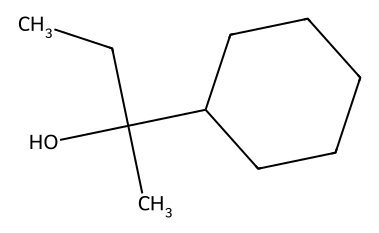
- The exocyclic alkene with an ethyl group
- The ring alkene with a sec-butyl group
- The exocyclic alkene bearing a methyl and an ethyl group
- The trisubstituted alkene formed after a hydride shift
Show answer
Answer: (B) The ring alkene with a sec-butyl group
Explanation: Loss of water gives a tertiary cation on the ring carbon, and elimination can occur towards the ring or towards the side chain, possibly after a hydride shift. The isomer in option (2), which would need the double bond inside the ring with the side chain intact at a saturated carbon, cannot arise from that cation.
Question 4
Previous-year questionWhich of the following reactions can be used for the preparation of alkyl halides? (I) CH₃CH₂OH + HCl →(anhydrous ZnCl₂) (II) CH₃CH₂OH + HCl → (III) (CH₃)₃COH + HCl → (IV) (CH₃)₂CHOH + HCl →(anhydrous ZnCl₂) [AIPMT 2015]
- (I), (III) and (IV) only
- (I) and (II) only
- (IV) only
- (III) and (IV) only
Show answer
Answer: (A) (I), (III) and (IV) only
Explanation: Primary and secondary alcohols need the Lucas catalyst anhydrous ZnCl₂ to react with HCl, so (I) and (IV) work. A tertiary alcohol reacts with HCl alone, so (III) works. Reaction (II), a primary alcohol with HCl and no catalyst, does not proceed.
Question 5
In which of the following alcohols is the O–H proton the most acidic?
- I–CH₂CH₂CH₂–OH
- CH₃CH₂CH₂–OH
- CF₃–CH₂–OH
- F–CH₂CH₂CH₂–OH
Show answer
Answer: (C) CF₃–CH₂–OH
Explanation: An alcohol becomes more acidic when its alkoxide ion is stabilised by electron-withdrawing groups. The –I effect is greater for more electronegative atoms, for more such atoms, and for atoms closer to the oxygen. In CF₃CH₂OH three fluorine atoms sit only two bonds from the O–H, so its alkoxide is the most stabilised and it is the strongest acid of the set.
Question 6
Bromocyclopentane is treated with magnesium in dry ether to give X. X is then treated with formaldehyde, followed by dilute acid, to give Y. Y is
- Cyclopentylmethanol
- Cyclopentanol
- Cyclopentane
- Cyclopentanecarbaldehyde
Show answer
Answer: (A) Cyclopentylmethanol
Explanation: Magnesium in dry ether converts the bromide into the Grignard reagent cyclopentylmagnesium bromide, X. A Grignard reagent adds to formaldehyde, and acid hydrolysis of the adduct gives a primary alcohol with one extra carbon atom. Y is therefore C₅H₉–CH₂OH, cyclopentylmethanol.
Question 7
What is the correct decreasing order of acid strength of the isomeric alcohols butan-1-ol (P), butan-2-ol (Q) and 2-methylpropan-2-ol (R)?
- P > R > Q
- Q > P > R
- P > Q > R
- R > Q > P
Show answer
Answer: (C) P > Q > R
Explanation: An electron-releasing alkyl group increases the electron density on oxygen and lowers the polarity of the O–H bond, which reduces acid strength. The number of alkyl groups on the carbinol carbon rises from primary to secondary to tertiary. Acid strength therefore falls in the order 1° > 2° > 3°, that is, butan-1-ol > butan-2-ol > 2-methylpropan-2-ol.
Doing well? Create a free account to take timed tests on this topic and see your weak areas.
Question 8
Statement I: Lithium aluminium hydride reduces carboxylic acids to primary alcohols and is the usual reagent for this change on a commercial scale. Statement II: Commercially, a carboxylic acid is first converted into an ester, which is then reduced with hydrogen in the presence of a catalyst. Choose the correct option.
- Statement I is incorrect but Statement II is correct
- Both Statement I and Statement II are incorrect
- Both Statement I and Statement II are correct
- Statement I is correct but Statement II is incorrect
Show answer
Answer: (A) Statement I is incorrect but Statement II is correct
Explanation: LiAlH₄ does reduce carboxylic acids to primary alcohols, but it is an expensive reagent and is used only for preparing special chemicals, so Statement I is wrong. On a commercial scale the acid is converted to an ester and then catalytically hydrogenated, which makes Statement II correct.
Question 9
Which statement correctly describes the modern industrial production of methanol?
- Carbon monoxide and hydrogen in a 1 : 2 mole ratio are passed over ZnO–Cr₂O₃ at 573–673 K and 200–300 atm.
- Sucrose is fermented with invertase and zymase, and the product is distilled.
- Methane is mixed with steam and passed over Cr₂O₃–Al₂O₃ at 773 K and 1 atm.
- Carbon monoxide and hydrogen in a 1 : 1 mole ratio are passed over finely divided iron at 298 K and 1 atm.
Show answer
Answer: (A) Carbon monoxide and hydrogen in a 1 : 2 mole ratio are passed over ZnO–Cr₂O₃ at 573–673 K and 200–300 atm.
Explanation: Methanol was once obtained by destructive distillation of wood, which gave it the name wood spirit. It is now made by catalytic hydrogenation of carbon monoxide: CO + 2H₂ → CH₃OH. The reaction uses a ZnO–Cr₂O₃ catalyst at high pressure and 573–673 K. Fermentation of sucrose gives ethanol, not methanol.
Question 10
Ethanol is dehydrated with concentrated H₂SO₄ at 443 K, propan-2-ol with 85% H₃PO₄ at 440 K, and 2-methylpropan-2-ol with 20% H₃PO₄ at only 358 K. What is the main reason for this trend in conditions?
- The tertiary alcohol has the largest number of α-hydrogens, which are lost most easily.
- The carbocation forms most easily from the tertiary alcohol and least easily from the primary alcohol.
- The ethene formed from ethanol is the most stable of the three alkenes.
- Phosphoric acid is a stronger acid than sulphuric acid.
Show answer
Answer: (B) The carbocation forms most easily from the tertiary alcohol and least easily from the primary alcohol.
Explanation: Acid-catalysed dehydration passes through protonation of the alcohol followed by loss of water to give a carbocation, and this loss is the slow step. Tertiary carbocations are more stable and form more easily than secondary and primary ones, so the ease of dehydration is 3° > 2° > 1°. Hence a tertiary alcohol needs a dilute acid and a lower temperature. A tertiary alcohol has no α-hydrogen at all, and H₃PO₄ is a weaker acid than H₂SO₄.
Question 11
An ester is prepared from an alcohol in two ways: (X) with a carboxylic acid and a little concentrated H₂SO₄, and (Y) with an acid chloride in the presence of pyridine. Which statement about these preparations is correct?
- In X, the reaction is irreversible, so removing a product has no effect; in Y, pyridine protonates the carbonyl oxygen
- In X, the acid is consumed to give an alkyl hydrogen sulphate as the final product; in Y, pyridine becomes part of the ester
- In X, adding extra water raises the yield; in Y, pyridine supplies the HCl that catalyses the reaction
- In X, removing the water or the ester as it forms raises the yield; in Y, pyridine neutralises HCl and shifts the equilibrium to the right
Show answer
Answer: (D) In X, removing the water or the ester as it forms raises the yield; in Y, pyridine neutralises HCl and shifts the equilibrium to the right
Explanation: Esterification with a carboxylic acid is reversible, so taking away water or the ester as it forms prevents the backward reaction. Reaction with an acid chloride releases HCl, and the base pyridine neutralises it, which shifts the equilibrium towards the ester. In both cases the yield improves because a product is removed.
Question 12
Which of the following is correctly classified as a benzylic alcohol?
- 2-Phenylethan-1-ol, C6H5CH2CH2OH
- 1-Phenylethan-1-ol, C6H5CH(OH)CH3
- 4-Methylphenol, CH3C6H4OH
- Cyclohexylmethanol, C6H11CH2OH
Show answer
Answer: (B) 1-Phenylethan-1-ol, C6H5CH(OH)CH3
Explanation: In a benzylic alcohol the OH group is on an sp3 carbon that is directly attached to an aromatic ring. 1-Phenylethan-1-ol fits this and is a secondary benzylic alcohol. In 2-phenylethan-1-ol the OH carbon is one carbon removed from the ring. 4-Methylphenol has OH directly on the ring, so it is a phenol, and cyclohexylmethanol has no aromatic ring at all.
Question 13
An aromatic alcohol of formula C₉H₁₂O is optically active and gives a yellow precipitate with I₂ and NaOH. On oxidation with hot alkaline KMnO₄ followed by acidification it gives benzoic acid. Which structure fits all these facts?
- 1-(4-Methylphenyl)ethanol
- 1-Phenylpropan-1-ol
- 2-Phenylpropan-2-ol
- 1-Phenylpropan-2-ol
Show answer
Answer: (D) 1-Phenylpropan-2-ol
Explanation: The iodoform test requires a CH₃CH(OH)− group, which rules out 1-phenylpropan-1-ol and the tertiary, achiral 2-phenylpropan-2-ol. 1-(4-Methylphenyl)ethanol has two side chains and would give a dicarboxylic acid rather than benzoic acid. C₆H₅CH₂CH(OH)CH₃ has a chiral carbon, a methyl carbinol group and a single side chain, so it fits every observation.
Question 14
3,3-Dimethylbutan-2-ol is warmed with concentrated HBr. The major product is
- 1-bromo-2,3-dimethylbutane
- 2-bromo-2,3-dimethylbutane
- 1-bromo-3,3-dimethylbutane
- 2-bromo-3,3-dimethylbutane
Show answer
Answer: (B) 2-bromo-2,3-dimethylbutane
Explanation: Protonation of the OH group and loss of water gives a secondary carbocation next to a quaternary carbon. A 1,2-methyl shift converts it into a more stable tertiary carbocation at the neighbouring carbon. Bromide then attacks this rearranged centre, so bromine ends up on a carbon bearing a methyl group, giving 2-bromo-2,3-dimethylbutane.
Question 15
A small amount of sodium ethoxide is dissolved in water. What happens, and why?
- It gives ethane and NaOH, because the ethyl group is a strong electron donor
- It reacts almost completely to give ethanol and NaOH, because ethoxide is a stronger base than hydroxide
- It reacts almost completely to give ethanol and NaOH, because ethanol is a stronger acid than water
- It remains as ethoxide ions, because ethanol is a stronger acid than water
Show answer
Answer: (B) It reacts almost completely to give ethanol and NaOH, because ethoxide is a stronger base than hydroxide
Explanation: The +I effect of the ethyl group increases electron density on oxygen, so ethanol is a slightly weaker acid than water. Its conjugate base, ethoxide, is therefore a stronger Brønsted base than hydroxide. Ethoxide takes a proton from water to give ethanol and hydroxide ions. The C–O bond is not broken, so no ethane forms.
Want more ALCOHOLS General methods of preparation, properties, reactions, and uses. Alcohols – Identification of primary questions?
E-GYAN NIDHI has 122 questions on this topic and 63,000+ in total, all free: timed CBT tests, NEET marking and instant analysis.
Register free Free Sunday Mock TestMore topics in ORGANIC COMPOUNDS CONTAINING OXYGEN
- ALDEHYDE Aldehyde – Nature of carbonyl group MCQs
- PHENOLS General methods of preparation, properties, reactions, and uses. Phenols – Acidic nature MCQs
- ETHERS General methods of preparation, properties, reactions, and uses. Ethers – Structure MCQs
- CARBOXYLIC Acids General methods of preparation, properties, reactions, and uses. Acidic strength and factors affecting it, MCQs
- KETONES General methods of preparation, properties, reactions, and uses. MCQs