Aromatic hydrocarbons - Nomenclature, benzene - structure and aromaticity – Mechanism of electrophilic substitution: NEET MCQs with Answers
15 free questions on Aromatic hydrocarbons - Nomenclature, benzene - structure and aromaticity – Mechanism of electrophilic substitution for NEET (UG), starting with previous-year NEET and AIPMT questions. Try each one, then tap Show answer for the answer and a short explanation.
Syllabus covered: Mechanism of electrophilic substitution: halogenation, nitration. Friedel - Craft's alkylation and acylation, directive influence of the functional group in mono- substituted benzene.
Question 1
Previous-year questionDirect halogenation of toluene with X₂ in the presence of Fe in the dark, C₆H₅CH₃ + X₂ —(Fe, dark)→ o-X–C₆H₄–CH₃ + p-X–C₆H₄–CH₃, is NOT a suitable method for preparing the corresponding haloarenes because of the very high reactivity of the halogen. Identify X. [Re-NEET 2024]
- F
- I
- Cl
- Br
Show answer
Answer: (A) F
Explanation: Fluorine reacts violently with arenes, so direct fluorination is uncontrollable and aryl fluorides cannot be prepared this way (they are made from diazonium salts, e.g. the Balz–Schiemann reaction). Chlorine and bromine react smoothly with Fe/Lewis acid catalysis. Iodination is also unsuitable, but that is because the reaction is reversible (HI formed reduces the product), not because iodine is highly reactive.
Question 2
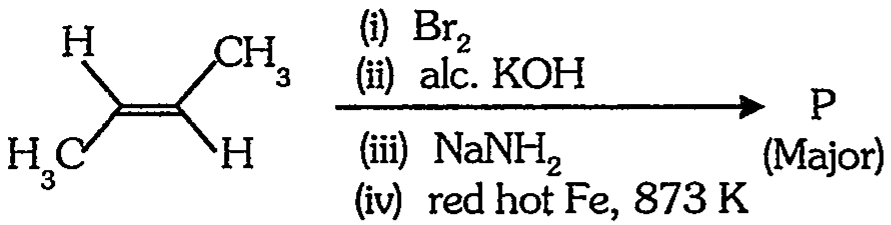
Previous-year questionIdentify the major product P formed in the reaction sequence shown below. [NEET (Sawai Madhopur) 2024]
- Structure (1)
- Structure (2)
- Structure (3)
- Structure (4)
Show answer
Answer: (B) Structure (2)
Explanation: Br₂ adds to but-2-ene to give 2,3-dibromobutane; alcoholic KOH and then NaNH₂ remove two molecules of HBr (double dehydrohalogenation) to give but-2-yne, CH₃C≡CCH₃. Passing an alkyne through a red-hot iron tube at 873 K causes cyclic trimerisation, so three molecules of but-2-yne give hexamethylbenzene. Mesitylene would come from propyne, not but-2-yne.
Question 3
Previous-year questionAssertion: Chlorine is an electron-withdrawing group, yet it directs incoming electrophiles to the ortho and para positions in electrophilic aromatic substitution. [Re-NEET 2022]
Reason: The inductive effect of chlorine destabilises the carbocation intermediate formed during electrophilic substitution, but because of its more pronounced resonance effect, the halogen stabilises the carbocation when attack occurs at the ortho and para positions.
Reason: The inductive effect of chlorine destabilises the carbocation intermediate formed during electrophilic substitution, but because of its more pronounced resonance effect, the halogen stabilises the carbocation when attack occurs at the ortho and para positions.
- Both Assertion and Reason are true and the Reason is a correct explanation of the Assertion.
- Both Assertion and Reason are true but the Reason is not a correct explanation of the Assertion.
- Assertion is true but the Reason is false.
- Assertion is false but the Reason is true.
Show answer
Answer: (A) Both Assertion and Reason are true and the Reason is a correct explanation of the Assertion.
Explanation: Both statements are true. Chlorine withdraws electrons by its –I effect, which deactivates the ring and destabilises the arenium ion; but its +R effect donates a lone pair to the ortho and para positions, giving an extra resonance structure that stabilises the carbocation formed by ortho/para attack. Hence chlorine is a deactivating but ortho/para-directing group, and R correctly explains A.
Question 4
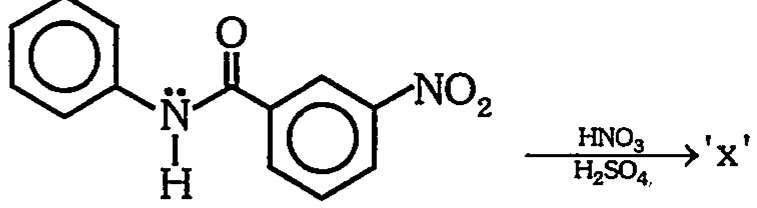
Previous-year questionThe compound shown below is nitrated with HNO₃/H₂SO₄ to give 'X'. What is the structure of the major product 'X'? [NEET 2021 (Paper-2)]
- Structure (1)
- Structure (2)
- Structure (3)
- Structure (4)
Show answer
Answer: (B) Structure (2)
Explanation: The –NH– group attached to the left benzene ring donates its lone pair into that ring by resonance (the amide N is still an activating, ortho/para-directing group), whereas the right ring carries two deactivating groups (–C=O and –NO₂). Hence nitration occurs on the ring attached to nitrogen, mainly at the less hindered para position, giving the product with a new NO₂ para to N and the original meta NO₂ unchanged.
Question 5
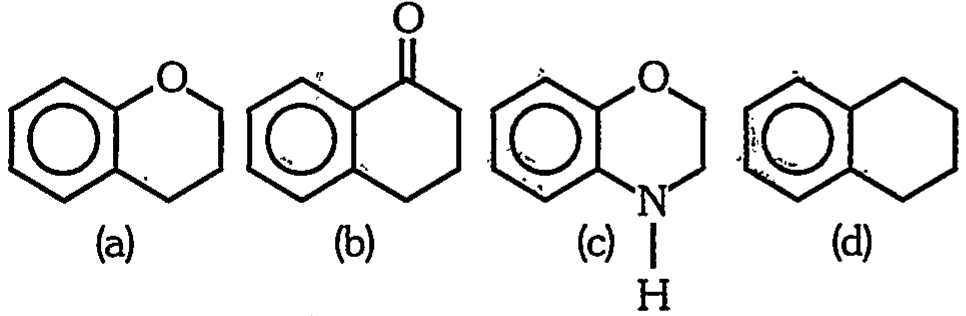
Previous-year questionArrange the compounds (a)–(d) shown below in decreasing order of reactivity towards electrophilic aromatic substitution. [NEET 2021 (Paper-2)]
- (c) > (a) > (b) > (d)
- (c) > (a) > (d) > (b)
- (d) > (c) > (b) > (a)
- (a) > (c) > (d) > (b)
Show answer
Answer: (B) (c) > (a) > (d) > (b)
Explanation: Groups that donate electrons by resonance activate the ring most: in (c) both –NH– and –O– are attached to the ring, and nitrogen is the stronger +R donor, so (c) is most reactive. In (a) the ring bears an –O– (alkoxy) group, a strong activator. In (d) only alkyl groups (+I/hyperconjugation) activate the ring weakly, while in (b) the C=O group directly attached to the ring is deactivating (–R). Hence (c) > (a) > (d) > (b).
Question 6
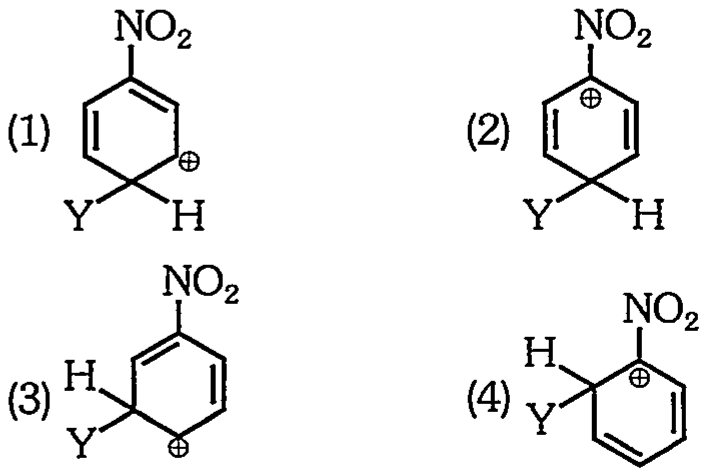
Previous-year questionWhich of the following carbocations is expected to be the most stable? [NEET 2018]
- Structure (1)
- Structure (2)
- Structure (3)
- Structure (4)
Show answer
Answer: (C) Structure (3)
Explanation: In these arenium (σ-complex) ions the positive charge is delocalised onto the carbons ortho and para to the sp³ carbon. When the sp³ carbon is meta to the NO₂ group, the positive charge never comes on the carbon bearing the strongly electron-withdrawing NO₂ group, so this ion is the most stable. In the ions where the sp³ carbon is ortho or para to NO₂, one resonance form places the positive charge directly on the carbon attached to NO₂, which is highly destabilising.
Question 7
Previous-year questionThe oxidation of benzene by V₂O₅ in the presence of air produces [AIPMT 2015]
- benzoic anhydride
- maleic anhydride
- benzoic acid
- benzaldehyde
Show answer
Answer: (B) maleic anhydride
Explanation: Vapour-phase oxidation over vanadium pentoxide at about 775 K destroys two of the ring carbons as CO₂ and leaves a four-carbon unsaturated anhydride. The product is maleic anhydride, made industrially in this way.
Doing well? Create a free account to take timed tests on this topic and see your weak areas.
Question 8
A nitro group attached to a benzene ring:
- Directs incoming electrophiles to the ortho and para positions
- Makes the ring less reactive towards electrophiles
- Makes the ring basic
- Makes the ring less reactive towards nucleophiles
Show answer
Answer: (B) Makes the ring less reactive towards electrophiles
Explanation: The nitro group withdraws electron density from the ring by both –I and –R effects. The electron-poor ring reacts more slowly with electrophiles, and substitution goes to the meta position. The same electron withdrawal makes the ring more open to attack by nucleophiles, not less.
Question 9
Cyclopentadiene, C₅H₆, is unusually acidic for a hydrocarbon. When its CH₂ group loses a hydrogen, the hydrogen leaves as:
- A proton, leaving an antiaromatic anion
- A proton, leaving an aromatic anion
- A hydrogen atom, leaving a free radical
- A hydride ion, leaving an aromatic cation
Show answer
Answer: (B) A proton, leaving an aromatic anion
Explanation: Loss of H⁺ from the sp³ carbon leaves a lone pair in a p orbital, so the ring becomes fully conjugated. The cyclopentadienyl anion has 6 π electrons in a planar ring and is aromatic by Hückel's rule. This large stabilisation of the conjugate base is why the proton is lost easily.
Question 10
Which of the following carbocations is the most stable?
- Cycloheptatrienyl (tropylium) cation, C₇H₇⁺
- Cyclopentadienyl cation, C₅H₅⁺
- Allyl cation, CH₂=CH–CH₂⁺
- Benzyl cation, C₆H₅CH₂⁺
Show answer
Answer: (A) Cycloheptatrienyl (tropylium) cation, C₇H₇⁺
Explanation: The tropylium cation is cyclic, planar and fully conjugated with 6 π electrons, so it obeys Hückel's (4n + 2) rule and is aromatic. Its positive charge is shared equally over seven carbons. The benzyl and allyl cations are stabilised by resonance but are not aromatic, and the cyclopentadienyl cation, with 4 π electrons, is antiaromatic and very unstable.
Question 11
Which of the following statements is NOT correct?
- –COOH is a meta-directing group
- –NH₂ withdraws electrons from the benzene ring by a –M effect
- –OCH₃ is an ortho/para-directing group in electrophilic aromatic substitution
- Dichlorocarbene, :CCl₂, behaves as an electrophile
Show answer
Answer: (B) –NH₂ withdraws electrons from the benzene ring by a –M effect
Explanation: The nitrogen lone pair of –NH₂ is delocalised into the ring, so the group donates electrons by a +M effect and is a strong activator. –OCH₃ is likewise a +M ortho/para director, and –COOH withdraws electrons and directs to meta. Dichlorocarbene has only six electrons on carbon and acts as an electrophile.
Question 12
Which of the following is attacked most readily by the nitronium ion, NO₂⁺?
- C₆H₅–NO₂
- C₆H₅–COCH₃
- C₆H₅–N⁺(CH₃)₃
- C₆H₅–O⁻ (phenoxide ion)
Show answer
Answer: (D) C₆H₅–O⁻ (phenoxide ion)
Explanation: Electrophilic attack is fastest on the ring with the highest electron density. The –O⁻ group of the phenoxide ion pushes its negative charge into the ring by a strong +M effect, making it highly activated. The nitro, trimethylammonium and acetyl groups all withdraw electrons and deactivate the ring.
Question 13
The following compounds are nitrated separately: (I) C₆H₅–CN (II) C₆H₅–CH₃ (III) C₆H₅–COOH (IV) C₆H₅–Br. In which of them does the nitro group enter mainly at the meta position?
- II and IV only
- III only
- I, III and IV
- I and III only
Show answer
Answer: (D) I and III only
Explanation: Groups that withdraw electrons from the ring by both –I and –M effects, such as –CN and –COOH, lower the electron density most at the ortho and para positions and so direct the electrophile to meta. The methyl group is an activating ortho/para director. Bromine deactivates the ring but its lone pairs still direct to ortho and para positions.
Question 14
Toluene is to be converted into 3-bromo-5-nitrobenzoic acid. Which order of reagents gives this product?
- Br₂/FeBr₃, then KMnO₄/H⁺ with heat, then HNO₃/H₂SO₄
- HNO₃/H₂SO₄, then Br₂/FeBr₃, then KMnO₄/H⁺ with heat
- KMnO₄/H⁺ with heat, then Br₂/FeBr₃, then HNO₃/H₂SO₄
- KMnO₄/H⁺ with heat, then HNO₃/H₂SO₄, then Br₂/FeBr₃
Show answer
Answer: (D) KMnO₄/H⁺ with heat, then HNO₃/H₂SO₄, then Br₂/FeBr₃
Explanation: Both substituents must end up meta to the carboxyl group and meta to each other, so the ortho- and para-directing methyl group must first be oxidised to the meta-directing –COOH. Nitration then gives 3-nitrobenzoic acid. The –COOH and –NO₂ groups are both meta directors and both send bromine to position 5. If bromine were put in before the nitro group, its ortho and para directing effect would oppose nitration at that position.
Question 15
Suppose benzene really had fixed alternating single and double bonds, as in a single Kekulé structure. How many isomers of 1,2-dibromobenzene would be expected, and what is found by experiment?
- Two expected, differing in the bond between the bromine-bearing carbons; two are found, which confirms fixed double bonds.
- Two expected, with the bromine-bearing carbons joined by a double bond in one and a single bond in the other; only one is found.
- One expected, because neighbouring carbons are equivalent; two are found.
- Three expected, namely ortho, meta and para forms; only one is found.
Show answer
Answer: (B) Two expected, with the bromine-bearing carbons joined by a double bond in one and a single bond in the other; only one is found.
Explanation: With localised bonds, the two adjacent C–Br carbons could be linked either by C=C or by C–C, which would give two different compounds. Only one 1,2-dibromobenzene exists. This fits a structure in which all six carbon–carbon bonds are identical, about 139 pm long, lying between the C–C single bond and the C=C double bond. Benzene is therefore best described as a resonance hybrid with delocalised π electrons.
Want more Aromatic hydrocarbons - Nomenclature, benzene - structure and aromaticity – Mechanism of electrophilic substitution questions?
E-GYAN NIDHI has 213 questions on this topic and 63,000+ in total, all free: timed CBT tests, NEET marking and instant analysis.
Register free Free Sunday Mock Test