Alkanes-Conformations – Sawhorse and Newman projections (of ethane): NEET MCQs with Answers
15 free questions on Alkanes-Conformations – Sawhorse and Newman projections (of ethane) for NEET (UG), starting with previous-year NEET and AIPMT questions. Try each one, then tap Show answer for the answer and a short explanation.
Syllabus covered: Sawhorse and Newman projections (of ethane): Mechanism of halogenation of alkanes. Classification, isomerism, IUPAC nomenclature, general methods of preparation, properties, and reactions.
Question 1
Previous-year questionFor which set of substituents can the alkane R₁R₂R₃C–H be oxidised by KMnO₄ to the corresponding alcohol R₁R₂R₃C–OH? [Re-NEET 2024]
R₂–C(R₁)(R₃)–H —(KMnO₄)→ R₂–C(R₁)(R₃)–OH
R₂–C(R₁)(R₃)–H —(KMnO₄)→ R₂–C(R₁)(R₃)–OH
- R₁ = H; R₂ = H; R₃ = H
- R₁ = CH₃; R₂ = CH₃; R₃ = CH₃
- R₁ = CH₃; R₂ = H; R₃ = H
- R₁ = CH₃; R₂ = CH₃; R₃ = H
Show answer
Answer: (B) R₁ = CH₃; R₂ = CH₃; R₃ = CH₃
Explanation: Alkanes with a tertiary hydrogen are oxidised by KMnO₄ to the corresponding tertiary alcohols, e.g. (CH₃)₃CH (2-methylpropane) → (CH₃)₃C–OH (2-methylpropan-2-ol). This needs all three R groups to be alkyl, i.e. R₁ = R₂ = R₃ = CH₃. The other sets give methane, ethane and propane, which have no tertiary C–H and are not oxidised this way.
Question 2
Previous-year questionMatch the compounds in List-I (shown as bond-line structures) with their boiling points in List-II. [NEET 2022 (Overseas)]
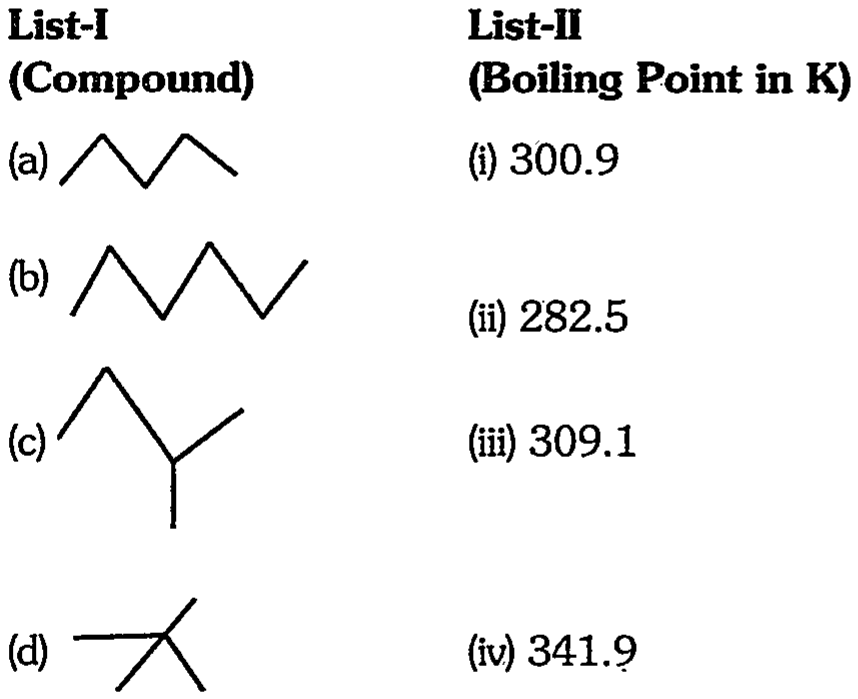
- (a)-(iii), (b)-(i), (c)-(iv), (d)-(ii)
- (a)-(iii), (b)-(iv), (c)-(i), (d)-(ii)
- (a)-(iv), (b)-(i), (c)-(ii), (d)-(iii)
- (a)-(i), (b)-(iv), (c)-(iii), (d)-(ii)
Show answer
Answer: (B) (a)-(iii), (b)-(iv), (c)-(i), (d)-(ii)
Explanation: The compounds are (a) n-pentane, (b) n-hexane, (c) isopentane (2-methylbutane) and (d) neopentane (2,2-dimethylpropane). Boiling point increases with molecular mass and decreases with branching (smaller surface area): n-hexane 341.9 K > n-pentane 309.1 K > isopentane 300.9 K > neopentane 282.5 K. Hence (a)-(iii), (b)-(iv), (c)-(i), (d)-(ii).
Question 3
Previous-year questionWhich one of the following reactions is correct? [NEET 2022 (Overseas)]
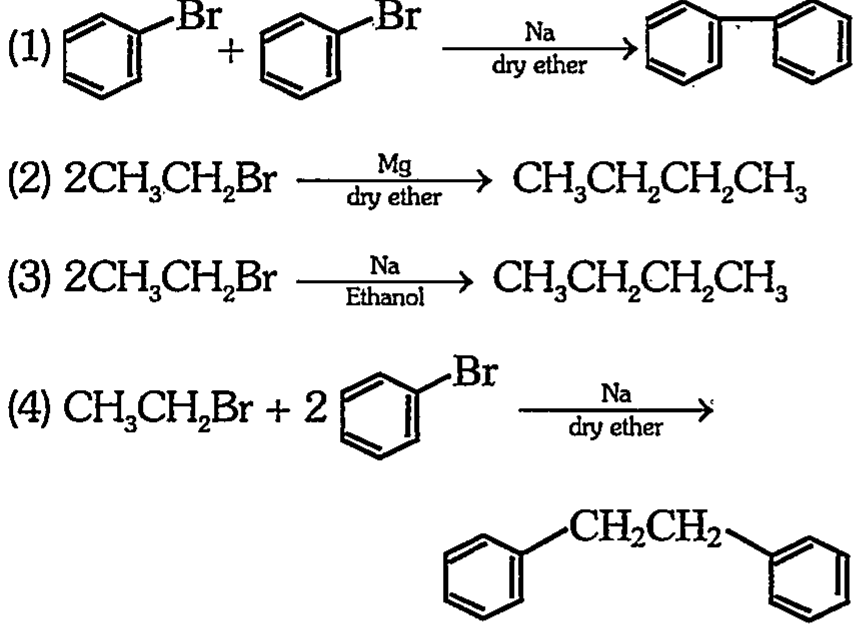
- Structure (1)
- Structure (2)
- Structure (3)
- Structure (4)
Show answer
Answer: (A) Structure (1)
Explanation: Two molecules of bromobenzene react with sodium in dry ether to give biphenyl. This is the Fittig reaction, so this equation is correct. With Mg in dry ether, ethyl bromide forms the Grignard reagent C₂H₅MgBr, not butane. Wurtz coupling needs dry ether, not ethanol, because ethanol reacts with Na. The Wurtz–Fittig reaction of C₂H₅Br with bromobenzene gives ethylbenzene, not 1,2-diphenylethane.
Question 4
Previous-year questionWhich of the following is a free-radical substitution reaction? [NEET 2020 (COVID-19)]
- Benzene with Br₂/AlCl₃
- Acetylene with HBr
- Methane with Br₂/hν
- Propene with HBr/(C₆H₅CO)₂O₂
Show answer
Answer: (C) Methane with Br₂/hν
Explanation: Halogenation of methane in light proceeds by a free-radical chain mechanism (Br• + CH₄ → CH₃• + HBr, CH₃• + Br₂ → CH₃Br + Br•) and replaces H by Br, so it is free-radical substitution. Benzene with Br₂/AlCl₃ is electrophilic substitution, acetylene with HBr is electrophilic addition, and propene with HBr/peroxide is free-radical addition (not substitution).
Question 5
Previous-year questionHydrocarbon (A) reacts with bromine by substitution to form an alkyl bromide which by the Wurtz reaction is converted into a gaseous hydrocarbon containing less than four carbon atoms. (A) is [NEET 2018]
- CH≡CH
- CH₂=CH₂
- CH₄
- CH₃–CH₃
Show answer
Answer: (C) CH₄
Explanation: Only an alkane undergoes substitution with bromine. Methane gives CH₃Br, which on Wurtz coupling gives ethane — a gas with fewer than four carbon atoms. Ethane would give butane, which has four carbons.
Question 6
Previous-year questionWith respect to the conformers of ethane, which of the following statements is true? [NEET 2017]
- Bond angles change but bond lengths remain the same
- Both bond angles and bond lengths change
- Both bond angles and bond lengths remain the same
- Bond angles remain the same but bond lengths change
Show answer
Answer: (C) Both bond angles and bond lengths remain the same
Explanation: Conformers differ only in the torsion (dihedral) angle produced by rotation about the C–C single bond. No bond is broken or stretched and no bond angle is altered, so both bond lengths and bond angles stay the same.
Question 7
Previous-year questionThe correct statement regarding the comparison of the staggered and eclipsed conformations of ethane is [NEET 2016]
- the staggered conformation is less stable than the eclipsed conformation, because the staggered form has torsional strain
- the eclipsed conformation is more stable than the staggered conformation, because the eclipsed form has no torsional strain
- the eclipsed conformation is more stable even though it has torsional strain
- the staggered conformation is more stable than the eclipsed conformation, because the staggered form has no torsional strain
Show answer
Answer: (D) the staggered conformation is more stable than the eclipsed conformation, because the staggered form has no torsional strain
Explanation: In the staggered form the C–H bonds of the two carbons are as far apart as possible, so electron-cloud repulsion is minimum and there is no torsional strain. It is therefore about 12.5 kJ mol⁻¹ more stable than the eclipsed form.
Doing well? Create a free account to take timed tests on this topic and see your weak areas.
Question 8
Two Newman projections of butane are drawn looking along the C-2–C-3 bond. In one the two methyl groups are 180° apart, and in the other they are 60° apart. These two structures are:
- geometrical isomers
- conformational isomers
- functional isomers
- position isomers
Show answer
Answer: (B) conformational isomers
Explanation: Both projections show the same molecule with the same bonds. They differ only by rotation about the C-2–C-3 single bond, which turns the anti arrangement into the gauche one. Such forms are conformations (conformers), not structural or geometrical isomers.
Question 9
The existence of eclipsed, staggered and intermediate (skew) conformations of ethane is a result of:
- changes in the C–H bond lengths
- a change in the hybridisation of the carbon atoms
- a π bond between the two carbon atoms
- rotation of the two methyl groups about the C–C sigma bond
Show answer
Answer: (D) rotation of the two methyl groups about the C–C sigma bond
Explanation: The C–C sigma bond in ethane is cylindrically symmetrical, so one methyl group can rotate relative to the other. Each angle of rotation gives a different spatial arrangement of the hydrogens, the extremes being the eclipsed and staggered forms. Bond lengths, bond angles and hybridisation stay the same during this rotation.
Question 10
Arrange the following C–H bonds in increasing order of ease of abstraction by a chlorine atom: (I) a C–H bond of methane (II) a C–H bond of ethene (III) the tertiary C–H bond of 2-methylpropane (IV) a C–H bond on C-2 of propane
- III < IV < I < II
- II < IV < I < III
- II < I < IV < III
- I < II < IV < III
Show answer
Answer: (C) II < I < IV < III
Explanation: The ease of hydrogen abstraction follows the stability of the radical formed. A vinylic radical is very unstable, so the ethene C–H is hardest to break, followed by methane, which gives a methyl radical. A secondary radical is more stable, and a tertiary radical the most stable, so the order is II < I < IV < III.
Question 11
The IUPAC name of (CH₃)₂CH–C(CH₃)(C₂H₅)–CH₂CH₂CH₂CH₃ is:
- 3-Isopropyl-3-methylheptane
- 2,3-Dimethyl-3-ethylheptane
- 5-Ethyl-5,6-dimethylheptane
- 3-Ethyl-2,3-dimethylheptane
Show answer
Answer: (D) 3-Ethyl-2,3-dimethylheptane
Explanation: Two seven-carbon chains are possible: one through the isopropyl group and one through the ethyl group. When chains are equally long, the one with more substituents is chosen; the chain through the isopropyl group carries three substituents, while the other carries two. Numbering from the isopropyl end gives the locants 2,3,3, and alphabetical citation gives 3-ethyl-2,3-dimethylheptane.
Question 12
Which one of the following fuels is NOT correctly matched with the way it is obtained?
- Coal gas – destructive distillation of coal
- CNG – compression of natural gas
- LNG – liquefaction of natural gas
- Petrol – destructive distillation of coal
Show answer
Answer: (D) Petrol – destructive distillation of coal
Explanation: Petrol, diesel and kerosene are obtained from petroleum by fractional distillation and cracking. Destructive distillation of coal gives coal gas. Natural gas, found in the upper strata during drilling of oil wells, gives CNG on compression and LNG on liquefaction.
Question 13
Which of the following alkyl halides is NOT converted into the corresponding alkane by zinc and dilute hydrochloric acid?
- Ethyl bromide
- Ethyl iodide
- Ethyl chloride
- Ethyl fluoride
Show answer
Answer: (D) Ethyl fluoride
Explanation: Alkyl chlorides, bromides and iodides are reduced to alkanes by zinc and dilute hydrochloric acid, with the halogen replaced by hydrogen. Alkyl fluorides are the exception. The C–F bond is the strongest of the carbon–halogen bonds, so it is not cleaved under these conditions.
Question 14
Butane is burnt in so limited a supply of air that all its carbon is left as carbon black and all its hydrogen becomes water. How many moles of O₂ are used per mole of butane, and what mass of carbon black is formed from 5.8 g of butane? (C = 12, H = 1)
- 2.5 mol O₂; 1.2 g
- 2.5 mol O₂; 4.8 g
- 4.5 mol O₂; 4.8 g
- 6.5 mol O₂; 4.8 g
Show answer
Answer: (B) 2.5 mol O₂; 4.8 g
Explanation: The balanced equation is 2C₄H₁₀ + 5O₂ → 8C + 10H₂O, so 1 mol of butane needs 2.5 mol of O₂. Then 5.8 g of butane is 0.1 mol and gives 0.4 mol of carbon, which is 4.8 g. Carbon black made in this way is used in ink, black pigments and as a filler.
Question 15
Assertion (A): The staggered and eclipsed conformations of ethane cannot be separated and isolated at ordinary temperature. Reason (R): The energy difference between these two forms is only about 12.5 kJ mol⁻¹, which molecules readily overcome through energy gained in collisions.
- A is true but R is false.
- Both A and R are true, and R is the correct explanation of A.
- Both A and R are true, but R is not the correct explanation of A.
- A is false but R is true.
Show answer
Answer: (B) Both A and R are true, and R is the correct explanation of A.
Explanation: Rotation about the C–C single bond in ethane is opposed only by a small torsional barrier of about 12.5 kJ mol⁻¹. At ordinary temperature, collisions supply enough energy to cross this barrier, so the conformations interconvert rapidly and rotation is almost free. That is exactly why they cannot be isolated, so the reason explains the assertion.
Want more Alkanes-Conformations – Sawhorse and Newman projections (of ethane) questions?
E-GYAN NIDHI has 264 questions on this topic and 63,000+ in total, all free: timed CBT tests, NEET marking and instant analysis.
Register free Free Sunday Mock Test