Alkenes - Geometrical isomerism – Mechanism of electrophilic addition: NEET MCQs with Answers
15 free questions on Alkenes - Geometrical isomerism – Mechanism of electrophilic addition for NEET (UG), starting with previous-year NEET and AIPMT questions. Try each one, then tap Show answer for the answer and a short explanation.
Syllabus covered: Mechanism of electrophilic addition: addition of hydrogen, halogens, water, hydrogen halides (Markownikoffs and peroxide effect): Ozonolysis and polymerization.
Question 1
Previous-year questionA single compound of the structure CH₃–CO–CH₂–CH(CH₃)–CH₂–CHO is obtainable from the ozonolysis of which of the following cyclic compounds? [AIPMT 2015]
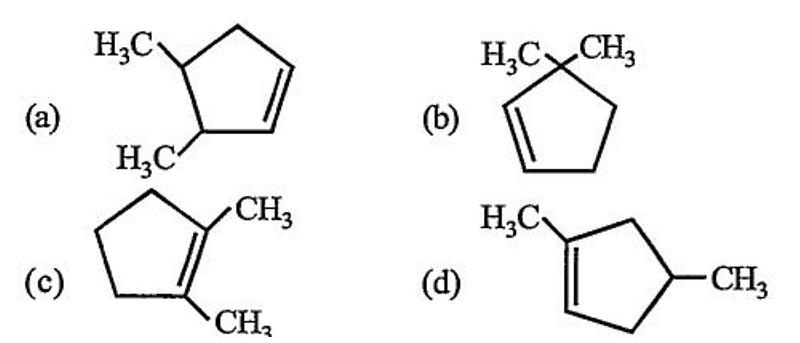
- Structure (a)
- Structure (b)
- Structure (c)
- Structure (d)
Show answer
Answer: (D) Structure (d)
Explanation: A single product containing both carbonyl groups means the double bond lies in a ring, which opens on ozonolysis. Joining the ketone carbon and the aldehyde carbon of CH₃COCH₂CH(CH₃)CH₂CHO by a double bond closes a five-membered ring: C(CH₃)=CH in the ring, with a CH₂ on each side of the CH(CH₃) carbon. This is 1,4-dimethylcyclopentene.
Question 2
Previous-year questionWhich of the following is Baeyer's reagent? [Re-NEET 2024]
- Acidic potassium permanganate solution
- Acidic potassium dichromate solution
- Cold, dilute, aqueous solution of potassium permanganate
- Hot, concentrated solution of potassium permanganate
Show answer
Answer: (C) Cold, dilute, aqueous solution of potassium permanganate
Explanation: Baeyer's reagent is cold, dilute, aqueous (slightly alkaline) KMnO₄; it converts alkenes into vicinal glycols and its purple colour is discharged, so it is used as a test for unsaturation. Acidic or hot concentrated KMnO₄ cleaves the C=C bond instead, and acidic dichromate is a different oxidant.
Question 3
Previous-year questionRead the two statements given below and choose the most appropriate answer. [Re-NEET 2024]
Statement I: Propene reacts with diborane to give an addition product with the formula ((CH₃)₂CH)₃B.
Statement II: Oxidation of ((CH₃)₂CH)₃B with hydrogen peroxide in the presence of NaOH gives propan-2-ol.
Statement I: Propene reacts with diborane to give an addition product with the formula ((CH₃)₂CH)₃B.
Statement II: Oxidation of ((CH₃)₂CH)₃B with hydrogen peroxide in the presence of NaOH gives propan-2-ol.
- Statement I is correct but Statement II is incorrect
- Statement I is incorrect but Statement II is correct
- Both Statement I and Statement II are correct
- Both Statement I and Statement II are incorrect
Show answer
Answer: (B) Statement I is incorrect but Statement II is correct
Explanation: In hydroboration, boron adds to the less substituted terminal carbon of propene, so the trialkylborane formed is (CH₃CH₂CH₂)₃B, not ((CH₃)₂CH)₃B — Statement I is incorrect. Statement II is correct as written: oxidation of a trialkylborane with H₂O₂/NaOH replaces each C–B bond by C–OH with the same carbon, so ((CH₃)₂CH)₃B would indeed give propan-2-ol.
Question 4
Previous-year questionMatch the reactions in List-I with their products in List-II. [NEET (Sawai Madhopur) 2024]
List-I (Reactions):
A. CH₃CH=CH₂ + H₂O + [O] —(dil. KMnO₄, 273 K)→
B. CH₃CH=CH₂ —(i) O₃; (ii) Zn + H₂O→
C. (CH₃)₂C=CH₂ + H₂O —(H⁺)→
D. (CH₃)₂C=CH₂ —(KMnO₄/H⁺)→
List-II (Products):
I. (CH₃)₂C=O + CO₂ + H₂O
II. CH₃CH(OH)–CH₂OH
III. HCHO + CH₃CHO
IV. (CH₃)₃C–OH
List-I (Reactions):
A. CH₃CH=CH₂ + H₂O + [O] —(dil. KMnO₄, 273 K)→
B. CH₃CH=CH₂ —(i) O₃; (ii) Zn + H₂O→
C. (CH₃)₂C=CH₂ + H₂O —(H⁺)→
D. (CH₃)₂C=CH₂ —(KMnO₄/H⁺)→
List-II (Products):
I. (CH₃)₂C=O + CO₂ + H₂O
II. CH₃CH(OH)–CH₂OH
III. HCHO + CH₃CHO
IV. (CH₃)₃C–OH
- A-II, B-III, C-IV, D-I
- A-II, B-III, C-I, D-IV
- A-IV, B-I, C-III, D-II
- A-II, B-IV, C-III, D-I
Show answer
Answer: (A) A-II, B-III, C-IV, D-I
Explanation: A: cold dilute KMnO₄ (273 K) hydroxylates propene to propane-1,2-diol, CH₃CH(OH)CH₂OH (II). B: ozonolysis of propene with Zn/H₂O gives HCHO + CH₃CHO (III). C: acid-catalysed hydration of 2-methylpropene (Markovnikov) gives (CH₃)₃C–OH (IV). D: acidic KMnO₄ cleaves 2-methylpropene to acetone, while the =CH₂ end is oxidised to CO₂ + H₂O (I). Hence A-II, B-III, C-IV, D-I.
Question 5
Previous-year questionFor the reaction shown below, identify the major product 'P' formed when the alkene is treated with KMnO₄/H⁺. [NEET 2024]
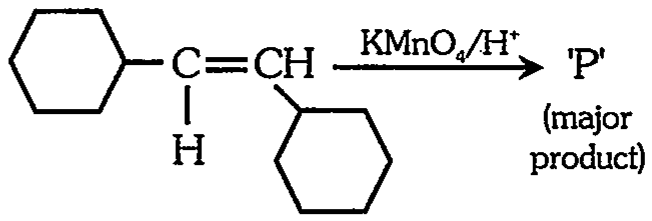
- Cyclohexanecarbaldehyde, C₆H₁₁–CHO
- Cyclohexanecarboxylic acid, C₆H₁₁–COOH
- C₆H₁₁–CH(OH)–CH(OH)–C₆H₁₁
- C₆H₁₁–CO–CO–C₆H₁₁
Show answer
Answer: (B) Cyclohexanecarboxylic acid, C₆H₁₁–COOH
Explanation: Acidic KMnO₄ is a strong oxidant that cleaves the C=C bond. In 1,2-dicyclohexylethene each alkene carbon bears one H, so each fragment is first an aldehyde, which is further oxidised to a carboxylic acid; both halves give cyclohexanecarboxylic acid (C₆H₁₁–COOH). The diol forms only with cold dilute alkaline KMnO₄ (Baeyer's reagent), and the aldehyde does not survive acidic KMnO₄.
Question 6
Previous-year questionWhat product is obtained from the reaction sequence: CH₃–CH₂–CH=CH₂ treated with (i) HBr in the presence of benzoyl peroxide with heating, then (ii) alcoholic KOH? [NEET 2022 (Overseas)]
- CH₃–CH=CH–CH₃
- CH₃–CH₂–CH=CH₂
- CH₃–CH₂–CH₂–CH₂–OH
- CH₃–CH₂–CH(OH)–CH₃
Show answer
Answer: (B) CH₃–CH₂–CH=CH₂
Explanation: With peroxide, HBr adds anti-Markovnikov to but-1-ene to give 1-bromobutane, CH₃CH₂CH₂CH₂Br. Alcoholic KOH then brings about β-elimination (dehydrohalogenation); the only β-hydrogens are on C-2, so but-1-ene, CH₃CH₂CH=CH₂, is formed. Alcoholic KOH does not substitute to give alcohols (that needs aqueous KOH).
Question 7
Previous-year questionPh(CH₃)C=CH₂ reacts with Cl₂ + H₂O to give compound 'A'. Identify A. [NEET 2021 (Paper-2)]
- Ph–C(OH)(CH₃)–CH₂Cl
- Ph–C(Cl)(CH₃)–CH₂OH
- Ph–C(Cl)(CH₃)–CH₂–Cl
- Ph–CH(CH₃)–CH₂–OH
Show answer
Answer: (A) Ph–C(OH)(CH₃)–CH₂Cl
Explanation: Cl₂/H₂O adds HOCl across the double bond: Cl⁺ (electrophile) adds first to the terminal CH₂, forming the more stable tertiary benzylic carbocation, which is then attacked by water. Thus OH goes to the carbon bearing Ph and CH₃, and Cl to the CH₂ group, giving Ph–C(OH)(CH₃)–CH₂Cl (chlorohydrin, Markovnikov orientation). Ph–C(Cl)(CH₃)–CH₂OH has the reverse orientation, and the dichloride would form only without water.
Doing well? Create a free account to take timed tests on this topic and see your weak areas.
Question 8
Previous-year questionWhich of the following alcohols give propylene (propene) when dehydrated with concentrated H₂SO₄ at 440 K? [NEET 2021 (Paper-2)]
(i) n-Propyl alcohol
(ii) Isobutyl alcohol
(iii) Isopropyl alcohol
(iv) n-Butyl alcohol
(i) n-Propyl alcohol
(ii) Isobutyl alcohol
(iii) Isopropyl alcohol
(iv) n-Butyl alcohol
- (ii), (iii)
- (i), (iii)
- (i), (ii), (iii)
- (ii), (iii), (iv)
Show answer
Answer: (B) (i), (iii)
Explanation: Acid-catalysed dehydration removes H₂O from an alcohol; the carbon skeleton of a three-carbon alcohol gives a three-carbon alkene. Both n-propyl alcohol (CH₃CH₂CH₂OH) and isopropyl alcohol ((CH₃)₂CHOH) give CH₃CH=CH₂. Isobutyl alcohol and n-butyl alcohol contain four carbons and give butenes, not propene.
Question 9
Previous-year questionIdentify Z in the following reaction. [NEET 2020 (COVID-19)]
CH₃CH₂CH=CH₂ —[(i) B₂H₆; (ii) H₂O₂, OH⁻]→ Z
CH₃CH₂CH=CH₂ —[(i) B₂H₆; (ii) H₂O₂, OH⁻]→ Z
- CH₃CH₂CH₂CH₂OH
- CH₃CH₂CH(OH)CH₃
- CH₃CH₂CH₂CHO
- CH₃CH₂CH₂CH₃
Show answer
Answer: (A) CH₃CH₂CH₂CH₂OH
Explanation: Hydroboration–oxidation (B₂H₆ followed by H₂O₂/OH⁻) adds water across the C=C in an anti-Markovnikov manner: boron attaches to the terminal carbon and is replaced by OH. So but-1-ene gives butan-1-ol, CH₃CH₂CH₂CH₂OH. Butan-2-ol would be the Markovnikov product of acid-catalysed hydration.
Question 10
Previous-year questionWhich of the following is NOT formed on dehydration of the alcohol shown below? [Re-AIPMT 2015]
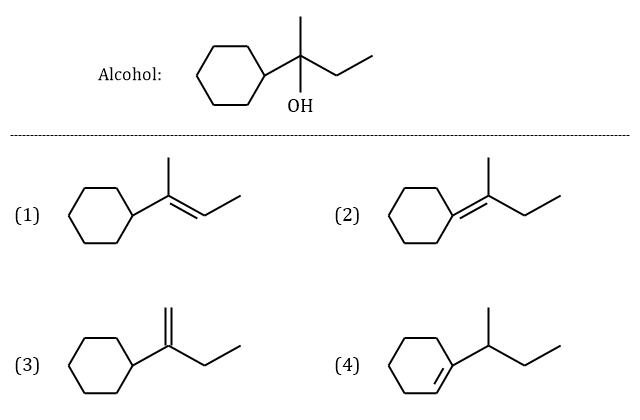
- Structure (1)
- Structure (2)
- Structure (3)
- Structure (4)
Show answer
Answer: (D) Structure (4)
Explanation: Acid-catalysed dehydration gives a tertiary carbocation at the carbon carrying OH (attached to the ring, CH₃ and C₂H₅). Loss of a β-H from the CH₂ of ethyl gives 2-cyclohexylbut-2-ene, loss from the ring CH gives the exocyclic alkene (sec-butylidenecyclohexane), and loss from CH₃ gives 2-cyclohexylbut-1-ene. The structure with C=C inside the ring and a sec-butyl side chain cannot be formed directly from this carbocation, so it is the one not obtained.
Question 11
Previous-year questionWhat is the product obtained when C₆H₅CH=CHCH₃ reacts with HBr? [AIPMT 2015]
- C₆H₅CH₂CH(Br)CH₃
- C₆H₅CH₂CH₂CH₂Br
- p-Br–C₆H₄–CH=CHCH₃
- C₆H₅CH(Br)CH₂CH₃
Show answer
Answer: (D) C₆H₅CH(Br)CH₂CH₃
Explanation: Electrophilic addition of HBr goes through the more stable carbocation. Adding H⁺ to the carbon away from the ring gives C₆H₅–C⁺H–CH₂CH₃, a benzylic carbocation stabilised by resonance with the benzene ring, so Br⁻ attaches to the benzylic carbon giving C₆H₅CH(Br)CH₂CH₃. Ring bromination needs Br₂/FeBr₃, not HBr, and anti-Markovnikov products need peroxide.
Question 12
Previous-year questionOzonolysis of which of the following cyclic compounds can give the single compound whose structure is given below? [AIPMT 2015]
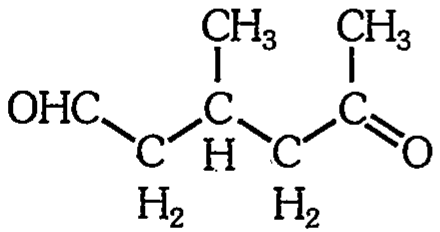
- Structure (1)
- Structure (2)
- Structure (3)
- Structure (4)
Show answer
Answer: (D) Structure (4)
Explanation: The product is OHC–CH₂–CH(CH₃)–CH₂–CO–CH₃, a single open-chain molecule with an aldehyde at one end and a methyl ketone at the other, so it must come from a cyclic alkene whose ring C=C is broken. Joining the CHO carbon and the C=O carbon by a double bond gives a five-membered ring, CH=C(CH₃)–CH₂–CH(CH₃)–CH₂, i.e. 1,4-dimethylcyclopentene. 3,4-Dimethylcyclopentene and 3,3-dimethylcyclopentene would give dialdehydes, and 1,2-dimethylcyclopentene would give a diketone.
Question 13
Previous-year questionAn alkene 'A' on reaction with O₃ and Zn–H₂O gives propanone and ethanal in equimolar ratio. Addition of HCl to alkene 'A' gives 'B' as the major product. The structure of product 'B' is [NEET 2019]
- Cl–CH₂–CH₂–CH(CH₃)₂
- CH₃–CH₂–CH(CH₃)–CH₂Cl
- CH₃–CH₂–C(Cl)(CH₃)–CH₃
- CH₃–CHCl–CH(CH₃)₂
Show answer
Answer: (C) CH₃–CH₂–C(Cl)(CH₃)–CH₃
Explanation: Propanone and ethanal in equal amounts mean A is 2-methylbut-2-ene. Markownikoff addition of HCl gives the tertiary carbocation, so chlorine ends up on C-2, giving 2-chloro-2-methylbutane.
Question 14
Previous-year questionThe reaction of C₆H₅–CH=CH–CH₃ with HBr produces [AIPMT 2015]
- C₆H₅CH₂CH(Br)CH₃
- C₆H₅CH₂CH₂CH₂Br
- p-BrC₆H₄–CH=CH–CH₃
- C₆H₅CH(Br)CH₂CH₃
Show answer
Answer: (D) C₆H₅CH(Br)CH₂CH₃
Explanation: The proton adds so as to give the more stable carbocation, and here that is the benzylic cation, which is stabilised by resonance with the ring. Bromide then attacks the benzylic carbon.
Question 15
Previous-year question2,3-Dimethyl-2-butene can be prepared by heating which of the following compounds with a strong acid? [AIPMT 2015]
- (CH₃)₂CH–CH(CH₃)–CH=CH₂
- (CH₃)₃C–CH=CH₂
- (CH₃)₂C=CH–CH₂–CH₃
- (CH₃)₂CH–CH₂–CH=CH₂
Show answer
Answer: (B) (CH₃)₃C–CH=CH₂
Explanation: Protonation of 3,3-dimethylbut-1-ene gives a secondary carbocation which rearranges by a 1,2-methyl shift to the more stable tertiary cation. Loss of a proton from this cation then gives the tetrasubstituted alkene 2,3-dimethylbut-2-ene.
Want more Alkenes - Geometrical isomerism – Mechanism of electrophilic addition questions?
E-GYAN NIDHI has 278 questions on this topic and 63,000+ in total, all free: timed CBT tests, NEET marking and instant analysis.
Register free Free Sunday Mock Test