Zeroth Law and First Law of Thermodynamics – Thermal equilibrium: NEET MCQs with Answers
15 free questions on Zeroth Law and First Law of Thermodynamics – Thermal equilibrium for NEET (UG), starting with previous-year NEET and AIPMT questions. Try each one, then tap Show answer for the answer and a short explanation.
Syllabus covered: Thermal equilibrium, zeroth law of thermodynamics, the concept of temperature. Heat, work, and internal energy. The first law of thermodynamics,
Question 1
Previous-year questionWhen an ideal gas is heated at constant pressure, the fraction of the heat energy supplied which increases the internal energy of the gas is α, β and δ for CO₂, He and N₂ respectively. Then [NEET 2021 (Paper-2)]
- α = β = δ
- α > β > δ
- β > δ > α
- α > δ > β
Show answer
Answer: (D) α > δ > β
Explanation: The fraction is Cᵥ/Cₚ = 1/γ. CO₂ (polyatomic, γ = 4/3): 3/4; N₂ (γ = 7/5): 5/7; He (γ = 5/3): 3/5. So α > δ > β.
Question 2
Previous-year questionWhen 10 g of water at 0 °C and 10⁵ N/m² pressure is converted into ice of volume 11 cm³, the external work done will be [NEET 2021 (Paper-2)]
- 0.1 J
- 0.2 J
- 1 J
- 2 J
Show answer
Answer: (A) 0.1 J
Explanation: 10 g of water occupies 10 cm³; ΔV = 11 – 10 = 1 cm³. W = PΔV = 10⁵ × 10⁻⁶ = 0.1 J (done by the system as it expands).
Question 3
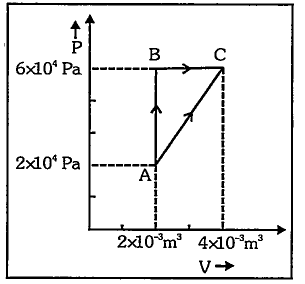
Previous-year questionThe figure shows two paths from state A to state C. In process AB, 400 J of heat is added and in process BC, 100 J of heat is added. The heat absorbed in the direct process AC will be [AIPMT 2015]
- 500 J
- 460 J
- 300 J
- 380 J
Show answer
Answer: (B) 460 J
Explanation: W_AB = 0 (constant volume); W_BC = 6 × 10⁴ × 2 × 10⁻³ = 120 J. So ΔU_AC = 500 – 120 = 380 J. Along AC, W = area of trapezium = ½(2 + 6) × 10⁴ × 2 × 10⁻³ = 80 J. Q_AC = 380 + 80 = 460 J.
Question 4
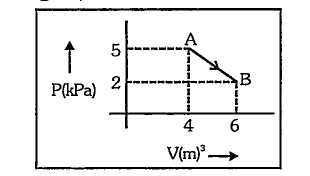
Previous-year questionOne mole of an ideal diatomic gas undergoes a transition from A to B along the path AB shown (P from 5 kPa to 2 kPa, V from 4 m³ to 6 m³). The change in internal energy of the gas during the transition is [AIPMT 2015]
- –20 kJ
- 20 J
- –12 kJ
- 20 kJ
Show answer
Answer: (A) –20 kJ
Explanation: For a diatomic gas U = (5/2)nRT = (5/2)PV. ΔU = (5/2)(P_BV_B – P_AV_A) = (5/2)(2 × 6 – 5 × 4) kJ = (5/2)(–8) = –20 kJ.
Question 5
Previous-year questionA sample of 0.1 g of water at 100 °C and normal pressure (1.013 × 10⁵ N m⁻²) requires 54 cal of heat energy to convert to steam at 100 °C. If the volume of the steam produced is 167.1 cc, the change in internal energy of the sample is [NEET 2018]
- 104.3 J
- 208.7 J
- 84.5 J
- 42.2 J
Show answer
Answer: (B) 208.7 J
Explanation: Q = 54 × 4.18 ≈ 226 J. The work done is W = P ΔV = 1.013 × 10⁵ × (167.1 − 0.1) × 10⁻⁶ ≈ 16.9 J. Hence ΔU = 226 − 16.9 ≈ 208.7 J.
Question 6
Previous-year questionThe first law of thermodynamics is essentially a statement of the conservation of
[AIPMT 1988]
[AIPMT 1988]
- work
- energy
- heat
- All of these
Show answer
Answer: (B) energy
Explanation: The first law, dQ = dU + dW, states that the heat supplied to a system is completely accounted for as the increase in its internal energy plus the work it performs. Nothing is created or destroyed in the exchange — energy merely changes form. It is therefore the law of conservation of energy applied to a thermodynamic system, and it holds for every process in nature. Heat and work are only modes of energy transfer, not separately conserved quantities.
Question 7
Previous-year questionA system absorbs 2 kcal of heat and at the same time performs 500 J of work on its surroundings. The change in the internal energy of the system is
[AIPMT 2009]
[AIPMT 2009]
- 8900 J
- 6400 J
- 5400 J
- 7900 J
Show answer
Answer: (D) 7900 J
Explanation: Convert the heat supplied to joules: ΔQ = 2 kcal = 2 × 4.2 × 10³ = 8400 J. From the first law, ΔU = ΔQ − ΔW = 8400 − 500 = 7900 J. The internal energy rises because only part of the absorbed heat is spent as work; the remainder is stored in the random molecular motion of the system.
Doing well? Create a free account to take timed tests on this topic and see your weak areas.
Question 8
Previous-year question1 g of water occupying a volume of 1 cm³ at 100 °C is completely converted into steam at the same temperature under normal atmospheric pressure (≈ 1 × 10⁵ Pa). The steam so produced occupies 1671 cm³. If the specific latent heat of vaporisation of water is 2256 J/g, the change in internal energy of the sample is
[NEET (Odisha) 2019]
[NEET (Odisha) 2019]
- 2423 J
- 2089 J
- 167 J
- 2256 J
Show answer
Answer: (B) 2089 J
Explanation: Heat supplied in vaporising the water is ΔQ = mL = 1 × 2256 = 2256 J. The change of phase occurs against a constant external pressure, so the expansion work is ΔW = pΔV = 1 × 10⁵ × (1671 − 1) × 10⁻⁶ = 167 J. By the first law of thermodynamics, ΔQ = ΔU + ΔW, hence ΔU = 2256 − 167 = 2089 J.
Question 9
Previous-year question0.1 g of water at 100°C and 1.013×10⁵ N/m² requires 54 cal to convert to steam at 100°C. If the steam volume is 167.1 cc, the change in internal energy is [NEET 2018]:
- 42.4 J
- 208.7 J
- 104.3 J
- 84.5 J
Show answer
Answer: (B) 208.7 J
Explanation: ΔQ = 54×4.18 ≈ 225.7 J and W = PΔV = 1.013×10⁵×(167.1−0.1)×10⁻⁶ ≈ 16.9 J. Hence ΔU = ΔQ − W ≈ 208.7 J.
Question 10
Previous-year questionA spherical black body of radius 12 cm radiates 450 W at 500 K. If the radius is halved and the temperature doubled, the power radiated is [NEET 2017]:
- 450 W
- 1000 W
- 1800 W
- 225 W
Show answer
Answer: (C) 1800 W
Explanation: P ∝ r²T⁴. P₂/P₁ = (1/2)²(2)⁴ = (1/4)(16) = 4. P₂ = 4×450 = 1800 W.
Question 11
Previous-year questionThe change in internal energy of a system that has absorbed 2 kcal of heat and done 500 J of work is [AIPMT 2009]:
- 7900 J
- 8900 J
- 6400 J
- 5400 J
Show answer
Answer: (A) 7900 J
Explanation: ΔQ = 2 kcal = 8400 J, ΔW = 500 J. ΔU = ΔQ − ΔW = 8400 − 500 = 7900 J.
Question 12
Previous-year questionIf Q, E and W denote the heat added, change in internal energy and work done in a closed cyclic process, then [CBSE AIPMT 2008]:
- W = 0
- Q = W = 0
- E = 0
- Q = 0
Show answer
Answer: (C) E = 0
Explanation: Over a cycle the internal energy returns to its start, so E = ΔU = 0.
Question 13
Previous-year questionOn a linear W-scale, the freezing and boiling points of water are 39°W and 239°W. The temperature corresponding to 39°C is [AIPMT 2008]:
- 200°W
- 139°W
- 78°W
- 117°W
Show answer
Answer: (D) 117°W
Explanation: (W−39)/(239−39) = (C−0)/(100−0). (W−39)/200 = 39/100 ⇒ W−39 = 78 ⇒ W = 117°W.
Question 14
Previous-year questionIf Q, E and W denote the heat added, change in internal energy and work done in a closed cyclic process, then [AIPMT 2008]:
- E = 0
- Q = 0
- W = 0
- Q = W = 0
Show answer
Answer: (A) E = 0
Explanation: Internal energy is a state function, so over a complete cycle E = ΔU = 0 (while Q = W ≠ 0 in general).
Question 15
Previous-year questionThe translational kinetic energy of the molecules of one mole of a monatomic gas is U = 3NKT/2. The atomic specific heat of the gas at constant pressure is [AIPMT 2006]:
- 3R/2
- 5R/2
- 7R/2
- 9R/2
Show answer
Answer: (B) 5R/2
Explanation: For a monatomic gas C_v = 3R/2, so C_p = C_v + R = 5R/2.
Want more Zeroth Law and First Law of Thermodynamics – Thermal equilibrium questions?
E-GYAN NIDHI has 159 questions on this topic and 63,000+ in total, all free: timed CBT tests, NEET marking and instant analysis.
Register free Free Sunday Mock Test