Thermodynamic State Variable ((P, V, T, U)) and Thermodynamic Processes – isothermal and adiabatic processes: NEET MCQs with Answers
15 free questions on Thermodynamic State Variable ((P, V, T, U)) and Thermodynamic Processes – isothermal and adiabatic processes for NEET (UG), starting with previous-year NEET and AIPMT questions. Try each one, then tap Show answer for the answer and a short explanation.
Syllabus covered: isothermal and adiabatic processes. The second law of thermodynamics: reversible and irreversible processes.
Question 1
Previous-year questionOne mole of an ideal gas goes from A to B first by isothermal expansion V→3V, then by isobaric compression 3V→V. The correct P-V diagram is [CBSE AIPMT 2012]:
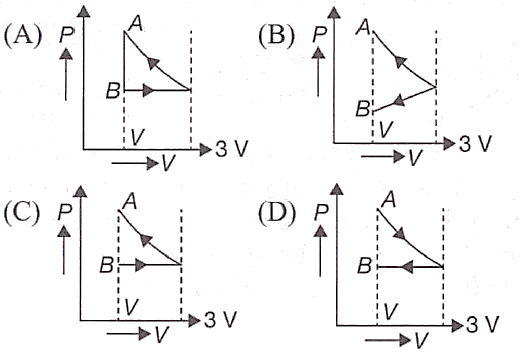
- Diagram (A)
- Diagram (B)
- Diagram (C)
- Diagram (D)
Show answer
Answer: (D) Diagram (D)
Explanation: The isothermal expansion from A is a falling hyperbola from V to 3V, so its arrow must point down and to the right. The isobaric compression is a horizontal line from 3V back to V, so its arrow must point left, ending at B. The correct diagram has both of these arrow directions; the others have an arrow reversed or draw the second step as a sloping line.
Question 2
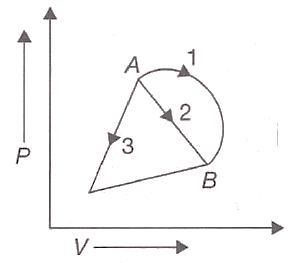
Previous-year questionA gas goes from A to B by three different processes with heats Q₁, Q₂, Q₃ and internal-energy changes ΔU₁, ΔU₂, ΔU₃. Then [CBSE AIPMT 2012]:
- Q₁ > Q₂ > Q₃ and ΔU₁ = ΔU₂ = ΔU₃
- Q₃ > Q₂ > Q₁ and ΔU₁ = ΔU₂ = ΔU₃
- Q₁ = Q₂ = Q₃ and ΔU₁ > ΔU₂ > ΔU₃
- Q₃ > Q₂ > Q₁ and ΔU₁ > ΔU₂ > ΔU₃
Show answer
Answer: (A) Q₁ > Q₂ > Q₃ and ΔU₁ = ΔU₂ = ΔU₃
Explanation: Same endpoints ⇒ equal ΔU for all three paths. The uppermost curve does the most work, so it absorbs the most heat: Q₁ > Q₂ > Q₃ with ΔU₁ = ΔU₂ = ΔU₃.
Question 3
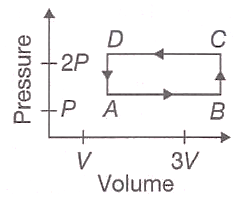
Previous-year questionA thermodynamic system is taken through cycle ABCD [rectangle A(V,P), B(3V,P), C(3V,2P), D(V,2P)] anticlockwise. The heat rejected by the gas during the cycle is [CBSE AIPMT 2012]:
- 2PV
- 4PV
- ½PV
- PV
Show answer
Answer: (A) 2PV
Explanation: Enclosed area = ΔP×ΔV = (2P−P)(3V−V) = 2PV. The loop is anticlockwise so W = −2PV, and for a cycle Q = W, meaning 2PV of heat is rejected.
Question 4
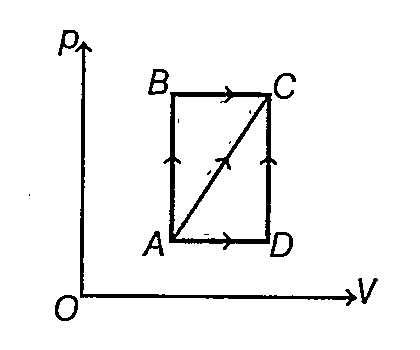
Previous-year questionA thermodynamic process is shown in the figure. The pressures and volumes corresponding to some of the points in the figure are p_A = 3 × 10⁴ Pa, V_A = 2 × 10⁻³ m³ and p_B = 8 × 10⁴ Pa, V_C = 5 × 10⁻³ m³. In the process AB, 600 J of heat is added to the system, and in the process BC, 200 J of heat is added to the system. The change in internal energy of the system in the process AC would be [ AIPMT 1991]
- 560 J
- 800 J
- 600 J
- 640 J
Show answer
Answer: (A) 560 J
Explanation: AB is a vertical line on the p–V diagram, so it is isochoric: dV = 0 and hence dW = 0, which also means V_B = V_A = 2 × 10⁻³ m³. Applying the first law to AB: 600 = (U_B − U_A) + 0, so U_B − U_A = 600 J. BC is a horizontal line, so it is isobaric at pressure p_B: 200 = (U_C − U_B) + p_B(V_C − V_B). Here p_B(V_C − V_B) = 8 × 10⁴ × (5 − 2) × 10⁻³ = 240 J, so U_C − U_B = 200 − 240 = −40 J. Adding the two steps: ΔU_AC = (U_B − U_A) + (U_C − U_B) = 600 − 40 = 560 J.
Question 5
Previous-year questionA thermodynamic system is taken from state A to B along ACB and is brought back to A along BDA as shown in the p–V diagram. The net work done during the complete cycle is given by the area [ AIPMT 1992]
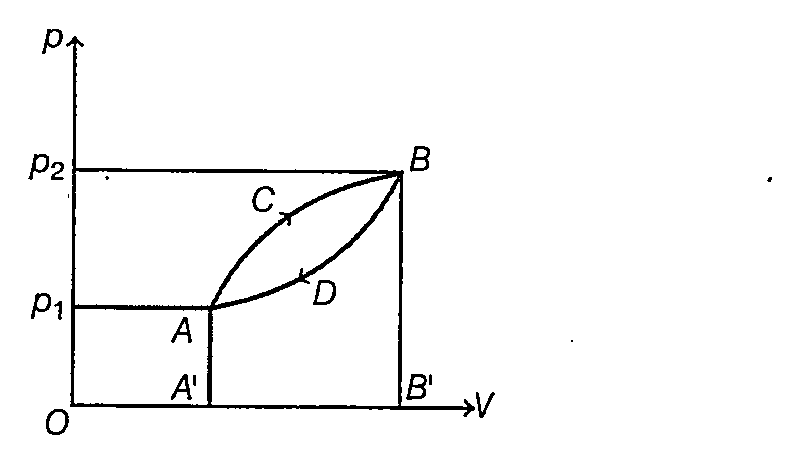
- p₁ACBp₂p₁
- ACBB′A′A
- ACBDA
- ADBB′A′A
Show answer
Answer: (C) ACBDA
Explanation: The work done along the outward path ACB is the area beneath it, namely ACBB′A′A, and it is positive because the volume increases. The work done along the return path BDA is the area beneath that path, BDAA′B′B, and it is negative because the volume decreases. The net work for the cycle is the difference of these two areas, which is exactly the region enclosed by the closed curve — the area ACBDA. In general, the net work done in any cyclic process equals the area enclosed by the cycle on the p–V diagram.
Question 6
Previous-year questionOne mole of an ideal gas goes from an initial state A to a final state B via two processes. It first undergoes an isothermal expansion from volume V to 3V, and then its volume is reduced from 3V back to V at constant pressure. The p–V diagram that correctly represents these two processes is [AIPMT 2012]
- Diagram A
- Diagram B
- Diagram C
- Diagram D
Show answer
Answer: (D) Diagram D
Explanation: In the isothermal expansion pV = nRT = constant, so the p–V curve is a rectangular hyperbola: as the volume grows from V to 3V, the pressure falls along a smooth downward-sloping arc starting at A. In the isobaric compression that follows, the pressure remains fixed at this new lower value while the volume returns from 3V to V. On the p–V diagram this is a horizontal straight line drawn leftwards, ending at B. So the correct diagram shows a curved hyperbolic arc falling to the right from A, followed by a horizontal line running back to the left at the lower pressure, with B directly below A.
Question 7
Previous-year questionA thermodynamic system is taken through the cycle ABCD shown in the figure, in which the pressure alternates between p and 2p and the volume between V and 3V. The heat rejected by the gas during the cycle is [AIPMT 2012]
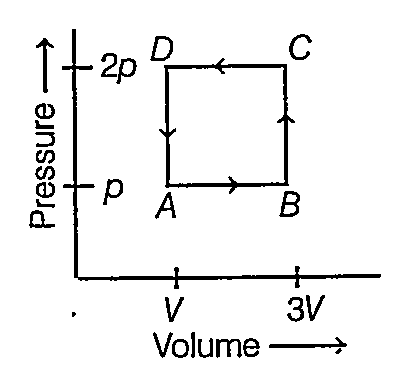
- 2 pV
- 4 pV
- ½ pV
- pV
Show answer
Answer: (A) 2 pV
Explanation: Over one complete cycle the system returns to its initial state, so ΔU = 0 and the first law gives Q = W. The closed path is a rectangle of width (3V − V) = 2V and height (2p − p) = p, so the area enclosed is 2pV. The cycle is described in the anticlockwise sense, which makes the net work done by the gas negative: W = −2pV. Hence Q = −2pV; the negative sign means that 2pV of heat is rejected by the gas during the cycle.
Doing well? Create a free account to take timed tests on this topic and see your weak areas.
Question 8
Previous-year questionAn ideal gas goes from state A to state B via three different processes as indicated in the p–V diagram. If Q₁, Q₂, Q₃ indicate the heat absorbed by the gas along the three processes and ΔU₁, ΔU₂, ΔU₃ indicate the change in internal energy along the three processes respectively, then [AIPMT 2012]
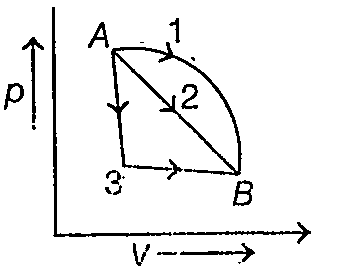
- Q₁ > Q₂ > Q₃ and ΔU₁ = ΔU₂ = ΔU₃
- Q₃ > Q₂ > Q₁ and ΔU₁ = ΔU₂ = ΔU₃
- Q₁ = Q₂ = Q₃ and ΔU₁ > ΔU₂ > ΔU₃
- Q₃ > Q₂ > Q₁ and ΔU₁ > ΔU₂ > ΔU₃
Show answer
Answer: (A) Q₁ > Q₂ > Q₃ and ΔU₁ = ΔU₂ = ΔU₃
Explanation: All three paths start at the same state A and finish at the same state B. Internal energy is a state function, so ΔU₁ = ΔU₂ = ΔU₃. Work done equals the area under each curve on the p–V diagram. From the figure, the area under curve 1 is the greatest and that under curve 3 the least, so W₁ > W₂ > W₃. By the first law Q = ΔU + W. Since ΔU is the same for all three, the ordering of Q follows that of W: Q₁ > Q₂ > Q₃.
Question 9
Previous-year questionA system is taken from state a to state c by two different paths adc and abc, as shown in the figure. The internal energy at a is U_a = 10 J. Along the path adc the heat absorbed is δQ₁ = 50 J and the work done is δW₁ = 20 J, whereas along the path abc the heat absorbed is δQ₂ = 36 J. The amount of work done along the path abc is [NEET 2013]
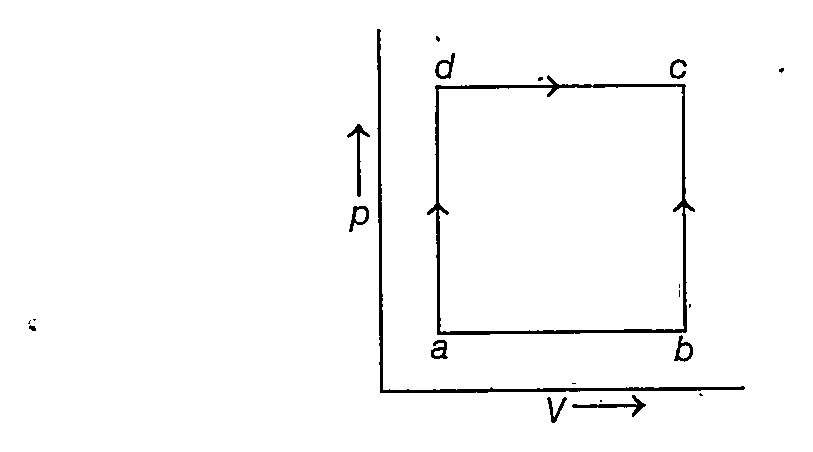
- 6 J
- 10 J
- 12 J
- 36 J
Show answer
Answer: (A) 6 J
Explanation: For the path adc, the first law gives ΔU_adc = δQ₁ − δW₁ = 50 − 20 = 30 J. Internal energy is a state function, so the change between the same two end states a and c is the same along every path: ΔU_abc = 30 J. Applying the first law to the path abc: W_abc = δQ₂ − ΔU_abc = 36 − 30 = 6 J. (The value U_a = 10 J is not needed — only the change in internal energy matters.)
Question 10
Previous-year questionFour thermodynamic processes I, II, III and IV undergone by a gas are indicated on the p–V diagram, together with three isotherms at 300 K, 500 K and 700 K. The processes are correctly identified as [NEET 2017]
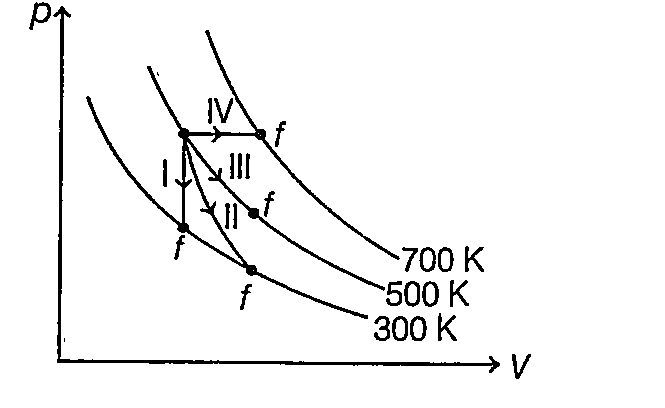
- I – adiabatic, II – isochoric, III – isothermal, IV – isobaric
- I – isochoric, II – adiabatic, III – isothermal, IV – isobaric
- I – isochoric, II – isothermal, III – isobaric, IV – adiabatic
- I – isothermal, II – isobaric, III – adiabatic, IV – isochoric
Show answer
Answer: (B) I – isochoric, II – adiabatic, III – isothermal, IV – isobaric
Explanation: Process I is drawn parallel to the pressure axis, so the volume stays constant: it is isochoric. Process IV is drawn parallel to the volume axis, so the pressure stays constant: it is isobaric. Process III runs along one of the given isotherms, so the temperature stays constant: it is isothermal. Process II falls away more steeply than the isotherm through the same point. Since the adiabat is steeper than the isotherm by the factor γ, process II is adiabatic.
Question 11
Previous-year questionFor an adiabatic process, the factor which remains constant is (all notations have their usual meaning) [NEET 2024 (Sawai Madhopur)]
- TV^(1–γ)
- V^(γ–1)T^γ
- P^(1–γ)T^γ
- P^(γ–1)T^γ
Show answer
Answer: (C) P^(1–γ)T^γ
Explanation: For an adiabatic process PV^γ = constant. Substituting V = nRT/P gives P^(1–γ)T^γ = constant, while the volume form is TV^(γ–1) = constant.
Question 12
Previous-year questionAn ideal gas follows a process described by PV² = C from the initial state (P₁, V₁, T₁) to the final state (P₂, V₂, T₂), where C is a constant. Then [Re-NEET 2022]
- if P₁ > P₂ then T₁ < T₂
- if V₂ > V₁ then T₂ > T₁
- if V₂ > V₁ then T₂ < T₁
- if P₁ > P₂ then V₁ > V₂
Show answer
Answer: (C) if V₂ > V₁ then T₂ < T₁
Explanation: PV² = C with PV = nRT gives TV = constant, so T ∝ 1/V: an increase in volume lowers the temperature (V₂ > V₁ ⇒ T₂ < T₁).
Question 13
Previous-year questionChoose the wrong pair (process : work done). [NEET 2021 (Paper-2)]
- Adiabatic : nR(T₂ – T₁)/(γ – 1)
- Isobaric : nR(T₂ – T₁)
- Isothermal : nRT ln(P₁/P₂)
- Isochoric : zero
Show answer
Answer: (A) Adiabatic : nR(T₂ – T₁)/(γ – 1)
Explanation: For an adiabatic process the work done by the gas is nR(T₁ – T₂)/(γ – 1), not nR(T₂ – T₁)/(γ – 1); the sign is reversed. The other three pairs are correct.
Question 14
Previous-year questionThe equilibrium state of a thermodynamic system is described by: A. Pressure, B. Total heat, C. Temperature, D. Volume, E. Work done. Choose the most appropriate answer. [Re-NEET 2024]
- A, B and E only
- B, C and D only
- A, B and C only
- A, C and D only
Show answer
Answer: (D) A, C and D only
Explanation: Pressure, volume and temperature are state variables that specify an equilibrium state. Heat and work are path-dependent quantities (not properties of a state).
Question 15
Previous-year questionFor the given cycle (A→B at 3 × 10² N/m² from V = 1 to 3 m³, B→C, C→A), the work done during the isobaric process is [NEET 2023 (Manipur)]
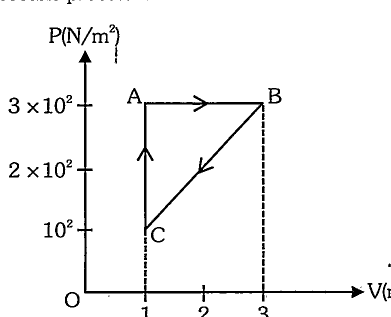
- 200 J
- Zero
- 400 J
- 600 J
Show answer
Answer: (D) 600 J
Explanation: AB is the isobaric step at P = 3 × 10² N/m² with ΔV = 3 – 1 = 2 m³. W = PΔV = 600 J.
Want more Thermodynamic State Variable ((P, V, T, U)) and Thermodynamic Processes – isothermal and adiabatic processes questions?
E-GYAN NIDHI has 331 questions on this topic and 63,000+ in total, all free: timed CBT tests, NEET marking and instant analysis.
Register free Free Sunday Mock Test