Ray Optics – Refraction: NEET MCQs with Answers
15 free questions on Ray Optics – Refraction for NEET (UG), starting with previous-year NEET and AIPMT questions. Try each one, then tap Show answer for the answer and a short explanation.
Syllabus covered: Refraction, TIR and Prism: Refraction of light at plane and spherical surfaces, Total internal reflection and its applications, Refraction of light through a prism.
Question 1
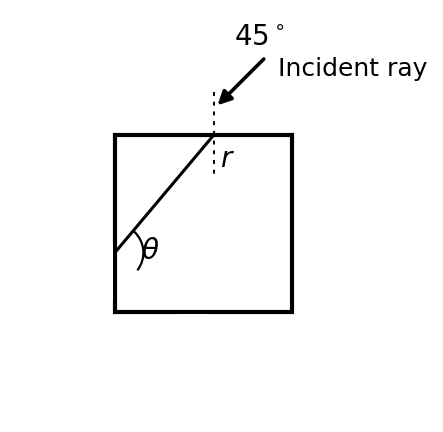
Previous-year questionFor the given incident ray as shown in the figure, the condition of total internal reflection of the ray will just be satisfied if the refractive index of the block is [AIPMT 2002]
- (√3 + 1)/2
- (√2 + 1)/2
- √(3/2)
- √(7/6)
Show answer
Answer: (C) √(3/2)
Explanation: At the top face, sin 45° = μ sin r. The ray then meets the vertical face at angle θ = 90° − r, and total internal reflection there requires sin θ ≥ 1/μ, i.e. cos r ≥ 1/μ. Now cos r = √(1 − sin²45°/μ²) = √(1 − 1/2μ²). The condition √(1 − 1/2μ²) ≥ 1/μ gives μ² − 1/2 ≥ 1, so μ ≥ √(3/2). The condition is just satisfied at the limiting value μ = √(3/2) ≈ 1.22.
Question 2
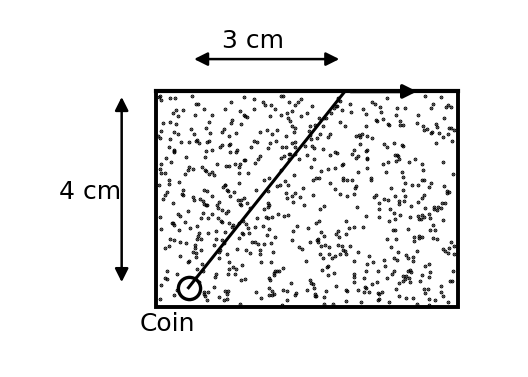
Previous-year questionA small coin is resting on the bottom of a beaker filled with a liquid. A ray of light from the coin travels up to the surface of the liquid and moves along its surface (see figure). How fast is the light travelling in the liquid? [AIPMT 2007]
- 1.8 × 10⁸ m/s
- 2.4 × 10⁸ m/s
- 3.0 × 10⁸ m/s
- 1.2 × 10⁴ m/s
Show answer
Answer: (A) 1.8 × 10⁸ m/s
Explanation: The ray grazing along the surface means it strikes at exactly the critical angle. From the geometry, sin i_c = R/√(R² + h²) = 3/√(3² + 4²) = 3/5. Hence μ = 1/sin i_c = 5/3, and v = c/μ = (3 × 10⁸)(3/5) = 1.8 × 10⁸ m/s.
Question 3
Previous-year questionA ray is incident at an angle of incidence i on one surface of a small-angle prism (with angle of prism A) and emerges normally from the opposite surface. If the refractive index of the material of the prism is µ, then the angle of incidence is nearly equal to [NEET 2020]
- 2A/µ
- µA
- µA/2
- A/2µ
Show answer
Answer: (B) µA
Explanation: Normal emergence means r₂ = 0 and hence r₁ = A. For small angles Snell's law gives i ≈ µr₁ = µA.
Question 4
Previous-year questionPick the wrong answer in the context of a rainbow. [NEET 2019]
- When the light rays undergo two internal reflections in a water drop, a secondary rainbow is formed
- The order of colours is reversed in the secondary rainbow
- An observer can see a rainbow when his front is towards the sun
- A rainbow is a combined effect of dispersion, refraction and reflection of sunlight
Show answer
Answer: (C) An observer can see a rainbow when his front is towards the sun
Explanation: A rainbow is always seen with the sun behind the observer, since the light returns from the drops through roughly 138°–140°. The other three statements are correct.
Question 5
Previous-year questionThe refractive index of the material of a prism is √2 and the angle of the prism is 30°. One of the two refracting surfaces of the prism is made a mirror inwards by silver coating. A beam of monochromatic light entering the prism from the other face will retrace its path (after reflection from the silvered surface) if its angle of incidence on the prism is [NEET 2018]
- 60°
- 45°
- Zero
- 30°
Show answer
Answer: (B) 45°
Explanation: To retrace, the ray must strike the silvered face normally, so r = A = 30°. Then sin i = µ sin r = √2 × 0.5 = 0.707, giving i = 45°.
Question 6
Previous-year questionA thin prism having a refracting angle of 10° is made of glass of refractive index 1.42. This prism is combined with another thin prism of glass of refractive index 1.7. This combination produces dispersion without deviation. The refracting angle of the second prism should be [NEET 2017]
- 6°
- 8°
- 10°
- 4°
Show answer
Answer: (A) 6°
Explanation: For zero net deviation, (1.42 − 1)(10°) = (1.7 − 1)A₂, so A₂ = 4.2/0.7 = 6°.
Question 7
Previous-year questionThe angle of incidence for a ray of light at a refracting surface of a prism is 45°. The angle of the prism is 60°. If the ray suffers minimum deviation through the prism, the angle of minimum deviation and refractive index of the material of the prism respectively are [NEET 2016]
- 45°, 1/√2
- 30°, √2
- 45°, √2
- 30°, 1/√2
Show answer
Answer: (B) 30°, √2
Explanation: At minimum deviation i = (A + δm)/2, so 45° = (60° + δm)/2 giving δm = 30°. Then µ = sin 45°/sin 30° = √2.
Doing well? Create a free account to take timed tests on this topic and see your weak areas.
Question 8
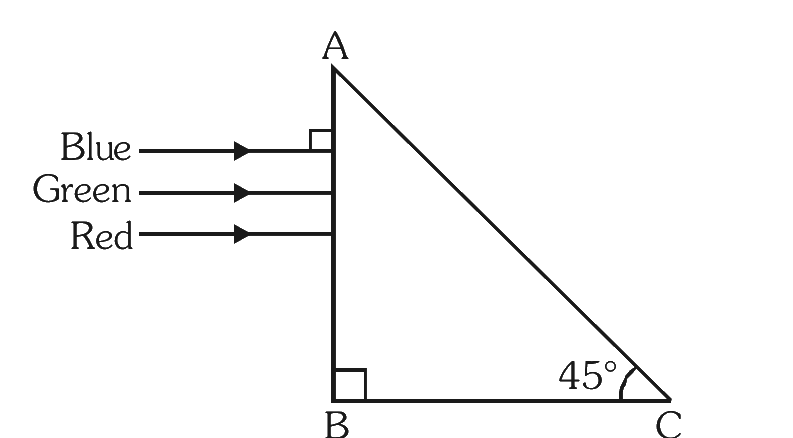
Previous-year questionA beam of light consisting of red, green and blue colours is incident on a right-angled prism. The refractive indices of the material of the prism for these red, green and blue wavelengths are 1.39, 1.44 and 1.47 respectively. The prism will [AIPMT 2015]
- separate all the three colours from one another
- not separate the three colours at all
- separate the red colour part from the green and blue colours
- separate the blue colour part from the red and green colours
Show answer
Answer: (C) separate the red colour part from the green and blue colours
Explanation: At the hypotenuse the angle of incidence is 45°, so TIR occurs when µ > 1/sin 45° = 1.414. Green (1.44) and blue (1.47) are totally reflected while red (1.39) is transmitted, so red is separated from the other two.
Question 9
Previous-year questionThe angle of a prism is A. One of its refracting surfaces is silvered. Light rays falling at an angle of incidence 2A on the first surface return back through the same path after suffering reflection at the silvered surface. The refractive index µ of the prism is [AIPMT 2014]
- 2 sin A
- 2 cos A
- (1/2)cos A
- tan A
Show answer
Answer: (B) 2 cos A
Explanation: To retrace its path the ray must hit the silvered face normally, so the angle of refraction at the first face is r = A. Snell's law then gives µ = sin 2A/sin A = 2 cos A.
Question 10
Previous-year questionA beam of monochromatic light is refracted from vacuum into a medium of refractive index 1.5. The wavelength of the refracted light will be [AIPMT 1991, 1992]
- dependent on the intensity of refracted light
- same
- smaller
- larger
Show answer
Answer: (C) smaller
Explanation: The frequency is unchanged on refraction, while the speed falls to v = c/μ. Since λ = v/ν, the wavelength in the medium is λ_m = λ_vacuum/μ, i.e. smaller by the factor 1.5.
Question 11
Previous-year questionThere is a prism with refractive index equal to √2 and the refracting angle equal to 30°. One of the refracting surfaces of the prism is polished. A beam of monochromatic light will retrace its path if its angle of incidence over the refracting surface of the prism is [AIPMT 1992]
- 0°
- 30°
- 45°
- 60°
Show answer
Answer: (C) 45°
Explanation: Retracing requires normal incidence on the polished face, so the angle of refraction at the entry surface equals the prism angle, r = 30°. Then sin i = μ sin r = √2 × 1/2 = 1/√2, giving i = 45°.
Question 12
Previous-year questionTime taken by sunlight to pass through a window of thickness 4 mm whose refractive index is 3/2 is [AIPMT 1993]
- 2 × 10⁻⁴ s
- 2 × 10⁸ s
- 2 × 10⁻¹¹ s
- 2 × 10¹¹ s
Show answer
Answer: (C) 2 × 10⁻¹¹ s
Explanation: The time is t = μx/c = (1.5 × 4 × 10⁻³)/(3 × 10⁸) = 6 × 10⁻³/(3 × 10⁸) = 2 × 10⁻¹¹ s.
Question 13
Previous-year questionA point source of light is placed 4 m below the surface of water of refractive index 5/3. The minimum diameter of a disc, which should be placed over the source on the surface of water to cut off all light coming out of water is [AIPMT 1994]
- infinite
- 6 m
- 4 m
- 3 m
Show answer
Answer: (B) 6 m
Explanation: Light escapes only within the cone bounded by the critical angle. With sin i_c = 1/μ = 3/5 and the geometry sin i_c = r/√(r² + h²), we get r² = h²/(μ² − 1) = 16/(25/9 − 1) = 9, so r = 3 m. The disc diameter must therefore be 2r = 6 m.
Question 14
Previous-year questionThe angle of deviation δ produced by a prism (refractive index = μ), supposing the angle of prism A to be small, can be given by [AIPMT 1994]
- δ = (μ − 1)A
- δ = (μ + 1)A
- δ = sin[(A + δ)/2]/sin(A/2)
- δ = [(μ − 1)/(μ + 1)]A
Show answer
Answer: (A) δ = (μ − 1)A
Explanation: For a thin prism all angles are small, so the sines may be replaced by the angles themselves, and the general relation reduces to the simple formula δ = (μ − 1)A. Note that δ is then independent of the angle of incidence.
Question 15
Previous-year questionLight travels through a glass plate of thickness t and refractive index μ. If c is the speed of light in vacuum, the time taken by light to travel this thickness of glass is [AIPMT 1996]
- μtc
- tc/μ
- 1/μt
- μt/c
Show answer
Answer: (D) μt/c
Explanation: The speed inside the glass is v = c/μ, so the time to cross the thickness t is t/v = t/(c/μ) = μt/c — longer than the vacuum transit time by the factor μ.
Want more Ray Optics – Refraction questions?
E-GYAN NIDHI has 192 questions on this topic and 63,000+ in total, all free: timed CBT tests, NEET marking and instant analysis.
Register free Free Sunday Mock TestMore topics in OPTICS
- Ray Optics – Reflection of Light MCQs
- Wave Optics – Huygen's Principle and Doppler's Effect of Light MCQs
- Ray Optics – Lenses MCQs
- Ray Optics – Optical Instruments MCQs
- Wave Optics – Interference and Young's Double Slit Experiment MCQs
- Wave Optics ; Diffraction – Diffraction due to a single slit MCQs
- Wave Optics – Polarisation MCQs