Ray Optics – Lenses: NEET MCQs with Answers
15 free questions on Ray Optics – Lenses for NEET (UG), starting with previous-year NEET and AIPMT questions. Try each one, then tap Show answer for the answer and a short explanation.
Syllabus covered: Lenses: Magnification (Lens), Power of a Lens. Combination of thin lenses in contact, Combination of thin lenses in contact, thin lens formula and lens maker formula
Question 1
Previous-year questionAn equiconvex lens is cut into two halves along (i) XOX′ and (ii) YOY′ as shown in the figure. Let f, f′ and f″ be the focal lengths of the complete lens, of each half in case (i), and of each half in case (ii), respectively. Choose the correct statement from the following. [AIPMT 2003]
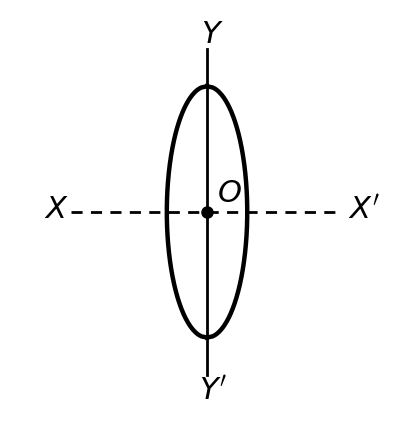
- f′ = f, f″ = f
- f′ = 2f, f″ = 2f
- f′ = f, f″ = 2f
- f′ = 2f, f″ = f
Show answer
Answer: (C) f′ = f, f″ = 2f
Explanation: Cutting along XOX′ (the principal axis) leaves both radii unchanged, so each half is still equiconvex with the same focal length: f′ = f. Cutting along YOY′ (perpendicular to the axis) turns each half into a plano-convex lens with one surface flat, so 1/f″ = (μ − 1)(1/R) — half the original power — giving f″ = 2f.
Question 2
Previous-year questionTwo similar thin equi-convex lenses of focal length f each are kept coaxially in contact with each other such that the focal length of the combination is F₁. When the space between the two lenses is filled with glycerin (which has the same refractive index, µ = 1.5, as that of glass), the equivalent focal length is F₂. The ratio F₁ : F₂ will be [NEET 2019]
- 2 : 1
- 1 : 2
- 2 : 3
- 3 : 4
Show answer
Answer: (B) 1 : 2
Explanation: Without glycerin F₁ = f/2. Glycerin with the same index as glass forms a bi-concave lens of the same radii, with focal length −f, so 1/F₂ = 1/f + 1/f − 1/f = 1/f. Thus F₂ = f and F₁ : F₂ = 1 : 2.
Question 3
Previous-year questionFocal length of a convex lens of refractive index 1.5 is 2 cm. Focal length of the lens when immersed in a liquid of refractive index 1.25 will be [AIPMT 1988]
- 10 cm
- 2.5 cm
- 5 cm
- 7.5 cm
Show answer
Answer: (C) 5 cm
Explanation: Dividing the lens maker's formula in air by that in the liquid: f_l/f_a = (μ_g − 1)/(μ_g/μ_l − 1) = (1.5 − 1)/(1.5/1.25 − 1) = 0.5/0.2 = 2.5. Hence f_l = 2.5 × 2 = 5 cm.
Question 4
Previous-year questionFocal length of a convex lens will be maximum for [AIPMT 1994]
- blue light
- yellow light
- green light
- red light
Show answer
Answer: (D) red light
Explanation: Since f ∝ 1/(μ − 1) and μ is smallest for the longest wavelength, the focal length is greatest for red light — the least refracted colour of the visible spectrum.
Question 5
Previous-year questionAn achromatic combination of lenses is formed by joining [AIPMT 1995]
- 2 convex lenses
- 2 concave lenses
- 1 convex, 1 concave lens
- 1 convex and 1 plane mirror
Show answer
Answer: (C) 1 convex, 1 concave lens
Explanation: An achromatic doublet must cancel the chromatic dispersion of one lens with the opposite dispersion of another, which requires one converging and one diverging element made of glasses of different dispersive powers. Hence one convex and one concave lens are joined.
Question 6
Previous-year questionA lens is placed between a source of light and a wall. It forms images of area A₁ and A₂ on the wall, for its two different positions. The area of the source of light is [AIPMT 1995]
- √(A₁A₂)
- (A₁ + A₂)/2
- (A₁ − A₂)/2
- 1/A₁ + 1/A₂
Show answer
Answer: (A) √(A₁A₂)
Explanation: In the displacement method the two magnifications satisfy m₁m₂ = 1, so the overall magnification for area is the geometric mean. Hence the source area A satisfies A = √(A₁A₂).
Question 7
Previous-year questionA convex lens of focal length 80 cm and a concave lens of focal length 50 cm are combined together. What will be their resulting power? [AIPMT 1996]
- +6.5 D
- −6.5 D
- +7.5 D
- −0.75 D
Show answer
Answer: (D) −0.75 D
Explanation: P = P₁ + P₂ = 100/f₁(cm) + 100/f₂(cm) = 100/80 + 100/(−50) = 1.25 − 2 = −0.75 D. The combination is therefore net diverging.
Doing well? Create a free account to take timed tests on this topic and see your weak areas.
Question 8
Previous-year questionThe focal lengths of a converging lens measured for violet, green and red colours are f_V, f_G, f_R respectively. We will find [AIPMT 1997]
- f_G > f_R
- f_V < f_R
- f_V > f_R
- f_V = f_R
Show answer
Answer: (B) f_V < f_R
Explanation: By Cauchy's relation the refractive index is greatest for the shortest wavelength, so μ_violet > μ_green > μ_red. Since f ∝ 1/(μ − 1), the focal length is smallest for violet and largest for red: f_V < f_G < f_R.
Question 9
Previous-year questionA planoconvex lens is made of material of refractive index 1.6. The radius of curvature of the curved surface is 60 cm. The focal length of the lens is [AIPMT 1999]
- 50 cm
- 100 cm
- 200 cm
- 400 cm
Show answer
Answer: (B) 100 cm
Explanation: For a plano-convex lens one surface is flat, so R₂ = ∞. Then 1/f = (1.6 − 1)(1/60 − 0) = 0.6/60 = 1/100, giving f = 100 cm.
Question 10
Previous-year questionA planoconvex lens is made of a material of refractive index μ = 1.5. The radius of curvature of the curved surface of the lens is 20 cm. If its plane surface is silvered, the focal length of the silvered lens will be [AIPMT 2000]
- 10 cm
- 20 cm
- 40 cm
- 80 cm
Show answer
Answer: (B) 20 cm
Explanation: A silvered lens acts as a mirror with 1/F = 2/f_l + 1/f_m. Here the silvered surface is plane, so f_m = ∞ and 1/f_m = 0. For the plano-convex lens 1/f_l = (μ − 1)/R, so 1/F = 2(μ − 1)/R, giving F = R/[2(μ − 1)] = 20/(2 × 0.5) = 20 cm.
Question 11
Previous-year questionA body is located on a wall. Its image of equal size is to be obtained on a parallel wall with the help of a convex lens. The lens is placed at a distance d ahead of the second wall, then the required focal length will be [AIPMT 2002]
- only d/4
- only d/2
- more than d/4 but less than d/2
- less than d/4
Show answer
Answer: (B) only d/2
Explanation: For an image of equal size, magnification is unity, which requires |u| = |v| = 2f. Since the image forms on the second wall at distance d, v = d = 2f. Substituting into 1/f = 1/v − 1/u with u = −d gives 1/f = 1/d + 1/d = 2/d, so f = d/2.
Question 12
Previous-year questionA convex lens is dipped in a liquid whose refractive index is equal to the refractive index of the lens. Then its focal length will [AIPMT 2003]
- become small, but non-zero
- remain unchanged
- become zero
- become infinite
Show answer
Answer: (D) become infinite
Explanation: In a medium the lens maker's formula becomes 1/f_l = (μ_g/μ_l − 1)(1/R₁ − 1/R₂). When μ_l = μ_g the bracket vanishes, so 1/f_l = 0 and the focal length becomes infinite — the lens neither converges nor diverges.
Question 13
Previous-year questionA convex lens and a concave lens, each having the same focal length of 25 cm, are put in contact to form a combination of lenses. The power in dioptres of the combination is [AIPMT 2006]
- 25
- 50
- infinite
- zero
Show answer
Answer: (D) zero
Explanation: With f₁ = +25 cm and f₂ = −25 cm, 1/F = 1/25 − 1/25 = 0, so F is infinite and P = 0. Equivalently P₁ = +4 D and P₂ = −4 D, which cancel.
Question 14
Previous-year questionTwo thin lenses of focal lengths f₁ and f₂ are in contact and coaxial. The power of the combination is [AIPMT 2008]
- √(f₁/f₂)
- √(f₂/f₁)
- (f₁ + f₂)/2
- (f₁ + f₂)/f₁f₂
Show answer
Answer: (D) (f₁ + f₂)/f₁f₂
Explanation: For lenses in contact, 1/F = 1/f₁ + 1/f₂ = (f₁ + f₂)/(f₁f₂). Since power is the reciprocal of focal length, P = 1/F = (f₁ + f₂)/f₁f₂.
Question 15
Previous-year questionA boy is trying to start a fire by focusing sunlight on a piece of paper using an equiconvex lens of focal length 10 cm. The diameter of the sun is 1.39 × 10⁹ m and its mean distance from the earth is 1.5 × 10¹¹ m. What is the diameter of the sun's image on the paper? [AIPMT 2008]
- 9.2 × 10⁻⁴ m
- 6.5 × 10⁻⁴ m
- 6.5 × 10⁻⁵ m
- 12.4 × 10⁻⁴ m
Show answer
Answer: (A) 9.2 × 10⁻⁴ m
Explanation: The sun is effectively at infinity, so the image forms at the focal plane, v = 0.1 m. Using I/O = v/u: I = O × v/u = 1.39 × 10⁹ × 0.1/(1.5 × 10¹¹) = 9.2 × 10⁻⁴ m.
Want more Ray Optics – Lenses questions?
E-GYAN NIDHI has 125 questions on this topic and 63,000+ in total, all free: timed CBT tests, NEET marking and instant analysis.
Register free Free Sunday Mock TestMore topics in OPTICS
- Ray Optics – Reflection of Light MCQs
- Wave Optics – Huygen's Principle and Doppler's Effect of Light MCQs
- Ray Optics – Refraction MCQs
- Ray Optics – Optical Instruments MCQs
- Wave Optics – Interference and Young's Double Slit Experiment MCQs
- Wave Optics ; Diffraction – Diffraction due to a single slit MCQs
- Wave Optics – Polarisation MCQs