Quantitative analysis (basic principles only) - Estimation of carbon, hydrogen, nitrogen, halogens, sulphur, phosphorus. Calculations of empirical formulae and molecular formulae – Numerical problems in organic quantitative analysis,: NEET MCQs with Answers
10 free questions on Quantitative analysis (basic principles only) - Estimation of carbon, hydrogen, nitrogen, halogens, sulphur, phosphorus. Calculations of empirical formulae and molecular formulae – Numerical problems in organic quantitative analysis, for NEET (UG), starting with previous-year NEET and AIPMT questions. Try each one, then tap Show answer for the answer and a short explanation.
Syllabus covered: Numerical problems in organic quantitative analysis,
Question 1
Previous-year questionWhich method is used for the quantitative estimation of halogens in an organic compound? [NEET 2024 (Sawaimadhopur)]
- Carius method
- Kjeldahl's method
- Combustion method
- Dumas method
Show answer
Answer: (A) Carius method
Explanation: In the Carius method the compound is heated with fuming HNO₃ in the presence of AgNO₃ in a sealed (Carius) tube; the halogen forms silver halide, which is weighed. Kjeldahl's and Dumas methods estimate nitrogen, and the combustion (Liebig) method estimates carbon and hydrogen.
Question 2
Previous-year questionKjeldahl's method can be applied to estimate the nitrogen content of which one of the compounds given below? [NEET 2022]
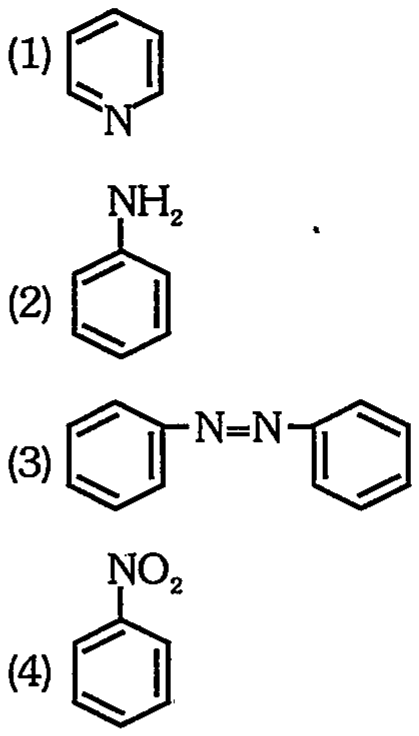
- Structure (1)
- Structure (2)
- Structure (3)
- Structure (4)
Show answer
Answer: (B) Structure (2)
Explanation: Kjeldahl's method is not applicable to compounds containing nitrogen in nitro and azo groups or nitrogen present in a ring (e.g. pyridine), because such nitrogen is not converted to ammonium sulphate on digestion with conc. H₂SO₄. Aniline has an –NH₂ group, so its nitrogen can be estimated; pyridine, azobenzene and nitrobenzene cannot.
Question 3
Previous-year questionIn Duma's method for the estimation of nitrogen, 0.25 g of an organic compound gave 40 mL of nitrogen collected at 300 K and 725 mm pressure. If the aqueous tension at 300 K is 25 mm, the percentage of nitrogen in the compound is [AIPMT 2015]
- 18.20
- 16.76
- 15.76
- 17.36
Show answer
Answer: (B) 16.76
Explanation: Pressure of dry N₂ = 725 − 25 = 700 mm. Volume at STP = 40 × (700/760) × (273/300) = 33.53 mL. %N = (28/22400) × (33.53/0.25) × 100 = 16.76%.
Question 4
Which statement about the CHN elemental analyser is correct?
- It needs a large sample of about 1 to 3 g and takes several hours to give a result
- It needs only about 1 to 3 mg of substance and displays the values on a screen within a short time
- It estimates halogens, sulphur and phosphorus but cannot estimate carbon
- It estimates nitrogen only, by the back titration of ammonia with standard acid
Show answer
Answer: (B) It needs only about 1 to 3 mg of substance and displays the values on a screen within a short time
Explanation: Elements in an organic compound are now estimated using microquantities of substance and automatic techniques. The CHN elemental analyser determines carbon, hydrogen and nitrogen. It requires only about 1 to 3 mg of the substance and shows the values on a screen within a short time.
Question 5
0.40 g of an organic compound is heated with fuming nitric acid, and the phosphoric acid formed is precipitated with ammonia and ammonium molybdate as (NH₄)₃PO₄·12MoO₃ (molar mass 1877 g mol⁻¹). The dry precipitate weighs 1.877 g. What is the percentage of phosphorus in the compound? (P = 31)
- 7.75%
- 15.5%
- 3.88%
- 31.0%
Show answer
Answer: (A) 7.75%
Explanation: The precipitate is 1.877/1877 = 0.001 mol and each formula unit contains one phosphorus atom. Mass of phosphorus = 0.001 × 31 = 0.031 g. Percentage of phosphorus = 0.031 × 100/0.40 = 7.75%.
Question 6
0.50 g of an organic compound is decomposed by heating in a stream of nitrogen. The gaseous products are passed over red-hot coke, converting all the oxygen to CO, and then through warm I₂O₅. The CO₂ formed weighs 0.66 g. What is the percentage of oxygen in the compound?
- 36%
- 96%
- 48%
- 24%
Show answer
Answer: (C) 48%
Explanation: From 2C + O₂ → 2CO and I₂O₅ + 5CO → I₂ + 5CO₂, each mole of O₂ from the compound gives two moles of CO₂, so 32 g of oxygen corresponds to 88 g of CO₂. Mass of oxygen = 32 × 0.66/88 = 0.24 g. Percentage of oxygen = 0.24 × 100/0.50 = 48%.
Question 7
An organic compound contains 12.4% phosphorus by mass. In the Carius method, 1.00 g of it is oxidised to phosphoric acid, which is precipitated as MgNH₄PO₄ and ignited. What mass of residue is obtained? (O = 16, Mg = 24, P = 31)
- 0.111 g
- 0.444 g
- 0.222 g
- 0.248 g
Show answer
Answer: (B) 0.444 g
Explanation: The sample contains 0.124 g of phosphorus, which is 0.124/31 = 0.004 mol of P atoms. Ignition gives Mg₂P₂O₇, of molar mass 222 g mol⁻¹, with two P atoms per formula unit. So 0.002 mol forms, a mass of 0.002 × 222 = 0.444 g.
Doing well? Create a free account to take timed tests on this topic and see your weak areas.
Question 8
1.52 g of thiourea, CS(NH₂)₂, is oxidised in a Carius tube with fuming nitric acid and the sulphuric acid formed is fully precipitated with BaCl₂. What mass of BaSO₄ is obtained? (H = 1, C = 12, N = 14, O = 16, S = 32, Ba = 137)
- 4.66 g
- 2.33 g
- 6.99 g
- 9.32 g
Show answer
Answer: (A) 4.66 g
Explanation: The molar mass of thiourea is 76 g mol⁻¹, so 1.52 g is 0.02 mol, and each molecule has one sulphur atom. All the sulphur ends up in BaSO₄, so 0.02 mol BaSO₄ forms. With a molar mass of 233 g mol⁻¹, this is 0.02 × 233 = 4.66 g.
Question 9
An organic compound contains only carbon, hydrogen and oxygen. Complete combustion of 0.46 g of it gives 0.88 g of CO₂ and 0.54 g of H₂O. What are the percentage of oxygen and the empirical formula of the compound?
- 34.8%; C₂H₆O
- 17.4%; C₄H₁₀O
- 34.8%; CH₃O
- 13.0%; C₃H₈O
Show answer
Answer: (A) 34.8%; C₂H₆O
Explanation: Mass of C = 0.88 × 12/44 = 0.24 g and mass of H = 0.54 × 2/18 = 0.06 g. Oxygen is found by difference: 0.46 − 0.30 = 0.16 g, which is 34.8%. The mole ratio C : H : O is 0.02 : 0.06 : 0.01, or 2 : 6 : 1, giving C₂H₆O.
Question 10
In the Dumas method, the gases from heating an organic compound with copper(II) oxide are passed over a heated copper gauze and then into a nitrometer containing potassium hydroxide solution. What are the roles of the copper gauze and the KOH solution respectively?
- Copper absorbs carbon dioxide; KOH reduces oxides of nitrogen
- Copper oxidises nitrogen to nitrogen dioxide; KOH absorbs water vapour
- Copper reduces oxides of nitrogen to nitrogen; KOH absorbs carbon dioxide
- Copper removes water vapour; KOH absorbs nitrogen
Show answer
Answer: (C) Copper reduces oxides of nitrogen to nitrogen; KOH absorbs carbon dioxide
Explanation: Any oxides of nitrogen formed are reduced to N₂ by hot copper, so that all the nitrogen is obtained as the free gas. Carbon dioxide reacts with KOH and is absorbed, while N₂ does not react and collects above the solution. Its volume therefore gives the nitrogen content of the compound.
Want more Quantitative analysis (basic principles only) - Estimation of carbon, hydrogen, nitrogen, halogens, sulphur, phosphorus. Calculations of empirical formulae and molecular formulae – Numerical problems in organic quantitative analysis, questions?
E-GYAN NIDHI has 49 questions on this topic and 63,000+ in total, all free: timed CBT tests, NEET marking and instant analysis.
Register free Free Sunday Mock Test