Qualitative analysis - Detection of nitrogen, sulphur, phosphorus, and halogens.: NEET MCQs with Answers
10 free questions on Qualitative analysis - Detection of nitrogen, sulphur, phosphorus, and halogens. for NEET (UG), starting with previous-year NEET and AIPMT questions. Try each one, then tap Show answer for the answer and a short explanation.
Question 1
Previous-year questionWhich of the compounds given below gives a blood-red colour in Lassaigne's test? [NEET 2024 (Sawaimadhopur)]
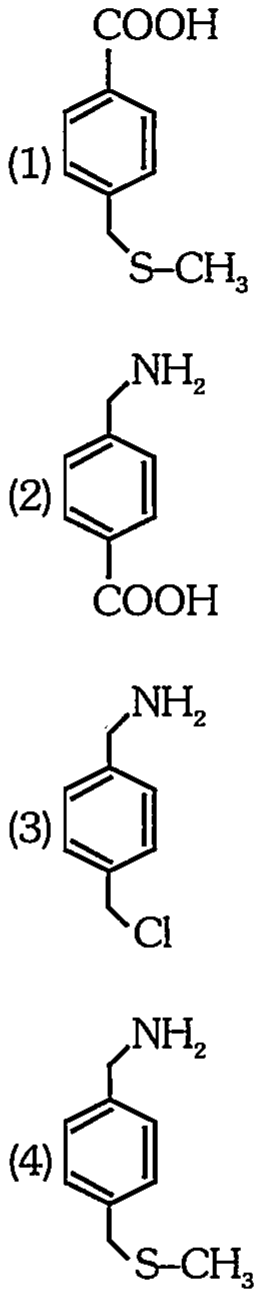
- Structure (1)
- Structure (2)
- Structure (3)
- Structure (4)
Show answer
Answer: (D) Structure (4)
Explanation: A blood-red colour in Lassaigne's test is obtained only when both nitrogen and sulphur are present: fusion with sodium forms NaSCN, which gives blood-red Fe(SCN)²⁺ with Fe³⁺. The compound with both a –CH₂NH₂ group and a –CH₂–S–CH₃ group qualifies. The acid with –CH₂–S–CH₃ has S but no N, the acid with –CH₂NH₂ has N but no S, and the compound with –CH₂NH₂ and –CH₂Cl has N and Cl but no S.
Question 2
An organic compound is heated with dry copper(II) oxide, and the products are tested with lime water and anhydrous copper sulphate. Which observation correctly shows the presence of both carbon and hydrogen?
- Lime water turns milky because of CO₂ from carbon, and blue copper sulphate turns white because it loses water to hydrogen
- Lime water stays clear because CuO retains the CO₂, and anhydrous copper sulphate turns blue because of H₂O from hydrogen
- Lime water turns milky because of H₂O from hydrogen, and anhydrous copper sulphate turns blue because of CO₂ from carbon
- Lime water turns milky because of CO₂ from carbon, and anhydrous copper sulphate turns blue because of H₂O from hydrogen
Show answer
Answer: (D) Lime water turns milky because of CO₂ from carbon, and anhydrous copper sulphate turns blue because of H₂O from hydrogen
Explanation: Copper(II) oxide oxidises carbon to CO₂ and hydrogen to H₂O and is itself reduced to copper. The CO₂ develops turbidity in lime water. The water turns white anhydrous copper sulphate blue.
Question 3
In the Lassaigne test for nitrogen, a student adds only freshly prepared iron(II) sulphate to the extract and adds no iron(III) salt, yet Prussian blue, which needs Fe³⁺ ions, is still obtained. Where do the Fe³⁺ ions come from?
- Concentrated sulphuric acid oxidises some Fe²⁺ to Fe³⁺ on heating
- Sodium metal left in the extract oxidises Fe²⁺ to Fe³⁺
- Fe³⁺ is released by reduction of the hexacyanidoferrate(II) ion on warming
- Cyanide ions oxidise Fe²⁺ to Fe³⁺ while forming hexacyanidoferrate(II)
Show answer
Answer: (A) Concentrated sulphuric acid oxidises some Fe²⁺ to Fe³⁺ on heating
Explanation: Sodium cyanide first reacts with iron(II) sulphate to form sodium hexacyanidoferrate(II). On heating with concentrated sulphuric acid, some iron(II) ions are oxidised to iron(III) ions. These react with the hexacyanidoferrate(II) to give iron(III) hexacyanidoferrate(II), Fe₄[Fe(CN)₆]₃·xH₂O, which is Prussian blue.
Question 4
Thiourea contains both nitrogen and sulphur. When it is fused with a large excess of sodium, the extract gives the Prussian blue test and the sulphide test instead of a blood-red colour with Fe³⁺. What is the best explanation?
- Excess sodium converts all the nitrogen into sodium nitrate, which reacts with Fe³⁺
- Excess sodium decomposes the sodium thiocyanate first formed into sodium cyanide and sodium sulphide
- Excess sodium removes all the sulphur from the extract as sulphur dioxide gas
- Excess sodium converts the Fe³⁺ of the test reagent into metallic iron, which forms the blue colour
Show answer
Answer: (B) Excess sodium decomposes the sodium thiocyanate first formed into sodium cyanide and sodium sulphide
Explanation: With limited sodium, nitrogen and sulphur together give NaSCN, and thiocyanate ions give the blood-red colour with Fe³⁺. With excess sodium, NaSCN + 2 Na → NaCN + Na₂S. The extract then holds free cyanide and sulphide ions, which give their usual separate tests.
Question 5
A compound containing both nitrogen and sulphur is fused with sodium. With a limited amount of sodium the extract gives a blood-red colour with Fe³⁺, but with excess sodium it gives the usual separate tests for nitrogen and sulphur. Why does excess sodium make this difference?
- Excess sodium decomposes sodium thiocyanate into sodium cyanide and sodium sulphide
- Excess sodium oxidises the cyanide ion to the thiocyanate ion
- Excess sodium converts Fe³⁺ into Fe²⁺, which cannot give any colour
- Excess sodium removes the sulphur completely as hydrogen sulphide gas
Show answer
Answer: (A) Excess sodium decomposes sodium thiocyanate into sodium cyanide and sodium sulphide
Explanation: With limited sodium, nitrogen and sulphur together form NaSCN, which gives blood-red Fe(SCN)²⁺ with Fe³⁺. With excess sodium the thiocyanate decomposes: NaSCN + 2Na → NaCN + Na₂S. The cyanide and sulphide ions then give their own usual tests.
Question 6
Carbon tetrachloride gives no white precipitate when heated with aqueous silver nitrate, but the acidified sodium fusion extract of the same compound gives one. What is the reason for this difference?
- Silver nitrate reacts only with fluorine and bromine in organic compounds, and fusion turns chlorine into bromine
- Silver chloride dissolves in CCl₄, so the precipitate is hidden until the CCl₄ is removed
- CCl₄ reduces silver ions to silver metal, which prevents precipitation
- Chlorine in CCl₄ is covalently bonded and gives no Cl⁻ ions until fusion with sodium converts it to NaCl
Show answer
Answer: (D) Chlorine in CCl₄ is covalently bonded and gives no Cl⁻ ions until fusion with sodium converts it to NaCl
Explanation: Silver ions precipitate AgCl only with free chloride ions. The C–Cl bonds of CCl₄ are covalent, so it supplies no Cl⁻ to the solution. Fusion with sodium converts the covalent chlorine into ionic NaCl, which then gives the white precipitate.
Question 7
An organic compound is heated with sodium peroxide, the product is boiled with concentrated nitric acid, and ammonium molybdate is then added. A yellow precipitate forms. What does this show?
- A halogen is present, and the precipitate is a molybdenum halide
- Nitrogen is present, and the precipitate is ammonium molybdate itself
- Phosphorus is present, and the precipitate is ammonium phosphomolybdate, (NH₄)₃PO₄·12MoO₃
- Sulphur is present, and the precipitate is molybdenum sulphide
Show answer
Answer: (C) Phosphorus is present, and the precipitate is ammonium phosphomolybdate, (NH₄)₃PO₄·12MoO₃
Explanation: Sodium peroxide oxidises phosphorus in the compound to phosphate. On boiling with nitric acid and adding ammonium molybdate, the phosphate gives a yellow precipitate of ammonium phosphomolybdate, which confirms phosphorus.
Doing well? Create a free account to take timed tests on this topic and see your weak areas.
Question 8
To detect phosphorus, an organic compound is heated with an oxidising agent such as sodium peroxide. What then gives the positive test, and what is seen?
- Phosphorus becomes cyanophosphate; adding iron(II) sulphate and then acid gives a Prussian blue colour
- Phosphorus becomes phosphide; adding lead acetate gives a black solid
- Phosphorus becomes phosphate; boiling with nitric acid and adding ammonium molybdate gives a yellow solid
- Phosphorus becomes phosphate; adding silver nitrate in ammonia gives a white solid soluble in excess ammonia
Show answer
Answer: (C) Phosphorus becomes phosphate; boiling with nitric acid and adding ammonium molybdate gives a yellow solid
Explanation: The oxidising agent converts the phosphorus in the compound into phosphate. The solution is boiled with nitric acid and treated with ammonium molybdate. A yellow colour or precipitate of ammonium phosphomolybdate, (NH₄)₃PO₄·12MoO₃, shows that phosphorus is present.
Question 9
Consider two statements about testing the sodium fusion extract for sulphur. Statement I: Acidifying the extract with acetic acid and adding lead acetate gives a black precipitate if sulphur is present. Statement II: Dilute sulphuric acid is an equally good choice for acidifying, because the lead sulphate formed is soluble in water.
- Statement I is incorrect but Statement II is correct
- Both statements are incorrect
- Statement I is correct but Statement II is incorrect
- Both statements are correct
Show answer
Answer: (C) Statement I is correct but Statement II is incorrect
Explanation: Sulphide ions in the extract give black lead sulphide with lead acetate. Sulphuric acid cannot be used because sulphate ions give a white precipitate of lead sulphate, which is insoluble and interferes with the test. Acetic acid introduces no such interfering anion.
Question 10
To test for sulphur, the sodium fusion extract is acidified and lead acetate is added. Why is acetic acid used for acidifying rather than dilute sulphuric acid?
- Sulphuric acid would convert Pb²⁺ into a soluble complex, so no precipitate could form
- Acetic acid is needed to convert CN⁻ into thiocyanate before the test
- Sulphate ions would give white PbSO₄ with lead acetate and interfere with the test
- Sulphuric acid would oxidise S²⁻ completely to SO₄²⁻ before the test
Show answer
Answer: (C) Sulphate ions would give white PbSO₄ with lead acetate and interfere with the test
Explanation: A positive test is a black precipitate of PbS. Lead acetate would also react with sulphate from sulphuric acid to give white insoluble PbSO₄, and this would interfere. Acetic acid adds no precipitating anion, because lead acetate is soluble.
Want more Qualitative analysis - Detection of nitrogen, sulphur, phosphorus, and halogens. questions?
E-GYAN NIDHI has 26 questions on this topic and 63,000+ in total, all free: timed CBT tests, NEET marking and instant analysis.
Register free Free Sunday Mock TestMore topics in PURIFICATION AND CHARACTERISATION OF ORGANIC COMPOUNDS
- Purification - Crystallization, sublimation, distillation, differential extraction, and chromatography - principles and their applications. MCQs
- Quantitative analysis (basic principles only) - Estimation of carbon, hydrogen, nitrogen, halogens, sulphur, phosphorus. Calculations of empirical formulae and molecular formulae – Numerical problems in organic quantitative analysis, MCQs