Plant Kingdom – Introduction: NEET MCQs with Answers
15 free questions on Plant Kingdom – Introduction for NEET (UG), starting with previous-year NEET and AIPMT questions. Try each one, then tap Show answer for the answer and a short explanation.
Syllabus covered: Introduction: Salient features and classification of plants into major groups, (three to five salient and distinguishing features and at least two examples of each category)
Question 1
Previous-year questionExamine figures A, B, C and D. Which option identifies all four correctly? [AIPMT Mains 2010]
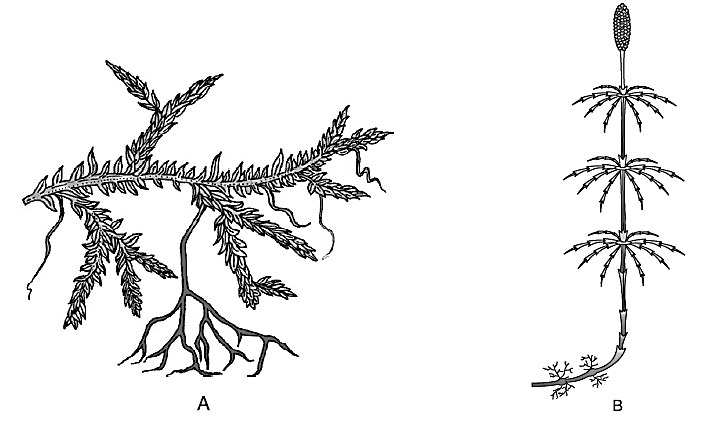
- A: Chara, B: Marchantia, C: Fucus, D: Pinus
- A: Equisetum, B: Ginkgo, C: Selaginella, D: Lycopodium
- A: Selaginella, B: Equisetum, C: Salvinia, D: Ginkgo
- A: Funaria, B: Adiantum, C: Salvinia, D: Riccia
Show answer
Answer: (C) A: Selaginella, B: Equisetum, C: Salvinia, D: Ginkgo
Explanation: The correctly identified set is A: Selaginella, B: Equisetum, C: Salvinia, D: Ginkgo.
Question 2
Previous-year questionWhich of the following is correctly matched? [Re-NEET 2024]
- Gymnosperms : Cedrus, Pinus, Sequoia
- Angiosperms : Wolffia, Eucalyptus, Sequoia
- Bryophytes : Polytrichum, Polysiphonia, Sphagnum
- Pteridophytes : Equisetum, Ginkgo, Adiantum
Show answer
Answer: (A) Gymnosperms : Cedrus, Pinus, Sequoia
Explanation: Cedrus, Pinus and Sequoia are all gymnosperms. Sequoia is not an angiosperm, Polysiphonia is a red alga rather than a bryophyte, and Ginkgo is a gymnosperm rather than a pteridophyte.
Question 3
Previous-year questionMatch List-I with List-II and choose the correct answer from the options given below. [NEET 2024 (Sawaimadhopur)]
List-I:
A. Microscopic angiosperm
B. Tallest gymnosperm
C. Thalloid bryophyte
D. Heterosporous pteridophyte
List-II:
I. Salvinia
II. Marchantia
III. Sequoia
IV. Wolffia
List-I:
A. Microscopic angiosperm
B. Tallest gymnosperm
C. Thalloid bryophyte
D. Heterosporous pteridophyte
List-II:
I. Salvinia
II. Marchantia
III. Sequoia
IV. Wolffia
- A-IV, B-III, C-II, D-I
- A-III, B-II, C-IV, D-I
- A-II, B-I, C-IV, D-III
- A-I, B-III, C-II, D-IV
Show answer
Answer: (A) A-IV, B-III, C-II, D-I
Explanation: Wolffia is the smallest (microscopic) angiosperm (IV); Sequoia, the giant redwood, is the tallest gymnosperm (III); Marchantia is a thalloid bryophyte (II); Salvinia is a heterosporous pteridophyte (I). Hence A-IV, B-III, C-II, D-I.
Question 4
Previous-year questionMatch List-I with List-II and choose the correct answer from the options given below. [Re-NEET 2022]
List-I:
(a) Chlamydomonas
(b) Cycas
(c) Selaginella
(d) Sphagnum
List-II:
(i) Moss
(ii) Pteridophyte
(iii) Alga
(iv) Gymnosperm
List-I:
(a) Chlamydomonas
(b) Cycas
(c) Selaginella
(d) Sphagnum
List-II:
(i) Moss
(ii) Pteridophyte
(iii) Alga
(iv) Gymnosperm
- (a)-(iii), (b)-(i), (c)-(ii), (d)-(iv)
- (a)-(iii), (b)-(iv), (c)-(ii), (d)-(i)
- (a)-(iii), (b)-(ii), (c)-(i), (d)-(iv)
- (a)-(ii), (b)-(iii), (c)-(i), (d)-(iv)
Show answer
Answer: (B) (a)-(iii), (b)-(iv), (c)-(ii), (d)-(i)
Explanation: Chlamydomonas is a green alga (iii), Cycas is a gymnosperm (iv), Selaginella is a pteridophyte (ii) and Sphagnum is a moss (i). Thus (a)-(iii), (b)-(iv), (c)-(ii), (d)-(i).
Question 5
Previous-year questionMatch List-I with List-II and choose the correct answer from the options given below. [NEET 2022 (Overseas)]
List-I:
(a) Cedrus
(b) Adiantum
(c) Sphagnum
(d) Marchantia
List-II:
(i) Pteridophyte
(ii) Gymnosperm
(iii) Liverwort
(iv) Moss
List-I:
(a) Cedrus
(b) Adiantum
(c) Sphagnum
(d) Marchantia
List-II:
(i) Pteridophyte
(ii) Gymnosperm
(iii) Liverwort
(iv) Moss
- (a)-(iii), (b)-(i), (c)-(iv), (d)-(ii)
- (a)-(ii), (b)-(i), (c)-(iv), (d)-(iii)
- (a)-(iii), (b)-(iv), (c)-(ii), (d)-(i)
- (a)-(ii), (b)-(iii), (c)-(i), (d)-(iv)
Show answer
Answer: (B) (a)-(ii), (b)-(i), (c)-(iv), (d)-(iii)
Explanation: Cedrus is a gymnosperm (ii), Adiantum is a pteridophyte (i), Sphagnum is a moss (iv) and Marchantia is a liverwort (iii). Hence (a)-(ii), (b)-(i), (c)-(iv), (d)-(iii).
Question 6
Previous-year questionWhich one of the following statements is correct? [NEET 2018]
- Ovules are not enclosed by ovary wall in gymnosperms
- Selaginella is heterosporous, while Salvinia is homosporous
- Horsetails are gymnosperms
- Stems are usually unbranched in both Cycas and Cedrus
Show answer
Answer: (A) Ovules are not enclosed by ovary wall in gymnosperms
Explanation: Gymnosperms have naked ovules that are not enclosed by an ovary wall. Both Selaginella and Salvinia are heterosporous, horsetails (Equisetum) are pteridophytes, and only Cycas has an unbranched stem whereas Cedrus is branched.
Question 7
Previous-year questionThe classification given by Bentham and Hooker is [AIPMT 1988]
- artificial
- natural
- phylogenetic
- numerical
Show answer
Answer: (B) natural
Explanation: Bentham and Hooker's system is a natural system of classification, since all the important characteristics of organisms that reveal their natural relationships were taken into consideration. This brings out the maximum number of similarities within a group and comparable differences from other groups.
Doing well? Create a free account to take timed tests on this topic and see your weak areas.
Question 8
Previous-year questionThe artificial system of classification was first used by [AIPMT 1989]
- Linnaeus
- de Candolle
- Pliny the Elder
- Bentham and Hooker
Show answer
Answer: (A) Linnaeus
Explanation: The artificial system of classification was first proposed by Carl Linnaeus, who used only a few morphological (chiefly sexual) characters such as the number and arrangement of stamens. Such a system separates closely related species and groups unrelated ones together.
Question 9
Previous-year questionPhylogenetic classification is based on [AIPMT 1994]
- a utilitarian system
- habits
- overall similarities
- common evolutionary descent
Show answer
Answer: (D) common evolutionary descent
Explanation: In phylogenetic classification, organisms are classified on the basis of evolutionary sequence and genetic relationship — that is, common evolutionary descent. Organisms placed in one group are assumed to have descended from a common ancestor.
Question 10
Previous-year questionA system of classification in which a large number of traits are considered is called [AIPMT 1999]
- artificial system
- synthetic system
- natural system
- phylogenetic system
Show answer
Answer: (C) natural system
Explanation: A system based on a large number of natural characters or traits is the natural system of classification. It uses morphological and anatomical characteristics and affinities considered in the light of phylogeny — the system of Bentham and Hooker is the classic example.
Question 11
Previous-year questionThe book 'Genera Plantarum' was written by [AIPMT 1999]
- Engler and Prantl
- Bentham and Hooker
- Bessey
- Hutchinson
Show answer
Answer: (B) Bentham and Hooker
Explanation: George Bentham and Joseph Dalton Hooker wrote Genera Plantarum (1862–1883), a monumental work providing elaborate keys for the easy identification of 202 natural orders and their genera. It represents the most comprehensive natural system of classification of seed plants.
Question 12
Previous-year questionPhenetic classification is based on [AIPMT 2003, 2004]
- sexual characteristics
- the ancestral lineage of existing organisms
- observable characteristics of existing organisms
- dendrograms based on DNA characteristics
Show answer
Answer: (C) observable characteristics of existing organisms
Explanation: Phenetic (numerical) classification is done on the basis of the observable characteristics of existing organisms — morphology and other traits that can be directly observed and scored. It deliberately ignores evolutionary or ancestral relationships, which form the basis of phylogenetic classification.
Question 13
Previous-year questionWhat is common to multicellular fungi, filamentous algae and the protonema of mosses? [2012]
- Mode of nutrition
- Diplontic life cycle
- Multiplication by fragmentation
- Membership of Kingdom Plantae
Show answer
Answer: (C) Multiplication by fragmentation
Explanation: All three bodies are filamentous, so a broken piece can grow on independently and fragmentation serves as a ready means of vegetative multiplication. Their nutrition differs, since fungi are heterotrophic while algae and the moss protonema are autotrophic; none of them is diplontic; and fungi belong to Kingdom Fungi rather than to Plantae.
Question 14
Previous-year questionWhich one of the following has a haplontic life cycle? [2010]
- Wheat
- Polytrichum
- Funaria
- Ustilago
Show answer
Answer: (D) Ustilago
Explanation: In a haplontic cycle the dominant plant body is haploid and the only diploid cell in the whole cycle is the zygote, which immediately undergoes meiosis. Ustilago follows this pattern, as do many algae such as Chlamydomonas and Spirogyra. Wheat is diplontic, while the mosses Polytrichum and Funaria are haplo-diplontic, having a dominant haploid gametophyte alongside a dependent diploid sporophyte.
Question 15
Previous-year questionFlagellated male gametes are present in all three members of which one of the following sets? [2007]
- Riccia, Dryopteris and Cycas
- Zygnema, Saprolegnia and Hydrilla
- Anthoceros, Funaria and Spirogyra
- Fucus, Marsilea and Calotropis
Show answer
Answer: (A) Riccia, Dryopteris and Cycas
Explanation: Riccia (liverwort), Dryopteris (fern) and Cycas (gymnosperm) all have motile flagellated male gametes, Cycas having multiflagellate sperms. Sets containing Zygnema or Spirogyra (non-flagellate gametes) or angiosperms such as Hydrilla and Calotropis are excluded.
Want more Plant Kingdom – Introduction questions?
E-GYAN NIDHI has 314 questions on this topic and 63,000+ in total, all free: timed CBT tests, NEET marking and instant analysis.
Register free Free Sunday Mock TestMore topics in Diversity in living world
- The Living World – Taxonomic Categories MCQs
- Biological Classification – Introduction MCQs
- The Living World – Diversity in Living World MCQs
- The Living World – What is Living? MCQs
- Biological Classification – Kingdom-Monera MCQs
- Biological Classification – Kingdom-Protista MCQs
- Biological Classification – Kingdom-Fungi MCQs
- Biological Classification – Virus MCQs
- Plant Kingdom – Algae MCQs
- Plant Kingdom – Bryophytes MCQs
- Plant Kingdom – Pteridophytes MCQs
- Plant Kingdom – Gymnosperms MCQs
- Plant Kingdom – Angiosperms MCQs