Plant Kingdom – Algae: NEET MCQs with Answers
15 free questions on Plant Kingdom – Algae for NEET (UG), starting with previous-year NEET and AIPMT questions. Try each one, then tap Show answer for the answer and a short explanation.
Syllabus covered: Algae:
Question 1
Previous-year questionRead the statements below and identify those that apply to the alga shown in the diagram given below. [Re-NEET 2022]
(a) It is a member of Chlorophyceae.
(b) Food is stored in the form of starch.
(c) It is a monoecious plant showing oogonium and antheridium.
(d) Food is stored in the form of laminarin or mannitol.
(e) It shows dominance of the pigments chlorophyll a, c and fucoxanthin.
(a) It is a member of Chlorophyceae.
(b) Food is stored in the form of starch.
(c) It is a monoecious plant showing oogonium and antheridium.
(d) Food is stored in the form of laminarin or mannitol.
(e) It shows dominance of the pigments chlorophyll a, c and fucoxanthin.
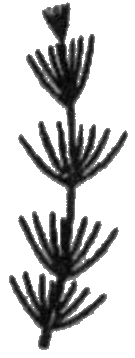
- (a) and (b) only
- (a), (b) and (c) only
- (a), (c) and (d) only
- (c), (d) and (e) only
Show answer
Answer: (B) (a), (b) and (c) only
Explanation: The alga shown is Chara, a member of Chlorophyceae (green algae). Green algae store food as starch and Chara is monoecious, bearing both oogonium and antheridium on the same plant. Laminarin/mannitol storage and dominance of chlorophyll a, c and fucoxanthin are features of brown algae (Phaeophyceae), so (d) and (e) do not apply.
Question 2
Previous-year questionIdentify the monoecious plant among the following. [NEET 2021]
- Carica papaya
- Chara
- Marchantia polymorpha
- Cycas circinalis
Show answer
Answer: (B) Chara
Explanation: Chara is monoecious, bearing both the male (globule) and female (nucule) sex organs on the same plant. Papaya, Marchantia polymorpha and Cycas are dioecious, with male and female structures on separate plants.
Question 3
Previous-year questionWhich of the following pairs is incorrectly matched? [NEET 2018]
- Uniflagellate gametes - Polysiphonia
- Biflagellate zoospores - Brown algae
- Gemma cups - Marchantia
- Unicellular organism - Chlorella
Show answer
Answer: (A) Uniflagellate gametes - Polysiphonia
Explanation: Polysiphonia is a red alga, and red algae have no flagellated stages, so its gametes are non-motile. Brown algae produce biflagellate (pear-shaped) zoospores, Marchantia bears gemma cups, and Chlorella is unicellular.
Question 4
Previous-year questionWhich of the following statements about algae is incorrect? [NEET-II 2016]
- Agar-agar is obtained from Gelidium and Gracilaria
- Laminaria and Sargassum are used as food
- Algae increase the level of dissolved oxygen in the immediate environment
- Algin is obtained from red algae, and carrageenin from brown algae.
Show answer
Answer: (D) Algin is obtained from red algae, and carrageenin from brown algae.
Explanation: Algin is obtained from brown algae and carrageen from red algae, so the statement giving them the other way round is incorrect. Agar comes from Gelidium and Gracilaria, Laminaria and Sargassum are eaten as food, and algae release O₂ during photosynthesis, raising dissolved oxygen around them.
Question 5
Previous-year questionFloridean starch has a structure similar to [NEET 2020]
- amylopectin and glycogen
- mannitol and algin
- laminarin and cellulose
- starch and cellulose
Show answer
Answer: (A) amylopectin and glycogen
Explanation: Floridean starch, the reserve food of red algae, is a branched glucan whose structure closely resembles that of amylopectin and glycogen.
Question 6
Previous-year questionWhich of the following pairs is of unicellular algae? [NEET 2020]
- Gelidium and Gracilaria
- Anabaena and Volvox
- Chlorella and Spirulina
- Laminaria and Sargassum
Show answer
Answer: (C) Chlorella and Spirulina
Explanation: Chlorella (a green alga) and Spirulina (a filamentous cyanobacterium treated with the algae) are microscopic unicellular forms rich in protein and are used as food supplements. The other pairs are multicellular red and brown algae, and Volvox is colonial.
Question 7
Previous-year questionWhich one is WRONGLY matched? [NEET 2018]
- Uniflagellate gametes – Polysiphonia
- Biflagellate zoospores – Brown algae
- Unicellular organism – Chlorella
- Gemma cups – Marchantia
Show answer
Answer: (A) Uniflagellate gametes – Polysiphonia
Explanation: Polysiphonia is a red alga and red algae possess NO flagellated stage — neither spores nor gametes are motile. Hence 'uniflagellate gametes – Polysiphonia' is wrongly matched.
Doing well? Create a free account to take timed tests on this topic and see your weak areas.
Question 8
Previous-year questionThe life cycles of Ectocarpus and Fucus respectively are [NEET 2017]
- Diplontic, Haplodiplontic
- Haplodiplontic, Diplontic
- Haplodiplontic, Haplontic
- Haplontic, Diplontic
Show answer
Answer: (B) Haplodiplontic, Diplontic
Explanation: Ectocarpus shows a haplodiplontic life cycle with both a multicellular haploid gametophyte and a multicellular diploid sporophyte, while Fucus is diplontic — the diploid plant body is dominant and only the gametes are haploid.
Question 9
Previous-year questionZygotic meiosis is characteristic of [NEET 2017]
- Fucus
- Funaria
- Chlamydomonas
- Marchantia
Show answer
Answer: (C) Chlamydomonas
Explanation: Chlamydomonas has a haplontic life cycle — the only diploid stage is the zygote, which undergoes meiosis immediately on germination (zygotic meiosis) to give haploid cells. Fucus is diplontic and Funaria and Marchantia are haplo-diplontic.
Question 10
Previous-year questionAn example of a colonial alga is [NEET 2017]
- Volvox
- Ulothrix
- Spirogyra
- Chlorella
Show answer
Answer: (A) Volvox
Explanation: Volvox is a colonial green alga in which numerous biflagellate cells are arranged in a hollow spherical coenobium. Ulothrix and Spirogyra are filamentous and Chlorella is unicellular.
Question 11
Previous-year questionWhich one of the following statements is WRONG? [AIPMT 2015]
- Agar-agar is obtained from Gelidium and Gracilaria
- Chlorella and Spirulina are used as space food
- Mannitol is the stored food in Rhodophyceae
- Algin and carrageen are products of algae
Show answer
Answer: (C) Mannitol is the stored food in Rhodophyceae
Explanation: Rhodophyceae store food as floridean starch. Mannitol (along with laminarin) is the reserve food of Phaeophyceae, so the third statement is wrong.
Question 12
Previous-year questionMale gametes are flagellated in [AIPMT 2015]
- Anabaena
- Ectocarpus
- Spirogyra
- Polysiphonia
Show answer
Answer: (B) Ectocarpus
Explanation: Ectocarpus is a brown alga whose gametes are pear-shaped and bear two laterally attached flagella. Spirogyra has non-motile gametes, red algae such as Polysiphonia lack flagella altogether, and Anabaena is a cyanobacterium.
Question 13
Previous-year questionWhich one of the following is WRONG about Chara? [AIPMT 2014]
- Upper oogonium and lower round antheridium
- Globule and nucule present on the same plant
- Upper antheridium and lower oogonium
- Globule is the male reproductive structure
Show answer
Answer: (C) Upper antheridium and lower oogonium
Explanation: In Chara the female sex organ (oogonium or nucule) is borne ABOVE and the male sex organ (antheridium or globule) BELOW it on the same plant. Hence the statement placing the antheridium above the oogonium is wrong.
Question 14
Previous-year questionAn alga which can be employed as food for human beings is [AIPMT 2014]
- Ulothrix
- Chlorella
- Spirogyra
- Polysiphonia
Show answer
Answer: (B) Chlorella
Explanation: Chlorella, a unicellular green alga rich in protein, is used as a food supplement and has even been used by space travellers. Porphyra, Laminaria and Sargassum are other algae used as food.
Question 15
Previous-year questionWhich one of the following shows isogamy with non-flagellated gametes? [AIPMT 2014]
- Sargassum
- Ectocarpus
- Ulothrix
- Spirogyra
Show answer
Answer: (D) Spirogyra
Explanation: In Spirogyra sexual reproduction takes place by scalariform or lateral conjugation, in which two morphologically similar but NON-MOTILE gametes fuse. Ectocarpus and Ulothrix have flagellated isogametes and Sargassum is oogamous.
Want more Plant Kingdom – Algae questions?
E-GYAN NIDHI has 454 questions on this topic and 63,000+ in total, all free: timed CBT tests, NEET marking and instant analysis.
Register free Free Sunday Mock TestMore topics in Diversity in living world
- The Living World – Taxonomic Categories MCQs
- Biological Classification – Introduction MCQs
- Plant Kingdom – Introduction MCQs
- The Living World – Diversity in Living World MCQs
- The Living World – What is Living? MCQs
- Biological Classification – Kingdom-Monera MCQs
- Biological Classification – Kingdom-Protista MCQs
- Biological Classification – Kingdom-Fungi MCQs
- Biological Classification – Virus MCQs
- Plant Kingdom – Bryophytes MCQs
- Plant Kingdom – Pteridophytes MCQs
- Plant Kingdom – Gymnosperms MCQs
- Plant Kingdom – Angiosperms MCQs