Photosynthesis – Dark Reaction: NEET MCQs with Answers
15 free questions on Photosynthesis – Dark Reaction for NEET (UG), starting with previous-year NEET and AIPMT questions. Try each one, then tap Show answer for the answer and a short explanation.
Syllabus covered: Dark Reaction
Question 1
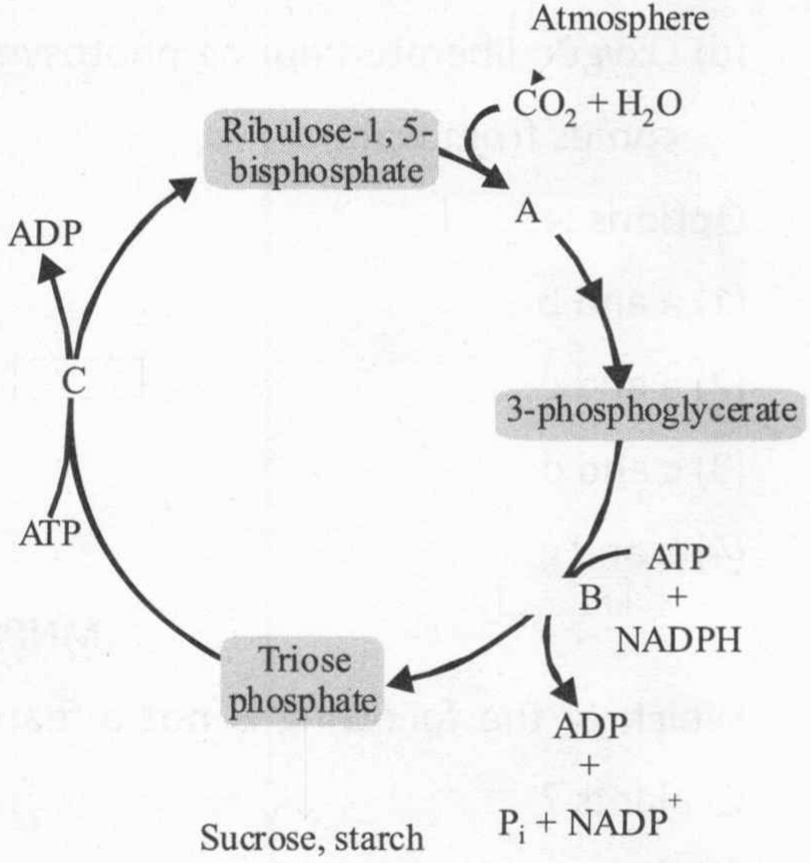
Previous-year questionStudy the figure given below. Identify the stages labelled A, B and C by choosing the correct option. [Re-NEET 2024]
- A-Carboxylation, B-Regeneration, C-Reduction
- A-Reduction, B-Decarboxylation, C-Regeneration
- A-Carboxylation, B-Reduction, C-Regeneration
- A-Reduction, B-Carboxylation, C-Regeneration
Show answer
Answer: (C) A-Carboxylation, B-Reduction, C-Regeneration
Explanation: In the Calvin cycle, A is carboxylation (RuBP + CO₂ → 3-PGA), B is reduction of 3-PGA to triose phosphate using ATP and NADPH, and C is regeneration of RuBP using ATP.
Question 2
Previous-year questionWhen one CO₂ molecule is fixed, how many of the high-energy intermediates made in the photochemical phase are used in the reduction phase? [Re-NEET 2022]
- 1 ATP + 1 NADPH
- 1 ATP + 2 NADPH
- 2 ATP + 1 NADPH
- 2 ATP + 2 NADPH
Show answer
Answer: (D) 2 ATP + 2 NADPH
Explanation: Fixation of one CO₂ gives two molecules of 3-PGA, and their reduction to triose phosphate uses 2 ATP and 2 NADPH. The third ATP needed for each CO₂ (of the total 3 ATP + 2 NADPH) is used in regeneration of RuBP. Hence the reduction phase uses 2 ATP + 2 NADPH per CO₂ fixed.
Question 3
Previous-year questionIn photosynthesis, the light-independent reactions take place at [AIPMT 2015]
- photosystem-I
- photosystem-II
- the stromal matrix
- the thylakoid lumen
Show answer
Answer: (C) the stromal matrix
Explanation: The enzymes of the Calvin cycle, including RuBisCO, are dissolved in the stroma. The light-independent reactions therefore occur in the stromal matrix, while the light reactions are confined to the thylakoid membranes.
Question 4
Previous-year questionCarbon dioxide enters the photosynthetic pathway during the [AIPMT 1988]
- PS-I
- PS-II
- light reaction
- dark reaction
Show answer
Answer: (D) dark reaction
Explanation: CO₂ is fixed during the dark (biosynthetic) reaction. Here the reducing agent NADPH and the energy source ATP, both generated in the light reaction, are used to convert carbon dioxide into carbohydrate. The light reaction itself involves no carbon fixation.
Question 5
Previous-year questionWhich technique proved most helpful in investigating the Calvin cycle? [AIPMT 1991]
- X-ray crystallography
- X-ray technique
- Radioactive isotope technique
- Intermittent light
Show answer
Answer: (C) Radioactive isotope technique
Explanation: Calvin, Benson and Bassham traced the path of carbon in photosynthesis by supplying algae with ¹⁴CO₂ and identifying the labelled intermediates at successive time intervals by chromatography and autoradiography. This radioactive isotope tracer technique revealed the entire cycle of carbon assimilation.
Question 6
Previous-year questionThe Calvin cycle can best be described as [AIPMT 1996]
- reductive carboxylation
- oxidative carboxylation
- photophosphorylation
- oxidative phosphorylation
Show answer
Answer: (A) reductive carboxylation
Explanation: The Calvin cycle involves carboxylation of RuBP followed by reduction of the resulting acid to carbohydrate, and finally regeneration of RuBP. Because carbon is both carboxylated and reduced, it is termed reductive carboxylation; it is also called the reductive pentose phosphate pathway or photosynthetic carbon reduction (PCR) cycle.
Question 7
Previous-year questionIn the Calvin cycle of C₃ plants, the acceptor of carbon dioxide is [AIPMT 1999, 1996, 1995, 1993]
- Phosphoenol pyruvate (PEP)
- Ribulose 1,5-diphosphate (RuDP)
- Phosphoglyceric acid (PGA)
- Ribulose monophosphate (RMP)
Show answer
Answer: (B) Ribulose 1,5-diphosphate (RuDP)
Explanation: In C₃ plants, CO₂ combines with the 5-carbon acceptor ribulose 1,5-bisphosphate (RuBP/RuDP) in the presence of RuBisCO, producing two molecules of 3-phosphoglyceric acid. PEP is the primary acceptor only in C₄ plants.
Doing well? Create a free account to take timed tests on this topic and see your weak areas.
Question 8
Previous-year questionWhich enzyme is the most abundant on Earth? [AIPMT 1999]
- Catalase
- RuBisCO
- Nitrogenase
- Invertase
Show answer
Answer: (B) RuBisCO
Explanation: RuBisCO (ribulose bisphosphate carboxylase-oxygenase) is the most abundant protein on the planet, constituting about 16% of total chloroplast protein. It catalyses the carboxylation of RuBP with CO₂ in the Calvin cycle, and its sheer abundance reflects its comparatively low catalytic efficiency.
Question 9
Previous-year questionThe fixation of one molecule of CO₂ through the Calvin cycle requires [AIPMT 2000]
- 1 ATP and 2 NADPH₂
- 2 ATP and 2 NADPH₂
- 3 ATP and 2 NADPH₂
- 2 ATP and 1 NADPH₂
Show answer
Answer: (C) 3 ATP and 2 NADPH₂
Explanation: In the Calvin cycle, 2 ATP and 2 NADPH are consumed in reducing the two molecules of PGA to glyceraldehyde-3-phosphate, and one additional ATP is spent in phosphorylating ribulose-5-phosphate back to RuBP. The total per CO₂ fixed is therefore 3 ATP and 2 NADPH₂.
Question 10
Previous-year questionHow many turns of the Calvin cycle are needed to yield one molecule of glucose? [AIPMT 2000]
- 8
- 2
- 6
- 4
Show answer
Answer: (C) 6
Explanation: Exactly one molecule of CO₂ is fixed in each turn of the Calvin cycle. A glucose molecule contains six carbon atoms, so six turns of the cycle are required to assemble it.
Question 11
Previous-year questionEnergy from the light reaction is transferred to the dark reaction in the form of [AIPMT 2002]
- ADP
- ATP
- RuDP
- chlorophyll
Show answer
Answer: (B) ATP
Explanation: The light reaction produces oxygen, ATP and NADPH. While oxygen is released into the atmosphere, ATP carries the chemical energy and NADPH the reducing power needed by the dark reaction. Of the options offered, ATP is the energy carrier that links the two phases.
Question 12
Previous-year questionIn C₃ plants, the first stable product formed during the dark reaction of photosynthesis is [AIPMT 2004]
- malic acid
- oxaloacetic acid
- 3-phosphoglyceric acid
- phosphoglyceraldehyde
Show answer
Answer: (C) 3-phosphoglyceric acid
Explanation: CO₂ combines with the 5-carbon acceptor RuBP in the presence of RuBisCO to yield an unstable 6-carbon intermediate that immediately splits into two molecules of the 3-carbon acid, 3-phosphoglyceric acid (PGA). Because the first stable product has three carbons, the pathway is called the C₃ pathway.
Question 13
Previous-year questionPGA was identified as the first product of CO₂ fixation in the photosynthesis of [AIPMT 2010]
- a bryophyte
- a gymnosperm
- an angiosperm
- an alga
Show answer
Answer: (D) an alga
Explanation: Melvin Calvin, working with Benson and Bassham, used radioactive ¹⁴C to trace the path of carbon in the unicellular green alga Chlorella. These studies established that the first stable product of CO₂ fixation is the 3-carbon compound 3-phosphoglyceric acid (PGA). Calvin received the Nobel Prize in 1961.
Question 14
Previous-year questionHow many molecules of ATP and NADPH₂ are required for the synthesis of one molecule of glucose during the Calvin cycle? [NEET 2019]
- 18 ATP and 12 NADPH₂
- 12 ATP and 16 NADPH₂
- 18 ATP and 16 NADPH₂
- 12 ATP and 12 NADPH₂
Show answer
Answer: (A) 18 ATP and 12 NADPH₂
Explanation: Six turns of the Calvin cycle are needed to fix the six carbon atoms of one glucose molecule. Since each turn requires 3 ATP and 2 NADPH₂, the total is 6 × 3 = 18 ATP and 6 × 2 = 12 NADPH₂.
Question 15
Previous-year questionFor every molecule of CO₂ fixed in the Calvin cycle, how many molecules of ATP and NADPH are needed? [NEET 2024]
- 2 molecules of ATP and 3 molecules of NADPH
- 2 molecules of ATP and 2 molecules of NADPH
- 3 molecules of ATP and 3 molecules of NADPH
- 3 molecules of ATP and 2 molecules of NADPH
Show answer
Answer: (D) 3 molecules of ATP and 2 molecules of NADPH
Explanation: Each turn of the Calvin cycle fixes one CO₂ and consumes 3 ATP and 2 NADPH. Two ATP and two NADPH are used in converting 2 molecules of PGA into 2 molecules of glyceraldehyde-3-phosphate, and one further ATP is required to regenerate RuBP from ribulose-5-phosphate.
Want more Photosynthesis – Dark Reaction questions?
E-GYAN NIDHI has 179 questions on this topic and 63,000+ in total, all free: timed CBT tests, NEET marking and instant analysis.
Register free Free Sunday Mock TestMore topics in Plant Physiology
- Photosynthesis – Light Reaction MCQs
- Respiration – The Respiratory Balance Sheet MCQs
- Plant Growth and Development – Plant Growth Regulators MCQs
- Photosynthesis – Early Experiments MCQs
- Photosynthesis – Site and Pigments Involved in Photosynthesis MCQs
- Photosynthesis – Photorespiration MCQs
- Photosynthesis – C3 and C4 Pathways MCQs
- Photosynthesis – Factors Affecting Photosynthesis MCQs
- Respiration – Aerobic Respiration (Krebs' Cycle & Electron Transport MCQs
- Respiration – Fermentation (anaerobic) MCQs
- Respiration – Glycolysis MCQs
- Plant Growth and Development – Development MCQs
- Plant Growth and Development – Plant Growth MCQs