Photosynthesis – C3 and C4 Pathways: NEET MCQs with Answers
15 free questions on Photosynthesis – C3 and C4 Pathways for NEET (UG), starting with previous-year NEET and AIPMT questions. Try each one, then tap Show answer for the answer and a short explanation.
Syllabus covered: C3 and C4 Pathways
Question 1
Previous-year questionStudy the pathway given below. In which of the following options are the correct words for all the three blanks A, B and C indicated? [AIPMT 2010]
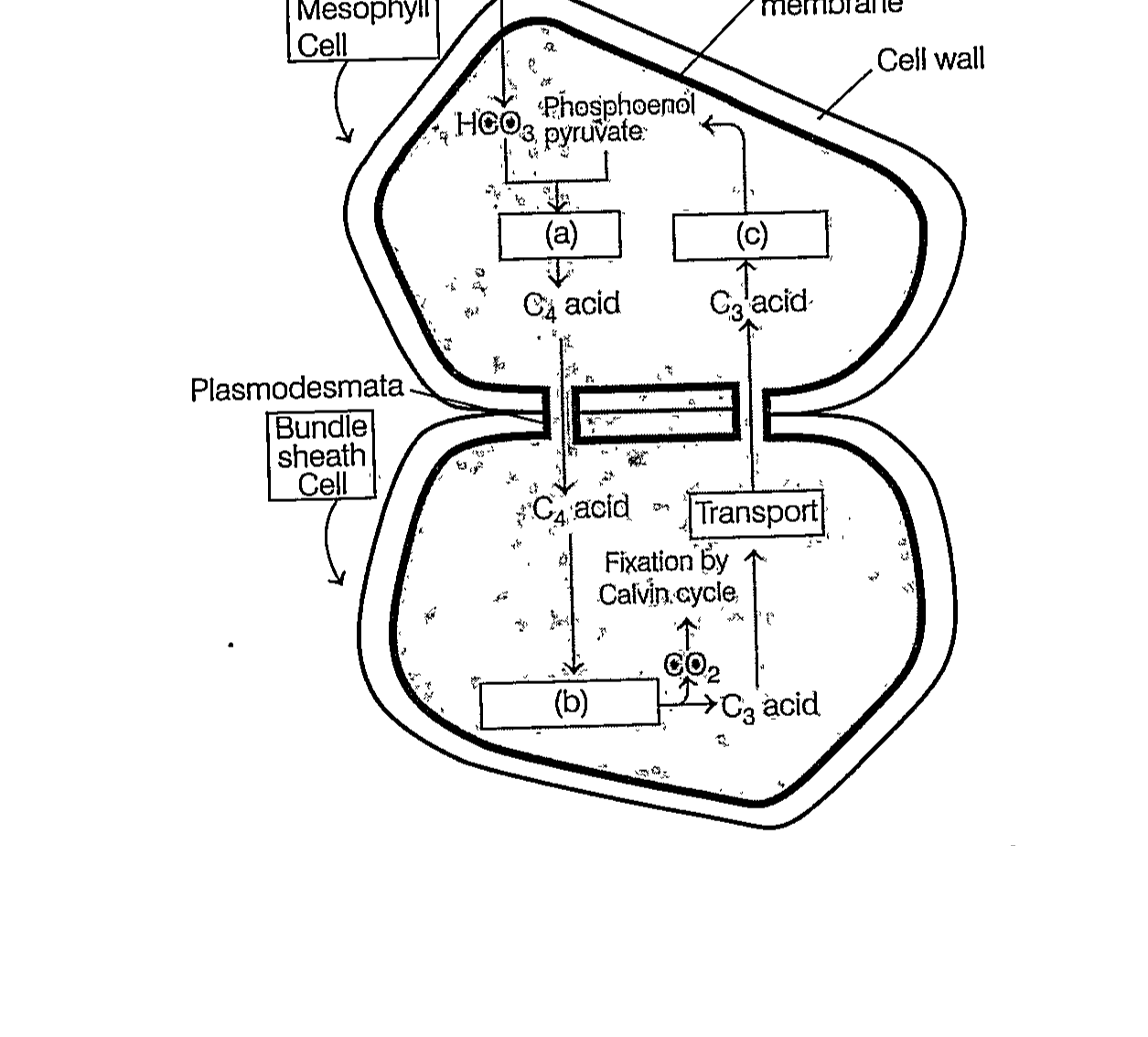
- A – Decarboxylation, B – Reduction, C – Regeneration
- A – Fixation, B – Transamination, C – Regeneration
- A – Fixation, B – Decarboxylation, C – Regeneration
- A – Carboxylation, B – Decarboxylation, C – Reduction
Show answer
Answer: (C) A – Fixation, B – Decarboxylation, C – Regeneration
Explanation: The diagram represents the Hatch and Slack (C₄) pathway. At A, atmospheric CO₂ is fixed onto PEP by PEP carboxylase in the mesophyll cell to give a C₄ acid. This acid moves through plasmodesmata into the bundle sheath cell, where at B it undergoes decarboxylation, releasing CO₂ for the Calvin cycle. The resulting C₃ acid returns to the mesophyll cell, where at C PEP is regenerated.
Question 2
Previous-year questionMatch the processes in List-I with the related molecules in List-II. [NEET 2024]
List-I:
A. C₄ pathway
B. Light reaction
C. Photorespiration
D. Calvin cycle
List-II:
I. 2H₂O → 4H⁺ + O₂ + 4e⁻
II. Ribulose 1,5-bisphosphate
III. Phosphoenol pyruvate
IV. Phosphoglycolate
List-I:
A. C₄ pathway
B. Light reaction
C. Photorespiration
D. Calvin cycle
List-II:
I. 2H₂O → 4H⁺ + O₂ + 4e⁻
II. Ribulose 1,5-bisphosphate
III. Phosphoenol pyruvate
IV. Phosphoglycolate
- A-IV, B-II, C-I, D-III
- A-III, B-I, C-IV, D-II
- A-III, B-IV, C-II, D-I
- A-II, B-I, C-IV, D-III
Show answer
Answer: (B) A-III, B-I, C-IV, D-II
Explanation: C₄ pathway – phosphoenol pyruvate (primary acceptor); light reaction – splitting of water (2H₂O → 4H⁺ + O₂ + 4e⁻); photorespiration – phosphoglycolate; Calvin cycle – ribulose 1,5-bisphosphate. Hence A-III, B-I, C-IV, D-II.
Question 3
Previous-year questionWhich one of the following statements is incorrect? [NEET 2020 (COVID-19)]
- RuBisCO is a bifunctional enzyme
- In C₄ plants, the site of RuBisCO activity is the mesophyll cell
- The substrate molecule for RuBisCO activity is a 5-carbon compound
- RuBisCO action requires ATP and NADPH
Show answer
Answer: (B) In C₄ plants, the site of RuBisCO activity is the mesophyll cell
Explanation: In C₄ plants, RuBisCO works in the bundle sheath cells and the mesophyll cells lack it, so placing RuBisCO activity in the mesophyll is incorrect. RuBisCO is bifunctional (carboxylase and oxygenase) and its substrate RuBP is a 5-carbon compound. ATP and NADPH are used by the Calvin cycle in the reduction and regeneration steps; the carboxylation by RuBisCO itself does not use them.
Question 4
Previous-year questionA plant in your garden avoids photorespiratory losses, has improved water use efficiency, shows high rates of photosynthesis at high temperatures and has improved efficiency of nitrogen utilisation. In which of the following physiological groups would you assign this plant? [NEET 2016]
- C₃
- C₄
- CAM
- Nitrogen fixer
Show answer
Answer: (B) C₄
Explanation: All four properties describe the C₄ syndrome. By concentrating CO₂ in the bundle sheath, a C₄ plant avoids photorespiration, needs less RuBisCO (and hence less nitrogen), can keep its stomata less open (saving water) and continues to photosynthesise rapidly at high temperature.
Question 5
Previous-year questionA very efficient converter of solar energy, with a net productivity of 2–4 kg/m² or more, is the crop [AIPMT 1989]
- wheat
- sugarcane
- rice
- bajra
Show answer
Answer: (B) sugarcane
Explanation: In C₄ plants such as sugarcane, maize and Sorghum, the optimum temperature for photosynthesis is 30–45 °C, and the rate of net photosynthesis in full sunlight (40–80 mg CO₂/dm²/hr) is far higher than that of C₃ plants (15–35 mg CO₂/dm²/hr). Sugarcane is thus among the most productive crops.
Question 6
Previous-year questionIn C₄ plants, the Calvin cycle operates in the [AIPMT 1989]
- stroma of bundle sheath chloroplasts
- grana of bundle sheath chloroplasts
- grana of mesophyll chloroplasts
- stroma of mesophyll chloroplasts
Show answer
Answer: (A) stroma of bundle sheath chloroplasts
Explanation: C₄ plants have dimorphic chloroplasts — granal chloroplasts in the mesophyll and agranal ones in the bundle sheath. Mesophyll cells are specialised for the light reaction, while the bundle sheath cells possess RuBisCO. The Calvin cycle therefore operates in the stroma of the bundle sheath chloroplasts.
Question 7
Previous-year questionThe first carbon dioxide acceptor in C₄ plants is [AIPMT 1992, 1990]
- phosphoenol-pyruvate
- ribulose 1,5-diphosphate
- oxaloacetic acid
- phosphoglyceric acid
Show answer
Answer: (A) phosphoenol-pyruvate
Explanation: In C₄ plants, phosphoenol pyruvate (PEP) is the first acceptor of CO₂, while ribulose bisphosphate acts as the second acceptor (in the bundle sheath, during the Calvin cycle). Oxaloacetic acid is the first stable product, not the acceptor.
Doing well? Create a free account to take timed tests on this topic and see your weak areas.
Question 8
Previous-year questionWhich one of the following is a C₄ plant? [AIPMT 1992]
- Papaya
- Pea
- Potato
- Maize/Corn
Show answer
Answer: (D) Maize/Corn
Explanation: Plants in which the first stable product of the dark reaction is a 4-carbon compound are called C₄ plants — for example sugarcane, maize and sorghum. These plants show the characteristic Kranz anatomy, and their primary CO₂ acceptor is phosphoenol pyruvate. Papaya, pea and potato are C₃ plants.
Question 9
Previous-year questionThe C₄ cycle was discovered by [AIPMT 1994]
- Hatch and Slack
- Calvin
- Hill
- Arnon
Show answer
Answer: (A) Hatch and Slack
Explanation: The C₄ or dicarboxylic acid pathway is an alternative route of CO₂ fixation, discovered by M.D. Hatch and C.R. Slack in 1967. It is therefore also known as the Hatch–Slack cycle. Calvin elucidated the C₃ cycle, Hill demonstrated the light-driven reduction reaction, and Arnon worked on photophosphorylation.
Question 10
Previous-year questionKranz anatomy is typical of [AIPMT 1995, 1990]
- C₄ plants
- C₃ plants
- C₂ plants
- CAM plants
Show answer
Answer: (A) C₄ plants
Explanation: The leaves of C₄ plants such as sugarcane and maize show Kranz anatomy, in which the mesophyll is undifferentiated and its cells are arranged in concentric layers around the vascular bundles, which are themselves ringed by large chloroplast-rich bundle sheath cells.
Question 11
Previous-year questionWhich of the following pairs is wrongly matched? [AIPMT 2001]
- C₃ — Maize
- C₄ — Kranz anatomy
- Calvin cycle — PGA
- Hatch and Slack pathway — Oxaloacetic acid
Show answer
Answer: (A) C₃ — Maize
Explanation: Maize is a C₄ plant, not a C₃ plant, so this pair is incorrect. The remaining pairs are correctly matched: C₄ plants possess Kranz anatomy, PGA is formed in the Calvin cycle, and OAA (a 4-C compound) is the first stable product of the Hatch and Slack cycle.
Question 12
Previous-year questionThe enzyme that catalyses the initial carbon dioxide fixation in C₄ plants is [AIPMT 2002, 1992]
- RuBP carboxylase
- PEP carboxylase
- carbonic anhydrase
- carboxydismutase
Show answer
Answer: (B) PEP carboxylase
Explanation: In C₄ plants, the first (primary) carboxylation is catalysed by PEP carboxylase in the mesophyll cells, forming the 4-carbon oxaloacetic acid. RuBP carboxylase (RuBisCO) acts only later, in the bundle sheath cells, during the Calvin cycle.
Question 13
Previous-year questionIn sugarcane, ¹⁴CO₂ is fixed into malic acid; the enzyme that fixes this CO₂ is [AIPMT 2003]
- fructose phosphatase
- ribulose bisphosphate carboxylase
- phosphoenol pyruvic acid carboxylase
- ribulose phosphate kinase
Show answer
Answer: (C) phosphoenol pyruvic acid carboxylase
Explanation: Sugarcane is a C₄ plant. CO₂ is taken up by phosphoenol pyruvate in a reaction catalysed by PEP carboxylase to yield oxaloacetic acid, which is then reduced by a dehydrogenase (using NADPH) to malic acid within the mesophyll cells.
Question 14
Previous-year questionPhotosynthesis in C₄ plants is relatively less limited by atmospheric CO₂ levels because [AIPMT 2005]
- of effective pumping of CO₂ into the bundle sheath cells
- RuBisCO in C₄ plants has a higher affinity for CO₂
- four-carbon acids are the primary initial CO₂ fixation products
- the primary fixation of CO₂ is mediated via PEP carboxylase
Show answer
Answer: (D) the primary fixation of CO₂ is mediated via PEP carboxylase
Explanation: The key reason is that primary fixation is carried out by PEP carboxylase, which has a much greater affinity for CO₂ than RuBisCO and, importantly, has no oxygenase activity. This allows C₄ plants to capture CO₂ efficiently even at low atmospheric concentrations, after which it is delivered to the bundle sheath cells.
Question 15
Previous-year questionAs compared to a C₃ plant, how many additional molecules of ATP are needed for the net production of one molecule of hexose sugar by C₄ plants? [AIPMT 2005]
- 2
- 6
- 12
- zero
Show answer
Answer: (C) 12
Explanation: In C₄ plants every CO₂ molecule is fixed twice — first by PEP carboxylase and then by RuBisCO — so more energy is needed. A C₃ plant requires 18 ATP for one hexose molecule, while a C₄ plant requires 30 ATP. The difference is therefore 12 additional ATP molecules.
Want more Photosynthesis – C3 and C4 Pathways questions?
E-GYAN NIDHI has 226 questions on this topic and 63,000+ in total, all free: timed CBT tests, NEET marking and instant analysis.
Register free Free Sunday Mock TestMore topics in Plant Physiology
- Photosynthesis – Light Reaction MCQs
- Respiration – The Respiratory Balance Sheet MCQs
- Plant Growth and Development – Plant Growth Regulators MCQs
- Photosynthesis – Early Experiments MCQs
- Photosynthesis – Site and Pigments Involved in Photosynthesis MCQs
- Photosynthesis – Dark Reaction MCQs
- Photosynthesis – Photorespiration MCQs
- Photosynthesis – Factors Affecting Photosynthesis MCQs
- Respiration – Aerobic Respiration (Krebs' Cycle & Electron Transport MCQs
- Respiration – Fermentation (anaerobic) MCQs
- Respiration – Glycolysis MCQs
- Plant Growth and Development – Development MCQs
- Plant Growth and Development – Plant Growth MCQs