Photoelectric Effect & Einstein's Photoelectric Equation – Photoelectric effect: NEET MCQs with Answers
15 free questions on Photoelectric Effect & Einstein's Photoelectric Equation – Photoelectric effect for NEET (UG), starting with previous-year NEET and AIPMT questions. Try each one, then tap Show answer for the answer and a short explanation.
Syllabus covered: Photoelectric effect. Hertz and Lenard's observations, Einstein's photoelectric equation
Question 1
Previous-year questionAccording to Einstein's photoelectric equation, the graph between the kinetic energy of photoelectrons ejected and the frequency of incident radiation is [AIPMT 2004]
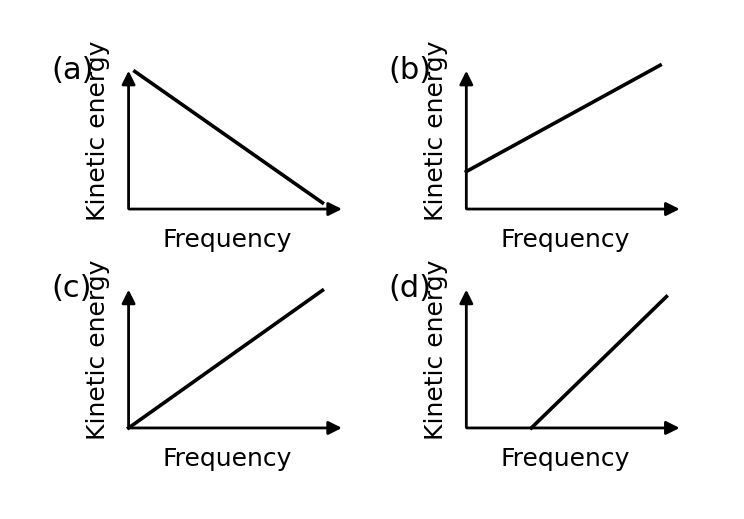
- Graph (a)
- Graph (b)
- Graph (c)
- Graph (d)
Show answer
Answer: (D) Graph (d)
Explanation: Einstein's equation K = hν − W₀ is a straight line of positive slope h. Kinetic energy is zero at the threshold frequency ν₀ = W₀/h, and no photoelectrons are emitted below it. The correct graph is therefore a straight line that starts on the frequency axis at ν₀ and rises with constant slope; it does not pass through the origin. This is graph (d).
Question 2
Previous-year questionThe figure shows a plot of photocurrent versus anode potential for a photosensitive surface for three different radiations. Which one of the following is a correct statement? [AIPMT 2009]
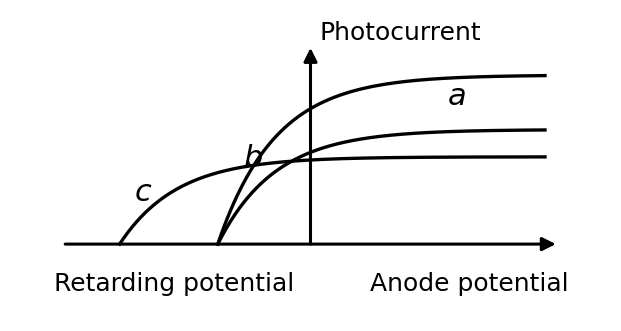
- Curves a and b represent incident radiations of different frequencies and different intensities
- Curves a and b represent incident radiations of same frequency but of different intensities
- Curves b and c represent incident radiations of different frequencies and different intensities
- Curves b and c represent incident radiations of same frequency having same intensity
Show answer
Answer: (B) Curves a and b represent incident radiations of same frequency but of different intensities
Explanation: The stopping potential, where a curve meets the retarding axis, depends only on the frequency of the radiation, while the saturation current depends on its intensity. Curves a and b meet the axis at the same stopping potential, so they have the same frequency. They reach different saturation currents, so their intensities differ.
Question 3
Previous-year questionLight whose frequency is 1.5 times the threshold frequency is incident on a photosensitive material. If the frequency is halved and the intensity is doubled, the photoelectric current becomes [NEET 2020]
- four times
- one-fourth
- zero
- doubled
Show answer
Answer: (C) zero
Explanation: Halving 1.5ν₀ gives 0.75ν₀, which is below the threshold frequency. No photoemission takes place regardless of the intensity, so the photocurrent is zero.
Question 4
Previous-year questionLight of frequency 2ν₀ (ν₀ being the threshold frequency) is incident on a metal plate and the maximum velocity of the emitted electrons is v₁. When the frequency of the incident radiation is raised to 5ν₀, the maximum velocity becomes v₂. The ratio v₁ : v₂ is [NEET 2018]
- 1 : 2
- 1 : 4
- 2 : 1
- 4 : 1
Show answer
Answer: (A) 1 : 2
Explanation: ½mv₁² = h(2ν₀ − ν₀) = hν₀ and ½mv₂² = h(5ν₀ − ν₀) = 4hν₀. Hence v₁²/v₂² = 1/4 and v₁ : v₂ = 1 : 2.
Question 5
Previous-year questionThe photoelectric threshold wavelength of silver is 3250 × 10⁻¹⁰ m. The speed of the electron ejected from a silver surface by ultraviolet light of wavelength 2536 × 10⁻¹⁰ m is (h = 4.14 × 10⁻¹⁵ eV s, c = 3 × 10⁸ m s⁻¹) [NEET 2017]
- ≈ 6 × 10⁵ m s⁻¹
- ≈ 61 × 10³ m s⁻¹
- ≈ 0.3 × 10⁶ m s⁻¹
- ≈ 6 × 10⁷ m s⁻¹
Show answer
Answer: (A) ≈ 6 × 10⁵ m s⁻¹
Explanation: φ = 12400/3250 = 3.81 eV and E = 12400/2536 = 4.89 eV, so K.E.(max) ≈ 1.08 eV = 1.73 × 10⁻¹⁹ J. Then v = √(2K/m) = √(2 × 1.73 × 10⁻¹⁹/9.1 × 10⁻³¹) ≈ 6 × 10⁵ m s⁻¹.
Question 6
Previous-year questionA metallic surface illuminated with radiation of wavelength λ gives a stopping potential V. When the same surface is illuminated with radiation of wavelength 2λ, the stopping potential is V/4. The threshold wavelength for the metallic surface is [NEET 2016]
- 4λ
- 5λ
- 5λ/2
- 3λ
Show answer
Answer: (D) 3λ
Explanation: eV = hc/λ − hc/λ₀ and eV/4 = hc/2λ − hc/λ₀. Multiplying the second by 4 and equating: hc/λ − hc/λ₀ = 2hc/λ − 4hc/λ₀, so 3hc/λ₀ = hc/λ and λ₀ = 3λ.
Question 7
Previous-year questionA photoelectric surface is illuminated in turn by monochromatic light of wavelength λ and then λ/2. If the maximum kinetic energy of the photoelectrons in the second case is three times that in the first case, the work function of the surface is [AIPMT 2015]
- hc/λ
- 2hc/λ
- hc/3λ
- hc/2λ
Show answer
Answer: (D) hc/2λ
Explanation: K₁ = hc/λ − φ and K₂ = 2hc/λ − φ with K₂ = 3K₁. Then 2hc/λ − φ = 3hc/λ − 3φ, giving 2φ = hc/λ, i.e. φ = hc/2λ.
Doing well? Create a free account to take timed tests on this topic and see your weak areas.
Question 8
Previous-year questionWhen the energy of the incident radiation is raised by 20 %, the kinetic energy of the photoelectrons emitted from a metal surface increases from 0.5 eV to 0.8 eV. The work function of the metal is [AIPMT 2014]
- 0.65 eV
- 1.0 eV
- 1.3 eV
- 1.5 eV
Show answer
Answer: (B) 1.0 eV
Explanation: Let the initial photon energy be E. Then E − φ = 0.5 and 1.2E − φ = 0.8. Subtracting, 0.2E = 0.3, so E = 1.5 eV and φ = 1.5 − 0.5 = 1.0 eV.
Question 9
Previous-year questionWhich of the following are thermions? [AIPMT 1988]
- Protons
- Electrons
- Photons
- Positrons
Show answer
Answer: (B) Electrons
Explanation: Thermionic emission is the release of electrons from a metal surface when it is heated sufficiently, the thermal energy supplying the work function. The electrons so emitted are called thermions or thermal electrons.
Question 10
Previous-year questionThe threshold frequency for the photoelectric effect on sodium corresponds to a wavelength of 5000 Å. Its work function is [AIPMT 1988]
- 4 × 10⁻¹⁹ J
- 1 J
- 2 × 10⁻¹⁹ J
- 3 × 10⁻¹⁹ J
Show answer
Answer: (A) 4 × 10⁻¹⁹ J
Explanation: W₀ = hc/λ₀ = (6.63 × 10⁻³⁴ × 3 × 10⁸)/(5000 × 10⁻¹⁰) = 1.989 × 10⁻²⁵/5 × 10⁻⁷ ≈ 4 × 10⁻¹⁹ J.
Question 11
Previous-year questionUltraviolet radiation of 6.2 eV falls on an aluminium surface. The kinetic energy of the fastest electron emitted is (work function = 4.2 eV) [AIPMT 1989]
- 3.2 × 10⁻²¹ J
- 3.2 × 10⁻¹⁹ J
- 7 × 10⁻²⁵ J
- 9 × 10⁻³² J
Show answer
Answer: (B) 3.2 × 10⁻¹⁹ J
Explanation: K = E − W₀ = 6.2 − 4.2 = 2.0 eV. Converting, K = 2.0 × 1.6 × 10⁻¹⁹ = 3.2 × 10⁻¹⁹ J.
Question 12
Previous-year questionThe photoelectric work function of a metal is 1 eV. Light of wavelength λ = 3000 Å falls on it. The photoelectrons come out with velocity [AIPMT 1991]
- 10 m/s
- 10² m/s
- 10⁴ m/s
- 10⁶ m/s
Show answer
Answer: (D) 10⁶ m/s
Explanation: The photon energy is 12375/3000 ≈ 4.125 eV, so K_max ≈ 3.1 eV = 5 × 10⁻¹⁹ J. Then v = √(2K/m) = √(2 × 5 × 10⁻¹⁹/9.1 × 10⁻³¹) ≈ 10⁶ m/s.
Question 13
Previous-year questionThe cathode of a photoelectric cell is changed such that the work function changes from W₁ to W₂ (W₂ > W₁). If the currents before and after the change are I₁ and I₂, all other conditions remaining unchanged, then (assuming hν > W₂) [AIPMT 1992]
- I₁ = I₂
- I₁ < I₂
- I₁ > I₂
- I₁ < I₂ < 2I₁
Show answer
Answer: (A) I₁ = I₂
Explanation: So long as the photon energy exceeds both work functions, every incident photon can still eject an electron. The photocurrent depends on the number of photons arriving, i.e. on the intensity, which is unchanged. Hence I₁ = I₂; only the electron kinetic energies differ.
Question 14
Previous-year questionThe number of ejected photoelectrons increases with an increase [AIPMT 1993]
- in intensity of light
- in wavelength of light
- in frequency of light
- never
Show answer
Answer: (A) in intensity of light
Explanation: The photoelectric current rises linearly with the intensity of the incident light, because a greater intensity delivers more photons per second and each photon can eject one electron. Frequency determines the energy of the electrons, not their number.
Question 15
Previous-year questionIn the photoelectric effect, the work function of a metal is 3.5 eV. The emitted electrons can be stopped by applying a potential of −1.2 V. Then [AIPMT 1994]
- the energy of the incident photons is 4.7 eV
- the energy of the incident photons is 2.3 eV
- if higher frequency photons be used, the photoelectric current will rise
- when the energy of photons is 3.5 eV, the photoelectric current will be maximum
Show answer
Answer: (A) the energy of the incident photons is 4.7 eV
Explanation: The stopping potential gives the maximum kinetic energy: K_max = 1.2 eV. By Einstein's equation the photon energy is hν = W₀ + K_max = 3.5 + 1.2 = 4.7 eV. Higher frequency raises the electron energy, not the current, and at exactly 3.5 eV emission only just begins.
Want more Photoelectric Effect & Einstein's Photoelectric Equation – Photoelectric effect questions?
E-GYAN NIDHI has 228 questions on this topic and 63,000+ in total, all free: timed CBT tests, NEET marking and instant analysis.
Register free Free Sunday Mock Test