Matter Waves and Davisson–Germer Experiment – Matter waves-wave nature of particle: NEET MCQs with Answers
15 free questions on Matter Waves and Davisson–Germer Experiment – Matter waves-wave nature of particle for NEET (UG), starting with previous-year NEET and AIPMT questions. Try each one, then tap Show answer for the answer and a short explanation.
Syllabus covered: Matter waves-wave nature of particle, de Broglie relation.
Question 1
Previous-year questionWhich of the following figures represents the variation of particle momentum and the associated de Broglie wavelength? [AIPMT 2015]
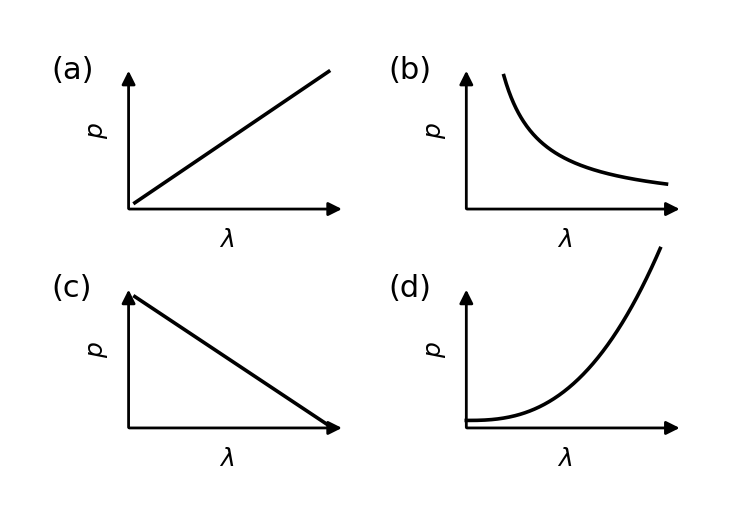
- Graph (a)
- Graph (b)
- Graph (c)
- Graph (d)
Show answer
Answer: (B) Graph (b)
Explanation: From λ = h/p we have pλ = h, a constant. This is the equation of a rectangular hyperbola, so the graph of p against λ falls steeply at small λ and flattens towards the axis at large λ — graph (b).
Question 2
Previous-year questionAn electron is accelerated from rest through a potential difference of V volt. If the de-Broglie wavelength of the electron is 1.227 × 10⁻² nm, the potential difference is [NEET 2020]
- 10² V
- 10³ V
- 10⁴ V
- 10 V
Show answer
Answer: (C) 10⁴ V
Explanation: λ = 1.227/√V nm. Setting 1.227/√V = 1.227 × 10⁻² gives √V = 100, so V = 10⁴ V.
Question 3
Previous-year questionAn electron is accelerated through a potential difference of 10,000 V. Its de-Broglie wavelength is nearly (mass of electron = 9 × 10⁻³¹ kg) [NEET 2019]
- 12.2 × 10⁻¹³ m
- 12.2 × 10⁻¹² m
- 12.2 × 10⁻¹⁴ m
- 12.2 nm
Show answer
Answer: (B) 12.2 × 10⁻¹² m
Explanation: λ = 12.27/√V Å = 12.27/100 = 0.1227 Å = 12.27 × 10⁻¹² m.
Question 4
Previous-year questionThe de-Broglie wavelength of a neutron in thermal equilibrium with heavy water at a temperature T (in kelvin) and having mass m is [NEET 2017]
- h/√(3mkT)
- 2h/√(3mkT)
- 2h/√(mkT)
- h/√(mkT)
Show answer
Answer: (A) h/√(3mkT)
Explanation: A thermal neutron has average kinetic energy (3/2)kT, so p = √(2m × 3kT/2) = √(3mkT) and λ = h/√(3mkT).
Question 5
Previous-year questionAn electron of mass m and a photon have the same energy E. The ratio of the de-Broglie wavelength of the electron to that of the photon is [NEET 2016]
- (1/c)(E/2m)^½
- (E/2m)^½
- c(2mE)^(−½)
- (1/xc)(2m/E)^½
Show answer
Answer: (A) (1/c)(E/2m)^½
Explanation: For the electron λ(e) = h/√(2mE); for the photon λ(ph) = hc/E. The ratio is λ(e)/λ(ph) = E/(c√(2mE)) = (1/c)√(E/2m).
Question 6
Previous-year questionLight of wavelength 500 nm is incident on a metal of work function 2.28 eV. The de-Broglie wavelength of the emitted electron is [AIPMT 2015]
- < 2.8 × 10⁻⁹ m
- ≥ 2.8 × 10⁻⁹ m
- ≤ 2.8 × 10⁻¹² m
- < 2.8 × 10⁻¹⁰ m
Show answer
Answer: (B) ≥ 2.8 × 10⁻⁹ m
Explanation: Photon energy = 1240/500 = 2.48 eV, so K.E.(max) = 0.2 eV. The fastest electron has λ = 12.27/√0.2 Å ≈ 27.4 Å ≈ 2.8 × 10⁻⁹ m. Slower electrons have longer wavelengths, so λ ≥ 2.8 × 10⁻⁹ m.
Question 7
Previous-year questionAn electron of mass m with an initial velocity v = v₀ î (v₀ > 0) is in an electric field E = −E₀ î (E₀ = constant > 0). If λ₀ is its initial de-Broglie wavelength, then at time t the wavelength is [NEET 2018]
- λ₀/[1 + (eE₀/m)(t/v₀)]
- λ₀[1 + eE₀t/mv₀]
- λ₀
- λ₀t
Show answer
Answer: (A) λ₀/[1 + (eE₀/m)(t/v₀)]
Explanation: The force on the electron is −eE = +eE₀ î, so the speed grows as v = v₀ + (eE₀/m)t. Then λ = h/mv = λ₀/[1 + (eE₀/m)(t/v₀)].
Doing well? Create a free account to take timed tests on this topic and see your weak areas.
Question 8
Previous-year questionThe de Broglie wave corresponding to a particle of mass m and velocity v has a wavelength associated with it [AIPMT 1989]
- h/mv
- hmv
- mh/v
- m/hv
Show answer
Answer: (A) h/mv
Explanation: De Broglie's hypothesis assigns to every moving particle a wave of wavelength λ = h/p = h/mv. The wavelength is inversely proportional to both mass and velocity, which is why it is measurable for electrons but utterly negligible for macroscopic bodies.
Question 9
Previous-year questionAn electron beam has a kinetic energy equal to 100 eV. Find its wavelength associated with a beam, if mass of electron = 9.1 × 10⁻³¹ kg and 1 eV = 1.6 × 10⁻¹⁹ J. (Planck's constant = 6.6 × 10⁻³⁴ J s) [AIPMT 1996]
- 24.6 Å
- 0.12 Å
- 1.2 Å
- 6.3 Å
Show answer
Answer: (C) 1.2 Å
Explanation: λ = h/√(2mE) = 6.6 × 10⁻³⁴/√(2 × 9.1 × 10⁻³¹ × 100 × 1.6 × 10⁻¹⁹) = 6.6 × 10⁻³⁴/√(2.912 × 10⁻⁴⁷). This equals 6.6 × 10⁻³⁴/5.4 × 10⁻²⁴ = 1.2 × 10⁻¹⁰ m = 1.2 Å.
Question 10
Previous-year questionThe wavelength associated with an electron, accelerated through a potential difference of 100 V, is of the order of [AIPMT 1996]
- 1000 Å
- 100 Å
- 10.5 Å
- 1.2 Å
Show answer
Answer: (D) 1.2 Å
Explanation: λ = 12.27/√V Å = 12.27/√100 = 12.27/10 = 1.227 Å ≈ 1.2 Å. Wavelengths of this order are comparable with interatomic spacings, which is why such electrons are diffracted by crystals.
Question 11
Previous-year questionThe energy of a photon of light is 3 eV. Then the wavelength of the photon must be [AIPMT 2000]
- 4125 nm
- 412.5 nm
- 41250 nm
- 4 nm
Show answer
Answer: (B) 412.5 nm
Explanation: Using λ(Å) = 12375/E(eV), λ = 12375/3 = 4125 Å. Converting, 4125 Å = 412.5 nm — a wavelength in the visible violet-blue region.
Question 12
Previous-year questionThe following particles are moving with the same velocity, then the maximum de Broglie wavelength will be for [AIPMT 2002]
- proton
- α-particle
- neutron
- β-particle
Show answer
Answer: (D) β-particle
Explanation: At a common velocity, λ = h/mv is inversely proportional to mass. The β-particle (an electron) is by far the lightest of the four, so it has the greatest de Broglie wavelength.
Question 13
Previous-year questionA particle of mass 1 mg has the same wavelength as an electron moving with a velocity of 3 × 10⁶ m s⁻¹. The velocity of the particle is (mass of electron = 9.1 × 10⁻³¹ kg) [AIPMT 2008]
- 2.7 × 10⁻¹⁸ m s⁻¹
- 9 × 10⁻² m s⁻¹
- 3 × 10⁻³¹ m s⁻¹
- 2.7 × 10⁻²¹ m s⁻¹
Show answer
Answer: (A) 2.7 × 10⁻¹⁸ m s⁻¹
Explanation: Equal wavelengths mean equal momenta: mv = m_ev_e. Hence v = (9.1 × 10⁻³¹ × 3 × 10⁶)/(1 × 10⁻⁶) = 2.73 × 10⁻²⁴/10⁻⁶ = 2.7 × 10⁻¹⁸ m s⁻¹.
Question 14
Previous-year questionElectrons used in an electron microscope are accelerated by a voltage of 25 kV. If the voltage is increased to 100 kV then the de Broglie wavelength associated with the electrons would [AIPMT 2011]
- increase by 2 times
- decrease by 2 times
- decrease by 4 times
- increase by 4 times
Show answer
Answer: (B) decrease by 2 times
Explanation: Since λ = 1.227/√V nm, λ ∝ 1/√V. Then λ₁/λ₂ = √(V₂/V₁) = √(100/25) = 2, so λ₂ = λ₁/2 — the wavelength decreases by a factor of 2.
Question 15
Previous-year questionIf the momentum of an electron is changed by p, then the de Broglie wavelength associated with it changes by 0.5%. The initial momentum of the electron will be [AIPMT 2012]
- 200p
- 400p
- p/200
- 100p
Show answer
Answer: (A) 200p
Explanation: Since λ = h/P, differentiating gives |Δλ/λ| = |ΔP/P|. Here ΔP = p and Δλ/λ = 0.5/100, so p/P = 0.005 and P = 200p.
Want more Matter Waves and Davisson–Germer Experiment – Matter waves-wave nature of particle questions?
E-GYAN NIDHI has 97 questions on this topic and 63,000+ in total, all free: timed CBT tests, NEET marking and instant analysis.
Register free Free Sunday Mock Test