Oscillations – Some Systems Executing SHM: NEET MCQs with Answers
13 free questions on Oscillations – Some Systems Executing SHM for NEET (UG), starting with previous-year NEET and AIPMT questions. Try each one, then tap Show answer for the answer and a short explanation.
Syllabus covered: Some Systems Executing SHM: oscillations of a spring -restoring force and force constant, Simple pendulum - derivation of expression for its time period
Question 1
Previous-year questionA mass of 2.0 kg is put on a flat pan attached to a vertical spring fixed on the ground. The mass of the spring and the pan is negligible. When pressed slightly and released the mass executes SHM. The spring constant is 200 N/m. What should be the minimum amplitude of the motion so that the mass gets detached from the pan? (Take g = 10 m/s²) [AIPMT 2007]
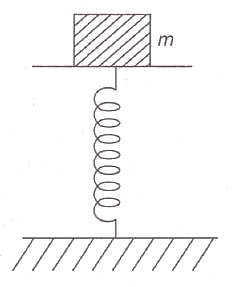
- 4.0 cm
- 8.0 cm
- 10.0 cm
- Any value less than 12.0 cm
Show answer
Answer: (C) 10.0 cm
Explanation: The mass separates when the downward acceleration at the top reaches g: Aω² = g. ω² = k/m = 200/2 = 100, so A = g/ω² = 10/100 = 0.1 m = 10 cm.
Question 2
Previous-year questionA pendulum is hung from the roof of a sufficiently high building and is moving freely to and fro like a simple harmonic oscillator. The acceleration of the bob is 20 m s⁻² at a distance of 5 m from the mean position. The time period of oscillation is [NEET 2018]
- 2π s
- π s
- 1 s
- 2 s
Show answer
Answer: (B) π s
Explanation: ω² = a/x = 20/5 = 4, so ω = 2 rad s⁻¹ and T = 2π/ω = π s.
Question 3
Previous-year questionA spring of force constant k is cut into lengths in the ratio 1 : 2 : 3. The pieces are connected in series to give a new force constant k′, and in parallel to give a force constant k″. Then k′ : k″ is [NEET 2017]
- 1 : 9
- 1 : 11
- 1 : 14
- 1 : 6
Show answer
Answer: (B) 1 : 11
Explanation: The pieces have force constants 6k, 3k and 2k. In series 1/k′ = 1/6k + 1/3k + 1/2k = 1/k, so k′ = k. In parallel k″ = 6k + 3k + 2k = 11k, so k′ : k″ = 1 : 11.
Question 4
Previous-year questionA spring of force constant k is cut into lengths in the ratio 1 : 2 : 3. They are connected in series and the new force constant is k′. If they are connected in parallel the force constant is k″. Then k′ : k″ is: [NEET 2017]
- 1 : 9
- 1 : 11
- 1 : 14
- 1 : 6
Show answer
Answer: (B) 1 : 11
Explanation: The pieces (total 6 parts) have constants 6k, 3k, 2k. Series: 1/k′ = 1/6k + 1/3k + 1/2k = 1/k ⇒ k′ = k. Parallel: k″ = 6k + 3k + 2k = 11k. So k′ : k″ = 1 : 11.
Question 5
Previous-year questionThe period of oscillation of a mass M suspended from a spring of negligible mass is T. If along with it another mass M is also suspended, the period of oscillation will now be: [AIPMT 2010]
- √2 T
- T
- T/√2
- 2T
Show answer
Answer: (A) √2 T
Explanation: T ∝ √m. Doubling the mass to 2M gives the new period √2 T.
Question 6
A block hung on a vertical spring has a static extension e on earth, so its period can be written as T = 2π√(e/g). If the same system is taken to the moon, what happens to the period?
- It stays the same, because the extension does not change
- It increases, because g is smaller
- It stays the same, because the extension falls in the same ratio as g
- It decreases, because the extension is smaller
Show answer
Answer: (C) It stays the same, because the extension falls in the same ratio as g
Explanation: At equilibrium ke = mg, so e = mg/k is proportional to g. On the moon both e and g fall by the same factor, leaving e/g = m/k unchanged. The period is therefore 2π√(m/k), the same as on earth.
Question 7
On earth, an object falling from rest through a height h takes a time t as read on a pendulum clock and also on a clock regulated by a horizontal spring-block oscillator; both clocks are correct there. The experiment and both clocks are taken to a planet where g is one quarter of its earth value. The readings of the pendulum clock and the spring clock for the same fall are respectively
- 2t and t
- t and 2t
- 2t and 2t
- t and t
Show answer
Answer: (B) t and 2t
Explanation: The actual fall time √(2h/g) doubles to 2t on the planet. The pendulum period 2π√(l/g) also doubles, so the pendulum clock runs at half rate and reads t. The spring-block period 2π√(m/k) does not depend on g, so that clock keeps true time and reads 2t.
Doing well? Create a free account to take timed tests on this topic and see your weak areas.
Question 8
A simple pendulum of length l and period T swings with small amplitude. A thin fixed peg is placed vertically below the point of suspension at a distance 5l/9 from it, so that when the bob swings to one side of the vertical the string bends around the peg. The new period of the motion is:
- 3T/4
- 5T/6
- 2T/3
- 8T/9
Show answer
Answer: (B) 5T/6
Explanation: On one side of the vertical the bob swings on the full length l, which takes half of T. On the other side only the lower 4l/9 of the string swings, whose full period would be T√(4/9) = 2T/3, so that half takes T/3. The new period is T/2 + T/3 = 5T/6.
Question 9
The time period of a simple pendulum hanging in a lift is √3 s when the lift accelerates upward with acceleration a, and √6 s when the lift accelerates downward with the same acceleration a (a < g). What is its time period when the lift is at rest?
- 3/√2 s
- 18^(1/4) s
- (√3 + √6)/2 s
- 2 s
Show answer
Answer: (D) 2 s
Explanation: With T = 2π√(l/g_eff), we have g + a = 4π²l/T₁² and g − a = 4π²l/T₂². Adding these gives 2g = 4π²l(1/T₁² + 1/T₂²), so 2/T₀² = 1/T₁² + 1/T₂² = 1/3 + 1/6 = 1/2. Hence T₀² = 4 and T₀ = 2 s.
Question 10
A simple pendulum of fixed length is carried above the earth's surface. At what height above the surface does its time period become 20% greater than its value at the surface? (R = radius of the earth)
- R/10
- R/5
- 2R/5
- 11R/25
Show answer
Answer: (B) R/5
Explanation: At height h, g′ = g/(1 + h/R)². Since T ∝ 1/√g, the period becomes T′ = T(1 + h/R). Setting T′/T = 1.2 gives h/R = 0.2, so h = R/5.
Question 11
A 3 kg block oscillates in SHM on a smooth surface at the end of a horizontal spring. In case A, a 1 kg lump is softly placed on the block as it passes through the equilibrium position. In case B, the same lump is softly placed on it at an extreme position. In each case the lump sticks at once. What fractions of the mechanical energy are lost in cases A and B respectively?
- 1/4 and 1/4
- 1/3 and zero
- 1/4 and zero
- Zero and 1/4
Show answer
Answer: (C) 1/4 and zero
Explanation: In case A, horizontal momentum is conserved, so the speed falls to 3/4 of its value. The kinetic energy, which is all of the mechanical energy at that point, becomes (3/4)²(4/3) = 3/4 of its former value, so 1/4 is lost. In case B the block is momentarily at rest, so sticking involves no loss and all the energy stays in the spring.
Question 12
Two blocks of equal mass hang from separate light springs of force constants 400 N/m and 100 N/m. They oscillate vertically in SHM with equal maximum speeds. What is the ratio of the maximum restoring force on the first block to that on the second?
- 2 : 1
- 4 : 1
- 1 : 2
- 1 : 1
Show answer
Answer: (A) 2 : 1
Explanation: Maximum speed is Aω with ω = √(k/m), so equal speeds and equal masses give A₁/A₂ = √(k₂/k₁) = 1/2. Maximum restoring force is kA. The ratio is therefore (400 × 1)/(100 × 2) = 2 : 1.
Question 13
A rigid cube of mass 1 kg and side 10 cm is fixed on top of a massless soft cube of the same size, whose base is held fixed on a table. The modulus of rigidity of the soft cube is 1000 N/m². The rigid cube is pushed slightly sideways and released. What is the approximate time period of its small oscillations?
- 0.63 s
- 0.20 s
- 2.0 s
- 6.3 s
Show answer
Answer: (A) 0.63 s
Explanation: A sideways displacement x produces shear strain x/L in the soft cube, so the restoring force is F = η(L²)(x/L) = ηLx. The effective force constant is k = ηL = 1000 × 0.1 = 100 N/m. The time period is T = 2π√(m/k) = 2π√(1/100) = 0.2π ≈ 0.63 s.
Want more Oscillations – Some Systems Executing SHM questions?
E-GYAN NIDHI has 203 questions on this topic and 63,000+ in total, all free: timed CBT tests, NEET marking and instant analysis.
Register free Free Sunday Mock Test