Oscillations – Simple Harmonic Motion: NEET MCQs with Answers
15 free questions on Oscillations – Simple Harmonic Motion for NEET (UG), starting with previous-year NEET and AIPMT questions. Try each one, then tap Show answer for the answer and a short explanation.
Syllabus covered: Simple Harmonic Motion: Oscillations and periodic motion – time period, frequency, displacement as a function of time. Periodic functions. Simple harmonic motion (S.H.M.) and its equation; phase, reflection of waves
Question 1
Previous-year questionThe phase difference between the displacement and the acceleration of a particle in simple harmonic motion is [NEET 2020]
- 3π/2 rad
- π/2 rad
- zero
- π rad
Show answer
Answer: (D) π rad
Explanation: Since a = −ω²y, the acceleration is always exactly opposite in sign to the displacement, corresponding to a phase difference of π radians.
Question 2
Previous-year questionThe displacement of a particle executing simple harmonic motion is given by y = A₀ + A sin ωt + B cos ωt. The amplitude of its oscillation is [NEET 2019]
- A₀ + √(A² + B²)
- √(A² + B²)
- √(A₀² + (A + B)²)
- A + B
Show answer
Answer: (B) √(A² + B²)
Explanation: A₀ merely shifts the mean position and does not contribute to the amplitude. The remaining two terms are perpendicular-phase SHMs of the same frequency, so the amplitude is √(A² + B²).
Question 3
Previous-year questionThe average velocity of a particle executing SHM in one complete vibration is [NEET 2019]
- Aω/2
- Aω
- Aω²/2
- zero
Show answer
Answer: (D) zero
Explanation: Over one complete vibration the particle returns to its starting point, so the net displacement, and hence the average velocity, is zero. (The average speed is 4A/T.)
Question 4
Previous-year questionA particle executes linear simple harmonic motion with an amplitude of 3 cm. When the particle is at 2 cm from the mean position, the magnitude of its velocity equals that of its acceleration. Its time period in seconds is [NEET 2017]
- √5/2π
- 4π/√5
- 2π/√3
- √5/π
Show answer
Answer: (B) 4π/√5
Explanation: Setting ω√(9 − 4) = ω²(2) gives ω = √5/2 rad s⁻¹. Hence T = 2π/ω = 4π/√5 s.
Question 5
Previous-year questionA particle is executing simple harmonic motion. Its maximum acceleration is α and its maximum velocity is β. Its time period of vibration is [AIPMT 2015]
- α/β
- β²/α
- 2πβ/α
- β²/α²
Show answer
Answer: (C) 2πβ/α
Explanation: α = ω²A and β = ωA, so ω = α/β. Therefore T = 2π/ω = 2πβ/α.
Question 6
Previous-year questionThe oscillation of a body on a smooth horizontal surface is represented by X = A cos(ωt), where X is the displacement at time t and ω the frequency of oscillation. Which graph correctly shows the variation of the acceleration a with t? [AIPMT 2014]
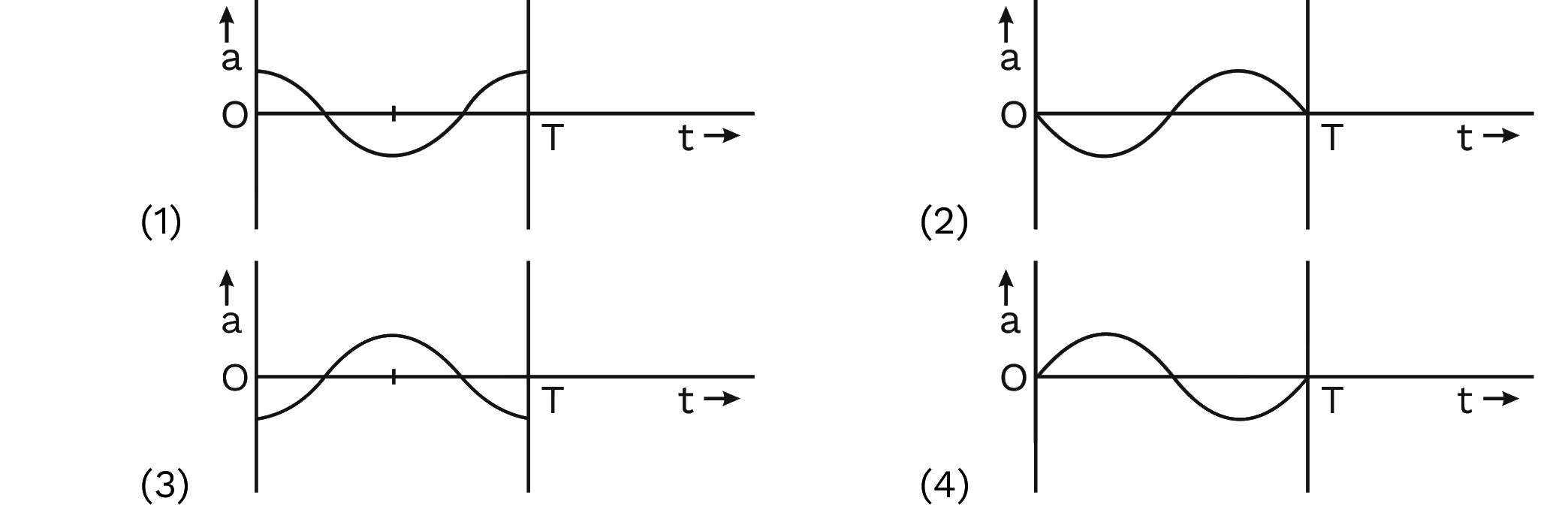
- a starts at zero, rises to a maximum at T/4 and returns to zero at T/2
- a starts at its maximum positive value and falls sinusoidally
- a starts at its maximum negative value, becomes maximum positive at T/2 and negative again at T
- a stays constant throughout the motion
Show answer
Answer: (C) a starts at its maximum negative value, becomes maximum positive at T/2 and negative again at T
Explanation: a = −ω²A cos ωt. At t = 0 the acceleration is −ω²A (most negative), at t = T/2 it is +ω²A and at t = T it is again −ω²A, i.e. an inverted cosine curve.
Question 7
Previous-year questionOut of the following functions representing motion of a particle, which represents SHM? (i) y = sin ωt − cos ωt, (ii) y = sin³ωt, (iii) y = 5 cos(3π/4 − 3ωt), (iv) y = 1 + ωt + ω²t². [AIPMT Pre., 2011]
- Only (i) and (ii)
- Only (i)
- Only (iv) does not represent SHM
- Only (i) and (iii)
Show answer
Answer: (D) Only (i) and (iii)
Explanation: (i) sin ωt − cos ωt = √2 sin(ωt − π/4) — a single sinusoid, hence SHM. (iii) is a single cosine function, hence SHM. (ii) sin³ωt = (3 sin ωt − sin 3ωt)/4 is a superposition of two frequencies — periodic but not simple harmonic. (iv) is non-periodic. So only (i) and (iii) represent SHM.
Doing well? Create a free account to take timed tests on this topic and see your weak areas.
Question 8
Previous-year questionA pendulum is hung from the roof of a sufficiently high building and is moving freely to and fro like a simple harmonic oscillator. The acceleration of the bob of the pendulum is 20 m/s² at a distance of 5 m from the mean position. The time period of oscillation is: [NEET 2018]
- 2 s
- π s
- 2π s
- 1 s
Show answer
Answer: (B) π s
Explanation: a = ω²x ⇒ 20 = ω² × 5 ⇒ ω² = 4 ⇒ ω = 2 rad/s. T = 2π/ω = π s.
Question 9
Previous-year questionA particle executes linear simple harmonic motion with an amplitude of 3 cm. When the particle is at 2 cm from the mean position, the magnitude of its velocity is equal to that of its acceleration. Its time period in seconds is: [NEET 2017]
- √5/2π
- 4π/√5
- 2π/√3
- √5/π
Show answer
Answer: (B) 4π/√5
Explanation: |v| = |a| ⇒ ω√(A² – x²) = ω²x ⇒ √(9 – 4) = 2ω ⇒ √5 = 2ω ⇒ ω = √5/2. T = 2π/ω = 4π/√5.
Question 10
Previous-year questionA particle is executing a simple harmonic motion. Its maximum acceleration is α and maximum velocity is β. Its time period of vibration will be: [AIPMT 2015]
- 2πβ/α
- β²/α²
- α/β
- β²/α
Show answer
Answer: (A) 2πβ/α
Explanation: α = Aω² and β = Aω, so ω = α/β and T = 2π/ω = 2πβ/α.
Question 11
Previous-year questionWhen two displacements represented by y₁ = a sin(ωt) and y₂ = b cos(ωt) are superimposed, the motion is: [AIPMT 2015]
- Simple harmonic with amplitude a/b
- Simple harmonic with amplitude √(a² + b²)
- Simple harmonic with amplitude (a + b)/2
- Not a simple harmonic
Show answer
Answer: (B) Simple harmonic with amplitude √(a² + b²)
Explanation: a sinωt + b cosωt = √(a² + b²) sin(ωt + φ), which is SHM of amplitude √(a² + b²).
Question 12
Previous-year questionA particle is executing SHM along a straight line. If velocities at distances x₁ and x₂ from the mean position are v₁ and v₂ respectively, its time period is: [AIPMT 2015]
- 2π√((v₁² + v₂²)/(x₁² + x₂²))
- 2π√((v₁² – v₂²)/(x₁² – x₂²))
- 2π√((x₁² + x₂²)/(v₁² + v₂²))
- 2π√((x₂² – x₁²)/(v₁² – v₂²))
Show answer
Answer: (D) 2π√((x₂² – x₁²)/(v₁² – v₂²))
Explanation: v₁² = ω²(A² – x₁²) and v₂² = ω²(A² – x₂²). Subtracting, v₁² – v₂² = ω²(x₂² – x₁²), so ω = √[(v₁² – v₂²)/(x₂² – x₁²)] and T = 2π√[(x₂² – x₁²)/(v₁² – v₂²)].
Question 13
Previous-year questionOut of the following functions, which represents SHM: (i) y = sinωt – cosωt, (ii) y = sin³ωt, (iii) y = 5cos(3π/4 – 3ωt), (iv) y = 1 + ωt + ω²t² [AIPMT 2011]
- Only (i)
- Only (iv) does not represent SHM
- Only (i) and (iii)
- Only (i) and (ii)
Show answer
Answer: (C) Only (i) and (iii)
Explanation: (i) sinωt – cosωt = √2 sin(ωt – π/4) is SHM; (iii) is a cosine, hence SHM. (ii) sin³ωt is periodic but not SHM; (iv) is not even periodic. So only (i) and (iii) represent SHM.
Question 14
Previous-year questionThe displacement of a particle along the X-axis is given by x = a sin²ωt. The motion of the particle corresponds to: [AIPMT 2010]
- SHM of frequency ω/2π
- SHM of frequency ω/π
- SHM of frequency 3ω/2π
- Non-simple harmonic motion
Show answer
Answer: (B) SHM of frequency ω/π
Explanation: x = a sin²ωt = (a/2)(1 – cos2ωt). The oscillating part has angular frequency 2ω, so the frequency is 2ω/2π = ω/π. (It is SHM about the mean value a/2.)
Question 15
Previous-year questionWhich one of the following equations of motion represents simple harmonic motion? (k, k₀, k₁ and a are all positive) [AIPMT 2009]
- Acceleration = kx
- Acceleration = –k₀x + k₁x²
- Acceleration = –k(x + a)
- Acceleration = k(x + a)
Show answer
Answer: (C) Acceleration = –k(x + a)
Explanation: SHM requires acceleration proportional to and directed opposite the displacement from a fixed point. Acceleration = –k(x + a) is linear and restoring about x = –a, so it represents SHM.
Want more Oscillations – Simple Harmonic Motion questions?
E-GYAN NIDHI has 285 questions on this topic and 63,000+ in total, all free: timed CBT tests, NEET marking and instant analysis.
Register free Free Sunday Mock Test