Kepler's Law of planetary motion: NEET MCQs with Answers
15 free questions on Kepler's Law of planetary motion for NEET (UG), starting with previous-year NEET and AIPMT questions. Try each one, then tap Show answer for the answer and a short explanation.
Question 1
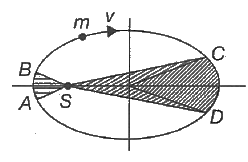
Previous-year questionThe figure shows elliptical orbit of a planet m about the sun S. The shaded area SCD is twice the shaded area SAB. If t₁ is the time for the planet to move from C to D and t₂ is the time to move from A to B, then: [AIPMT, 2009]
- t₁ = t₂
- t₁ > t₂
- t₁ = 4t₂
- t₁ = 2t₂
Show answer
Answer: (D) t₁ = 2t₂
Explanation: By Kepler’s second law areal velocity is constant, so time ∝ area swept. Area SCD = 2 × area SAB ⇒ t₁ = 2t₂.
Question 2
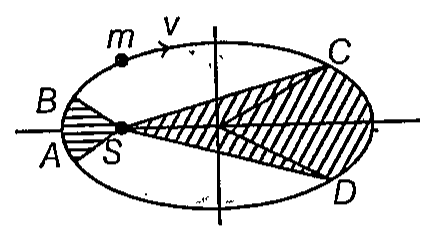
Previous-year questionThe figure shows the elliptical orbit of a planet m about the Sun S. The shaded area SCD is twice the shaded area SAB. If t₁ is the time taken by the planet to move from C to D and t₂ is the time to move from A to B, then [AIPMT 2009]
- t₁ > t₂
- t₁ = 4t₂
- t₁ = 2t₂
- t₁ = t₂
Show answer
Answer: (C) t₁ = 2t₂
Explanation: By Kepler's second law the areal velocity dA/dt is constant, so the area swept is directly proportional to the time taken: A₁/t₁ = A₂/t₂. Given A₁ = 2A₂ (area SCD is twice area SAB): t₁ = (A₁/A₂)t₂ = 2t₂.
Question 3
Previous-year questionKepler's second law (law of areas) implies that planetary orbital speed: [NEET 2023]
- Remains constant throughout the orbit
- Is maximum at perihelion (closest to Sun)
- Is maximum at aphelion (farthest from Sun)
- Decreases linearly with time
Show answer
Answer: (B) Is maximum at perihelion (closest to Sun)
Explanation: The law of areas states that the radius vector from the Sun sweeps equal areas in equal times. This requires planets to move faster when closer to the Sun (perihelion) and slower when farther (aphelion). This is consistent with conservation of angular momentum: L = mrv = constant.
Question 4
Previous-year questionAccording to Kepler's first law of planetary motion: [NEET 2024]
- The square of orbital period is proportional to the cube of semi-major axis
- A line joining a planet to the Sun sweeps equal areas in equal times
- All planets move in circular orbits around the Sun
- All planets move in elliptical orbits with the Sun at one focus
Show answer
Answer: (D) All planets move in elliptical orbits with the Sun at one focus
Explanation: Kepler's first law states that planetary orbits are ellipses with the Sun at one of the two foci. This explains why planetary orbits are not perfect circles and why distances from the Sun vary (perihelion and aphelion).
Question 5
Previous-year questionKepler's third law: T² ∝: [NEET 2024]
- r
- r²
- r³
- r⁴
Show answer
Answer: (C) r³
Explanation: T² = (4π²/GM)r³. So T² ∝ r³ or T ∝ r^1.5. Fundamental relation for orbital motion and satellite periods.
Question 6
Previous-year questionKepler's second law (Law of Areas) implies: [NEET 2024]
- Planetary speed is constant
- Speed increases near the Sun
- All planets move at same speed
- Speed depends on planet's mass
Show answer
Answer: (B) Speed increases near the Sun
Explanation: Equal areas in equal times requires higher speed at perihelion, lower at aphelion. Follows from angular momentum conservation: L = mrv = const.
Question 7
Previous-year questionKepler's first law states: [NEET 2023]
- Planets in circular orbits
- Planets in elliptical orbits, Sun at one focus
- Planets move with constant speed
- Speed proportional to orbital radius
Show answer
Answer: (B) Planets in elliptical orbits, Sun at one focus
Explanation: Overturned circular-orbit assumption. Explains seasonal distance variations (perihelion, aphelion). Fundamental to orbital mechanics.
Doing well? Create a free account to take timed tests on this topic and see your weak areas.
Question 8
Previous-year questionThe largest and the shortest distances of the Earth from the Sun are r₁ and r₂. Its distance from the Sun, when it is at the position perpendicular to the major axis of the orbit drawn from the Sun, is [AIPMT 1988]
- (r₁ + r₂)/4
- (r₁ + r₂)/(r₁ − r₂)
- 2r₁r₂/(r₁ + r₂)
- (r₁ + r₂)/3
Show answer
Answer: (C) 2r₁r₂/(r₁ + r₂)
Explanation: The required distance is the semi-latus rectum of the ellipse, which is the harmonic mean of the maximum and minimum distances. From the property of an ellipse: 2/R = 1/r₁ + 1/r₂ = (r₁ + r₂)/(r₁r₂) ⟹ R = 2r₁r₂/(r₁ + r₂).
Question 9
Previous-year questionThe distances of Neptune and Saturn from the Sun are nearly 10¹³ m and 10¹² m respectively. Assuming that they move in circular orbits, their periodic times will be in the ratio of [AIPMT 1994]
- 10
- 100
- 10√10
- 1000
Show answer
Answer: (C) 10√10
Explanation: By Kepler's third law, T² ∝ R³, so T ∝ R^(3/2). T_N/T_S = (R_N/R_S)^(3/2) = (10¹³/10¹²)^(3/2) = 10^(3/2) = 10 × 10^(1/2) = 10√10.
Question 10
Previous-year questionThe orbital speed of Jupiter is [AIPMT 1995]
- greater than the orbital speed of Earth
- less than the orbital speed of Earth
- equal to the orbital speed of Earth
- zero
Show answer
Answer: (B) less than the orbital speed of Earth
Explanation: For a planet in a circular orbit of radius r about the Sun, v = √(GM_sun/r), so v ∝ 1/√r. Jupiter's orbital radius is much larger than that of the Earth, so its orbital speed is smaller than the Earth's.
Question 11
Previous-year questionThe period of revolution of planet A around the Sun is 8 times that of planet B. The distance of A from the Sun is how many times greater than that of B from the Sun? [AIPMT 1997]
- 5
- 4
- 3
- 2
Show answer
Answer: (B) 4
Explanation: By Kepler's third law, T² ∝ r³, so r ∝ T^(2/3). r_A/r_B = (T_A/T_B)^(2/3) = (8)^(2/3) = (2³)^(2/3) = 2² = 4. Hence planet A is four times as far from the Sun as planet B.
Question 12
Previous-year questionA planet moves around the Sun. At a given point P it is closest to the Sun, at a distance d₁, and has a speed v₁. At another point Q, when it is farthest from the Sun at a distance d₂, its speed will be [AIPMT 2002]
- d₁²v₁/d₂²
- d₂v₁/d₁
- d₁v₁/d₂
- d₂²v₁/d₁²
Show answer
Answer: (C) d₁v₁/d₂
Explanation: Angular momentum about the Sun is conserved, because the gravitational force is central: mv₁d₁ = mv₂d₂ ⟹ v₂ = v₁d₁/d₂. Since d₂ > d₁, the speed at the farther point is smaller, as expected.
Question 13
Previous-year questionA planet moving along an elliptical orbit is closest to the Sun at a distance r₁ and farthest away at a distance r₂. If v₁ and v₂ are its linear velocities at these two points respectively, then the ratio v₁/v₂ is [AIPMT 2011]
- r₂/r₁
- (r₂/r₁)²
- r₁/r₂
- (r₁/r₂)²
Show answer
Answer: (A) r₂/r₁
Explanation: The gravitational pull is always along the line joining the planet to the Sun, so it exerts no torque about the Sun and the angular momentum is conserved. mv₁r₁ = mv₂r₂ ⟹ v₁/v₂ = r₂/r₁. The planet moves faster where it is nearer the Sun.
Question 14
Previous-year questionA geostationary satellite orbits the Earth at a height of 5R above the Earth's surface, R being the radius of the Earth. The time period, in hours, of another satellite at a height of 2R from the Earth's surface is [AIPMT 2012]
- 5
- 10
- 6√2
- 6/√2
Show answer
Answer: (C) 6√2
Explanation: Orbital radii measured from the centre: r₁ = 5R + R = 6R and r₂ = 2R + R = 3R. By Kepler's third law, T² ∝ r³ : T₂²/T₁² = (3R)³/(6R)³ = 1/8 T₂ = T₁/(2√2) = 24/(2√2) = 12/√2 = 6√2 h.
Question 15
Previous-year questionA geo-stationary satellite has a time period of 24 h at a height of 6R_E above the Earth's surface, where R_E is the radius of the Earth. The time period of another satellite orbiting at a height of 2.5R_E from the surface will be [NEET (Odisha) 2019]
- 6√2 h
- 12√2 h
- 24/2.5 h
- 12/2.5 h
Show answer
Answer: (A) 6√2 h
Explanation: By Kepler's third law, T ∝ r^(3/2), where r is measured from the centre of the Earth. r₁ = 6R_E + R_E = 7R_E and r₂ = 2.5R_E + R_E = 3.5R_E T₁/T₂ = (r₁/r₂)^(3/2) = (7/3.5)^(3/2) = 2^(3/2) = 2√2 T₂ = 24/(2√2) = 12/√2 = 6√2 h.
Want more Kepler's Law of planetary motion questions?
E-GYAN NIDHI has 51 questions on this topic and 63,000+ in total, all free: timed CBT tests, NEET marking and instant analysis.
Register free Free Sunday Mock Test