Acceleration Due to Gravity and its Variations with altitude and depth.: NEET MCQs with Answers
15 free questions on Acceleration Due to Gravity and its Variations with altitude and depth. for NEET (UG), starting with previous-year NEET and AIPMT questions. Try each one, then tap Show answer for the answer and a short explanation.
Question 1
Previous-year questionWhich one of the following plots represents the variation of gravitational field on a particle with distance r due to a thin spherical shell of radius R? (r is measured from the centre of the spherical shell.) [AIPMT Mains, 2012]
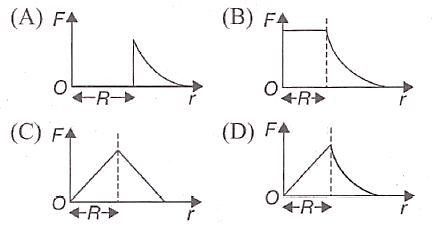
- (A)
- (B)
- (C)
- (D)
Show answer
Answer: (A) (A)
Explanation: For a thin shell the field is zero everywhere inside (r < R), jumps to its maximum GM/R² at the surface and then falls as 1/r² outside — the plot that is zero up to R and then decreases.
Question 2
Previous-year questionThe dependence of acceleration due to gravity g on the distance r from the centre of the earth, assumed to be a sphere of radius R of uniform density is as shown in figures (i) to (iv). The correct figure is: [AIPMT Main, 2010]
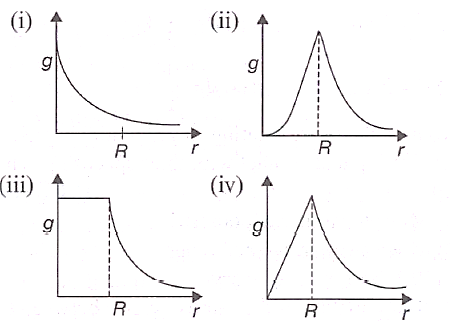
- (i)
- (ii)
- (iii)
- (iv)
Show answer
Answer: (D) (iv)
Explanation: Inside a uniform sphere g ∝ r (straight line from origin up to R); outside g ∝ 1/r² (falling curve). Figure (iv) shows exactly this linear rise followed by inverse-square fall.
Question 3
Previous-year questionA body weighs W at Earth's surface. If taken to a height equal to half the Earth's radius, its weight will be: [NEET 2023]
- W/2
- 4W/9
- 9W/4
- W/4
Show answer
Answer: (B) 4W/9
Explanation: At height h = R/2, g_h = GM/(3R/2)² = (4/9)·GM/R² = (4/9)g. Therefore, W_h = (4/9)W. The weight decreases to 4/9 of its original value, demonstrating how gravity weakens with altitude according to the inverse-square law.
Question 4
Previous-year questionDue to Earth's rotation, the effective acceleration due to gravity is less at the equator than at the poles because: [NEET 2024]
- Earth's radius is larger at the equator
- The centrifugal acceleration acts radially outward at the equator
- Earth's mass is concentrated at the poles
- The gravitational force is weaker at the equator
Show answer
Answer: (B) The centrifugal acceleration acts radially outward at the equator
Explanation: At the equator, g_eff = g - ω²R, where ω is Earth's angular velocity. The centrifugal effect reduces the effective weight. At the poles, this term is zero. Additionally, Earth's oblate shape means the radius is 21 km larger at the equator, which further reduces g by the inverse-square law.
Question 5
Previous-year questionThe acceleration due to gravity at Earth's surface is approximately 9.8 m/s². At a height equal to Earth's radius above the surface, the acceleration due to gravity will be approximately: [NEET 2024]
- 4.9 m/s²
- 2.45 m/s²
- 9.8 m/s²
- 19.6 m/s²
Show answer
Answer: (B) 2.45 m/s²
Explanation: At height h = R (Earth's radius), g_h = GM/(R+h)² = GM/(2R)² = (1/4)·(GM/R²) = g/4 = 9.8/4 = 2.45 m/s². This shows how quickly gravitational acceleration decreases with altitude, following the inverse-square law.
Question 6
Previous-year questionAt height equal to Earth radius, weight becomes: [NEET 2023]
- Same
- Half
- 1/4
- 1/9
Show answer
Answer: (C) 1/4
Explanation: At h = R: total distance 2R, so g_h = GM/(2R)² = g/4. Weight W = mg/4.
Question 7
Previous-year questionAt height h = R above Earth's surface, acceleration g becomes: [NEET 2024]
- g/2
- g/3
- g/4
- g/9
Show answer
Answer: (C) g/4
Explanation: At h = R, total distance = 2R. Therefore g_h = GM/(2R)² = (1/4) × GM/R² = g/4. Factor is square of radius ratio.
Doing well? Create a free account to take timed tests on this topic and see your weak areas.
Question 8
Previous-year questionAcceleration due to gravity varies with altitude h as: [NEET 2023]
- g_h = g(R/(R+h))²
- g_h = g(R/(R+h))
- g_h = g - gh/R
- g_h = g/2 at all h
Show answer
Answer: (A) g_h = g(R/(R+h))²
Explanation: g_h = GM/(R+h)² = g[R/(R+h)]². Inverse-square relationship explains rapid weakening with altitude.
Question 9
Previous-year questionAt which location inside uniform Earth is g maximum? [NEET 2024]
- At the center
- At Earth's surface
- At half radius from center
- At 1/4 radius from center
Show answer
Answer: (B) At Earth's surface
Explanation: For uniform density: g_d = g(1 - d/R). Maximum at surface (d=0) where g = GM/R². Decreases linearly to zero at center.
Question 10
Previous-year questionA body weighs 72 N on the surface of the earth. What is the gravitational force on it at a height equal to half the radius of the earth? [NEET 2020]
- 32 N
- 30 N
- 24 N
- 48 N
Show answer
Answer: (A) 32 N
Explanation: At h = R/2 the distance from the centre is 3R/2, so the force is reduced by (2/3)² = 4/9. Hence F = 72 × 4/9 = 32 N.
Question 11
Previous-year questionA body weighs 200 N on the surface of the earth. How much will it weigh half way down to the centre of the earth? [NEET 2019]
- 150 N
- 200 N
- 250 N
- 100 N
Show answer
Answer: (D) 100 N
Explanation: At a depth d = R/2, g′ = g(1 – d/R) = g/2. Hence the weight becomes 200/2 = 100 N.
Question 12
Previous-year questionThe acceleration due to gravity at a height of 1 km above the earth is the same as that at a depth d below the surface of the earth. Then [NEET 2017]
- d = 1 km
- d = 3/2 km
- d = 2 km
- d = ½ km
Show answer
Answer: (C) d = 2 km
Explanation: g(1 – 2h/R) = g(1 – d/R) gives d = 2h = 2 km.
Question 13
Previous-year questionThe radius of the Earth is about 6400 km and that of Mars is about 3200 km. The mass of the Earth is about 10 times the mass of Mars. An object weighs 200 N on the surface of the Earth. Its weight on the surface of Mars will be [AIPMT 1994]
- 20 N
- 8 N
- 80 N
- 40 N
Show answer
Answer: (C) 80 N
Explanation: w ∝ g = GM/R², so w_m/w_e = (M_m/M_e)(R_e/R_m)² = (1/10)(6400/3200)² = (1/10)(4) = 2/5. w_m = 200 × 0.4 = 80 N.
Question 14
Previous-year questionThe acceleration due to gravity g and the mean density of the Earth ρ are related by which of the following relations? (Here G is the gravitational constant and R is the radius of the Earth.) [AIPMT 1995]
- ρ = 3g/(4πGR)
- ρ = 3g/(4πGR³)
- ρ = 4πgR²/(3G)
- ρ = 4πgR³/(3G)
Show answer
Answer: (A) ρ = 3g/(4πGR)
Explanation: g = GM/R², and M = volume × density = (4/3)πR³ρ. g = G(4/3)πR³ρ/R² = (4/3)πGRρ Rearranging for ρ : ρ = 3g/(4πGR).
Question 15
Previous-year questionAssuming the Earth to be a sphere of uniform density, what is the value of g in a mine 100 km below the Earth's surface? (Given, R = 6400 km) [AIPMT 2001]
- 9.65 m/s²
- 7.65 m/s²
- 5.06 m/s²
- 3.10 m/s²
Show answer
Answer: (A) 9.65 m/s²
Explanation: g′ = g(1 − d/R) = 9.8 × (1 − 100/6400) = 9.8 × (1 − 0.015625) = 9.8 × 0.984 ≈ 9.65 m/s².
Want more Acceleration Due to Gravity and its Variations with altitude and depth. questions?
E-GYAN NIDHI has 117 questions on this topic and 63,000+ in total, all free: timed CBT tests, NEET marking and instant analysis.
Register free Free Sunday Mock Test