Genetic engineering – Tools of Recombinant DNA Technology: NEET MCQs with Answers
15 free questions on Genetic engineering – Tools of Recombinant DNA Technology for NEET (UG), starting with previous-year NEET and AIPMT questions. Try each one, then tap Show answer for the answer and a short explanation.
Syllabus covered: Tools of Recombinant DNA Technology
Question 1
Previous-year questionThe figure given below is a diagrammatic representation of the E. coli vector pBR322. Which one of the given options correctly identifies its components? [AIPMT 2012]
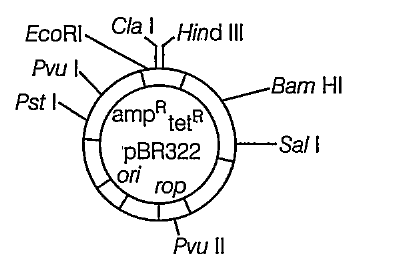
- ori — original restriction enzyme
- rop — reduced osmotic pressure
- Hind III, EcoRI — selectable markers
- ampᴿ, tetᴿ — antibiotic resistance genes
Show answer
Answer: (D) ampᴿ, tetᴿ — antibiotic resistance genes
Explanation: ampᴿ and tetᴿ are the antibiotic resistance genes of pBR322. Ori represents the site of origin of replication, rop codes for the proteins involved in the replication of the plasmid, and Hind III and EcoRI are recognition sites of restriction endonucleases.
Question 2
Previous-year questionThe figure below shows the restriction sites in the E. coli cloning vector pBR322. Find the role of the ‘X’ and ‘Y’ genes. [NEET 2024]
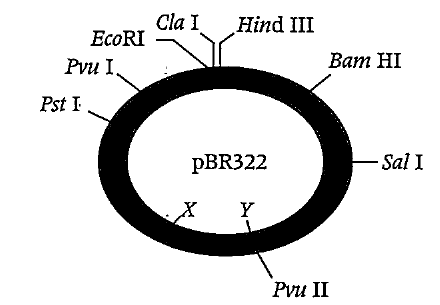
- The gene ‘X’ is responsible for resistance to antibiotics and ‘Y’ for the protein involved in the replication of the plasmid
- The gene ‘X’ is responsible for controlling the copy number of the linked DNA and ‘Y’ for the protein involved in the replication of the plasmid
- The gene ‘X’ is for the protein involved in the replication of the plasmid and ‘Y’ for resistance to antibiotics
- Gene ‘X’ is responsible for recognition sites and ‘Y’ is responsible for antibiotic resistance
Show answer
Answer: (B) The gene ‘X’ is responsible for controlling the copy number of the linked DNA and ‘Y’ for the protein involved in the replication of the plasmid
Explanation: In pBR322, X represents the ‘ori’ region and Y the ‘rop’ region. The ori site is the origin of replication that controls the copy number of the linked DNA, whereas rop codes for the proteins involved in the replication of the plasmid.
Question 3
Previous-year questionThe sequence that controls the copy number of the linked DNA in a vector is termed [NEET 2020]
- Ori site
- Palindromic sequence
- Recognition site
- Selectable marker
Show answer
Answer: (A) Ori site
Explanation: Replication starts at the origin of replication (ori), and this sequence also determines how many copies of the linked DNA are produced within the host cell.
Question 4
Previous-year questionThe specific palindromic sequence recognised by EcoRI is [NEET 2020]
- 5'-GGAACC-3' / 3'-CCTTGG-5'
- 5'-CTTAAG-3' / 3'-GAATTC-5'
- 5'-GGATCC-3' / 3'-CCTAGG-5'
- 5'-GAATTC-3' / 3'-CTTAAG-5'
Show answer
Answer: (D) 5'-GAATTC-3' / 3'-CTTAAG-5'
Explanation: EcoRI recognises GAATTC and cuts between G and A on both strands, producing AATT sticky ends. GGATCC is the recognition site of BamHI.
Question 5
Previous-year questionFollowing statements describe the enzyme restriction endonuclease. Identify the INCORRECT statement. [NEET 2019]
- The enzyme cuts the DNA molecule at an identified position within the DNA.
- The enzyme binds DNA at specific sites and cuts only one of the two strands.
- The enzyme cuts the sugar-phosphate backbone at specific sites on each strand.
- The enzyme recognises a specific palindromic nucleotide sequence in DNA.
Show answer
Answer: (B) The enzyme binds DNA at specific sites and cuts only one of the two strands.
Explanation: A restriction endonuclease cuts both strands of the DNA double helix — a little away from the centre of the palindrome — thereby producing sticky ends; cutting only one strand would merely nick the DNA.
Question 6
Previous-year questionWhich of the following is commonly used as a vector for introducing a DNA fragment into human lymphocytes? [NEET 2018]
- Retrovirus
- Ti plasmid
- pBR322
- λ phage
Show answer
Answer: (A) Retrovirus
Explanation: Disarmed retroviruses integrate their genetic material into the chromosome of animal cells and are therefore used to deliver a normal gene into lymphocytes, as in gene therapy for ADA deficiency.
Question 7
Previous-year questionA gene whose expression helps to identify a transformed cell is known as [NEET 2017]
- Vector
- Plasmid
- Structural gene
- Selectable marker
Show answer
Answer: (D) Selectable marker
Explanation: A selectable marker — typically an antibiotic resistance gene — allows transformants to grow while untransformed cells are killed, so the transformed cells can be identified.
Doing well? Create a free account to take timed tests on this topic and see your weak areas.
Question 8
Previous-year questionWhich of the following is NOT a feature of plasmids? [NEET 2016]
- Independent replication
- Circular structure
- Transferable
- Single-stranded
Show answer
Answer: (D) Single-stranded
Explanation: Plasmids are double-stranded, circular, extrachromosomal DNA molecules that replicate independently of the bacterial chromosome and can be transferred between cells.
Question 9
Previous-year questionWhich of the following is a restriction endonuclease? [NEET 2016]
- Hind II
- Protease
- DNase I
- RNase
Show answer
Answer: (A) Hind II
Explanation: Hind II is the first-discovered restriction endonuclease; DNase I cuts DNA non-specifically, while protease and RNase act on proteins and RNA respectively.
Question 10
Previous-year questionCutting of DNA at specific locations became possible with the discovery of [AIPMT 2015]
- Probes
- Selectable markers
- Ligases
- Restriction enzymes
Show answer
Answer: (D) Restriction enzymes
Explanation: Restriction endonucleases cut DNA only at their specific recognition sequences; their discovery made precise, reproducible cutting — and hence recombinant DNA technology — possible.
Question 11
Previous-year questionThe DNA molecule into which the gene of interest is integrated for cloning is called a [AIPMT 2015]
- Vector
- Template
- Carrier
- Transformer
Show answer
Answer: (A) Vector
Explanation: A vector (plasmid, bacteriophage, BAC, YAC, Ti plasmid) carries the alien DNA into the host cell and, having its own ori, multiplies it there.
Question 12
Previous-year questionWhich vector can clone only a small fragment of DNA? [AIPMT 2014]
- Bacterial artificial chromosome
- Yeast artificial chromosome
- Plasmid
- Cosmid
Show answer
Answer: (C) Plasmid
Explanation: Plasmids have a limited insert capacity of a few kilobases, whereas BACs, YACs and cosmids were developed precisely to clone much larger DNA fragments.
Question 13
Previous-year questionCommonly used vectors for human genome sequencing are [AIPMT 2014]
- T-DNA
- BAC and YAC
- Expression vectors
- kT/A cloning vectors
Show answer
Answer: (B) BAC and YAC
Explanation: Bacterial artificial chromosomes and yeast artificial chromosomes accept very large DNA inserts, so they were the vectors of choice for constructing the genomic libraries used in the Human Genome Project.
Question 14
Previous-year questionThe restriction enzymes are used in genetic engineering because [AIPMT 1995]
- they can cut DNA at a specific base sequence
- they are nucleases that cut DNA at variable sites
- they can degrade harmful proteins
- they can join different DNA fragments
Show answer
Answer: (A) they can cut DNA at a specific base sequence
Explanation: DNA restriction endonucleases cut double-stranded DNA molecules only at sites characterised by a specific nucleotide sequence, which allows precise and reproducible manipulation of DNA.
Question 15
Previous-year questionRestriction endonucleases are [AIPMT 1998]
- used for in vitro DNA synthesis
- used in genetic engineering
- synthesised by bacteria
- present in mammalian cells for degradation of DNA
Show answer
Answer: (C) synthesised by bacteria
Explanation: Restriction endonucleases are primarily found in bacteria and archaea and are synthesised by them. They function as part of the immune system of these organisms, defending against invading viral DNA.
Want more Genetic engineering – Tools of Recombinant DNA Technology questions?
E-GYAN NIDHI has 284 questions on this topic and 63,000+ in total, all free: timed CBT tests, NEET marking and instant analysis.
Register free Free Sunday Mock TestMore topics in Biotechnology and Its Application
- Biotechnological Applications in Agriculture – Genetically modified organisms-Bt crops MCQs
- Biotechnological Applications in Health and Medicine – Human insulin and vaccine production MCQs
- Transgenic Animals and Ethical Issues MCQs
- Biosafety issues- Biopiracy and patents MCQs
- Principles of Biotechnology MCQs
- Processes of Recombinant DNA Technology MCQs