First Law of Thermodynamics – The first law of thermodynamics: NEET MCQs with Answers
15 free questions on First Law of Thermodynamics – The first law of thermodynamics for NEET (UG), starting with previous-year NEET and AIPMT questions. Try each one, then tap Show answer for the answer and a short explanation.
Syllabus covered: The first law of thermodynamics - Concept of work, heat internal energy and enthalpy, heat capacity, molar heat capacity;
Question 1
Previous-year questionWhat is the work done when 1 mole of a gas expands reversibly and isothermally from a pressure of 5 atm to 1 atm at 300 K? (Given log 5 = 0.6989 and R = 8.314 J K⁻¹ mol⁻¹) [NEET 2022 (Overseas)]
- 150 J
- +4014.6 J
- −4014.6 J
- zero J
Show answer
Answer: (C) −4014.6 J
Explanation: For reversible isothermal expansion, w = −2.303 nRT log(p₁/p₂). w = −2.303 × 1 × 8.314 × 300 × log 5 = −5744.1 × 0.6989 ≈ −4014.6 J. The sign is negative because work is done by the gas during expansion.
Question 2
Previous-year questionThe P–V plots for two gases undergoing adiabatic processes are shown in the figure given below. Plots A and B should correspond, respectively, to: [NEET 2021 (Paper-2)]
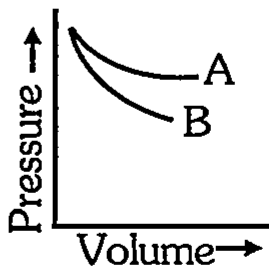
- He and O₂
- He and Ar
- O₂ and He
- O₂ and F₂
Show answer
Answer: (C) O₂ and He
Explanation: For an adiabatic process PV^γ = constant, so the slope of the P–V curve is proportional to γ. Curve B is steeper, so it has the larger γ (monoatomic He, γ = 1.67), while the flatter curve A has the smaller γ (diatomic O₂, γ = 1.4). Hence A = O₂ and B = He.
Question 3
Previous-year questionFor one mole of an ideal gas, which option gives the correct relation between Cp and Cv? [NEET 2021]
- Cp + Cv = R
- Cp − Cv = R
- Cp = RCv
- Cv = RCp
Show answer
Answer: (B) Cp − Cv = R
Explanation: For one mole of an ideal gas, H = U + RT, so dH/dT − dU/dT = R, i.e. Cp − Cv = R (Mayer's relation). Cp is always greater than Cv by R, so the other relations are incorrect.
Question 4
Previous-year questionThe correct option for free expansion of an ideal gas under adiabatic condition is [NEET 2020]
- q = 0, ΔT 0
- q < 0, ΔT = 0 and w = 0
- q > 0, ΔT > 0 and w > 0
- q = 0, ΔT = 0 and w = 0
Show answer
Answer: (D) q = 0, ΔT = 0 and w = 0
Explanation: Adiabatic gives q = 0, and free expansion against zero external pressure gives w = 0. Hence ΔU = 0, and for an ideal gas this means the temperature is unchanged, ΔT = 0.
Question 5
Previous-year questionUnder isothermal conditions, a gas at 300 K expands from 0.1 L to 0.25 L against a constant external pressure of 2 bar. The work done by the gas is [Given that 1 L bar = 100 J] [NEET 2019]
- −30 J
- 5 kJ
- 25 J
- 30 J
Show answer
Answer: (A) −30 J
Explanation: w = −Pₑₓₜ ΔV = −2 bar × (0.25 − 0.10) L = −0.30 L bar = −30 J. The negative sign shows the work is done by the gas.
Question 6
Previous-year questionA gas is allowed to expand in a well insulated container against a constant external pressure of 2.5 atm from an initial volume of 2.50 L to a final volume of 4.50 L. The change in internal energy ΔU of the gas in joules will be [NEET 2017]
- −500 J
- −505 J
- +505 J
- 1136.25 J
Show answer
Answer: (B) −505 J
Explanation: A well insulated container means q = 0, so ΔU = w = −Pₑₓₜ ΔV = −2.5 × 2.0 = −5.0 L atm. Converting, −5.0 × 101.3 = −506.5 ≈ −505 J.
Question 7
Previous-year questionA gas expands in a well-insulated container against a constant external pressure of 2.5 atm from 2.50 L to 4.50 L. The change in internal energy ΔE of the gas in joules is: [NEET 2017]
- –500 J
- –505 J
- +505 J
- 1136.25 J
Show answer
Answer: (B) –505 J
Explanation: Well insulated → adiabatic, q = 0. w = –P_extΔV = –2.5 × (4.50 – 2.50) = –5 L·atm = –5 × 101.3 ≈ –505 J. ΔE = q + w = –505 J.
Doing well? Create a free account to take timed tests on this topic and see your weak areas.
Question 8
Previous-year questionStandard enthalpy of vaporization Δ_vapH for water at 100°C is 40.66 kJ mol⁻¹. The internal energy of vaporization of water at 100°C (in kJ mol⁻¹) is: [AIPMT Pre. 2012]
- +43.76
- +40.66
- +37.56
- –43.76
Show answer
Answer: (C) +37.56
Explanation: ΔE = ΔH – Δn_gRT = 40.66 – (1)(8.314 × 10⁻³)(373) = 40.66 – 3.10 = 37.56 kJ mol⁻¹.
Question 9
Previous-year questionWhich of the following is the correct option for free expansion of an ideal gas under adiabatic conditions? [AIPMT Pre. 2011]
- q = 0, ΔT ≠ 0, w = 0
- q ≠ 0, ΔT = 0, w = 0
- q = 0, ΔT = 0, w = 0
- q = 0, ΔT < 0, w ≠ 0
Show answer
Answer: (C) q = 0, ΔT = 0, w = 0
Explanation: Free expansion: w = 0 (P_ext = 0); adiabatic: q = 0. So ΔE = 0, and for an ideal gas ΔT = 0.
Question 10
Previous-year questionThree moles of an ideal gas expanded spontaneously into vacuum. The work done will be: [AIPMT 2010]
- 3 Joule
- 9 Joule
- Zero
- Infinite
Show answer
Answer: (C) Zero
Explanation: Free expansion into vacuum has external pressure zero, so w = –P_extΔV = 0.
Question 11
An ideal gas at constant temperature expands from 1 L at 8 bar to 8 L at 1 bar. In path A it expands in one stage against a constant 1 bar. In path B it first expands to 4 L against a constant 2 bar, then to 8 L against a constant 1 bar. What are the magnitudes of the work done by the gas in A and B?
- A = 16.6 L bar and B = 10 L bar
- A = 7 L bar and B = 10 L bar
- A = 7 L bar and B = 7 L bar
- A = 10 L bar and B = 7 L bar
Show answer
Answer: (B) A = 7 L bar and B = 10 L bar
Explanation: For path A, work = 1 bar × 7 L = 7 L bar. For path B, the first stage gives 2 × 3 = 6 L bar and the second gives 1 × 4 = 4 L bar, a total of 10 L bar. Work depends on the path, and it rises as the external pressure is kept closer to the gas pressure. The reversible limit is the maximum, 8 ln 8 ≈ 16.6 L bar.
Question 12
A sample of an ideal gas is taken through several steps and returned exactly to its initial state. Over the whole cycle it absorbs 500 J of heat in some steps and gives out 300 J of heat in others. Which set of values is correct for the complete cycle?
- ΔU = +200 J, ΔH = +200 J, and no net work is done
- ΔU = 0, ΔH = +200 J, and the gas does 800 J of net work on the surroundings
- ΔU = 0, ΔH = 0, and the surroundings do 200 J of net work on the gas
- ΔU = 0, ΔH = 0, and the gas does 200 J of net work on the surroundings
Show answer
Answer: (D) ΔU = 0, ΔH = 0, and the gas does 200 J of net work on the surroundings
Explanation: Internal energy and enthalpy are state functions, so both changes are zero when the system returns to its initial state. Net heat absorbed is q = 500 − 300 = +200 J. From ΔU = q + w = 0, w = −200 J, which means the gas does 200 J of net work on the surroundings. Heat and work are path functions, so they need not be zero over a cycle.
Question 13
2.0 mol of MgCO₃(s) decomposes completely to MgO(s) and CO₂(g) at 300 K and a constant pressure of 1 bar, absorbing 200 kJ of heat. Treat CO₂ as an ideal gas and neglect the volumes of the solids. What are the work done on the system and the change in internal energy? (R = 8.3 J K⁻¹ mol⁻¹)
- w = −5.0 kJ and ΔU = +195 kJ
- w = +5.0 kJ and ΔU = +205 kJ
- w = −2.5 kJ and ΔU = +197.5 kJ
- w = 0 and ΔU = +200 kJ
Show answer
Answer: (A) w = −5.0 kJ and ΔU = +195 kJ
Explanation: Two moles of gas are formed, so the system expands against the surroundings and w = −Δn_g RT = −2 × 8.3 × 300 J = −4980 J, about −5.0 kJ. At constant pressure the heat absorbed equals ΔH, which is +200 kJ. Then ΔU = q + w = 200 − 5.0 = +195 kJ.
Question 14
One mole of ice melts at 0 °C and 1 bar with ΔH = +6.01 kJ mol⁻¹, and the molar volume falls by 1.6 cm³ on melting. What is the value of ΔU − ΔH for this change? (1 bar = 10⁵ Pa)
- −2.27 kJ
- −0.16 J
- +0.16 J
- +2.27 kJ
Show answer
Answer: (C) +0.16 J
Explanation: At constant pressure, ΔH = ΔU + pΔV, so ΔU − ΔH = −pΔV. Here pΔV = (10⁵ Pa)(−1.6 × 10⁻⁶ m³) = −0.16 J, which gives ΔU − ΔH = +0.16 J. This is negligible compared with 6.01 kJ, which is why ΔH and ΔU are taken as nearly equal for changes involving only solids and liquids.
Question 15
A sample of 4.0 mol of an ideal gas has a total heat capacity of 116.4 J K⁻¹ at constant pressure. What is the total heat capacity of this sample at constant volume? (R = 8.314 J K⁻¹ mol⁻¹)
- 149.7 J K⁻¹
- 83.1 J K⁻¹
- 29.1 J K⁻¹
- 108.1 J K⁻¹
Show answer
Answer: (B) 83.1 J K⁻¹
Explanation: The relation Cp − Cv = R applies to molar heat capacities, so for n moles the difference between total heat capacities is nR. Here nR = 4.0 × 8.314 = 33.3 J K⁻¹. The heat capacity at constant volume is therefore 116.4 − 33.3 = 83.1 J K⁻¹.
Want more First Law of Thermodynamics – The first law of thermodynamics questions?
E-GYAN NIDHI has 199 questions on this topic and 63,000+ in total, all free: timed CBT tests, NEET marking and instant analysis.
Register free Free Sunday Mock Test