Diazonium Salts & Other Nitrogen Containing Compounds Diazonium Salts – Importance in synthetic organic chemistry: NEET MCQs with Answers
11 free questions on Diazonium Salts & Other Nitrogen Containing Compounds Diazonium Salts – Importance in synthetic organic chemistry for NEET (UG), starting with previous-year NEET and AIPMT questions. Try each one, then tap Show answer for the answer and a short explanation.
Syllabus covered: Importance in synthetic organic chemistry.
Question 1
Previous-year questionIn the reaction of benzenediazonium chloride with aniline in the presence of H⁺, the yellow dye (A) formed is [AIPMT 2014]
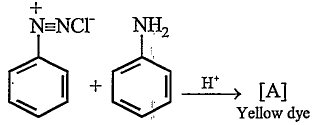
- 1,3-Diphenyltriazene, C₆H₅–N=N–NH–C₆H₅
- 2-Aminoazobenzene
- 3-Aminoazobenzene
- 4-Aminoazobenzene
Show answer
Answer: (D) 4-Aminoazobenzene
Explanation: The diazonium ion attacks the highly activated ring of aniline at the position para to the –NH₂ group, since that position is both electronically favoured and free from steric crowding, giving p-aminoazobenzene.
Question 2
Previous-year questionWhich of the following will be the most stable diazonium salt, RN₂⁺X⁻? [AIPMT 2014]
- CH₃N₂⁺X⁻
- C₆H₅N₂⁺X⁻
- CH₃CH₂N₂⁺X⁻
- C₆H₅CH₂N₂⁺X⁻
Show answer
Answer: (B) C₆H₅N₂⁺X⁻
Explanation: Only in the aryl diazonium ion is the positive charge delocalised over the benzene ring through resonance. Alkyl and benzyl diazonium ions lack this stabilisation and lose nitrogen immediately even at low temperature.
Question 3
The coupling reaction of arenediazonium salts with phenols or aromatic amines is used mainly in the manufacture of
- explosives
- soaps
- proteins
- azo dyes
Show answer
Answer: (D) azo dyes
Explanation: In coupling, the diazonium ion attacks the activated ring of a phenol or an aromatic amine, usually at the para position, and the two rings become joined by an –N=N– group. This extended conjugated system absorbs visible light, so the azo compounds are strongly coloured. Such compounds make up a large class of synthetic dyes, for example methyl orange.
Question 4
Aniline is shaken with excess bromine water. The product is diazotised with NaNO₂ and dilute HCl at 273–278 K, the diazonium salt is precipitated with fluoroboric acid, and the dry precipitate is heated. The final organic product is
- 1,3,5-tribromobenzene
- 2,4,6-tribromophenol
- 2,4,6-tribromofluorobenzene
- 4-bromofluorobenzene
Show answer
Answer: (C) 2,4,6-tribromofluorobenzene
Explanation: The –NH₂ group activates the ring so strongly that bromine water substitutes all ortho and para positions, giving 2,4,6-tribromoaniline. Diazotisation converts its –NH₂ into –N₂⁺, and fluoroboric acid precipitates the diazonium fluoroborate. Heating this dry salt removes N₂ and BF₃ and leaves fluorine on the ring, so the product is 2,4,6-tribromofluorobenzene.
Question 5
3-Nitroaniline is diazotised with NaNO₂ and HCl at 273–278 K, and the diazonium salt is then treated with reagent R to give nitrobenzene. Which of the following can be R?
- Aqueous KI
- Ethanol
- Warm water
- CuCN and KCN
Show answer
Answer: (B) Ethanol
Explanation: The change needed is replacement of the –N₂⁺ group by a hydrogen atom. Mild reducing agents such as ethanol or hypophosphorous acid do this; ethanol is itself oxidised to ethanal and nitrogen is given off. Warm water would give a phenol, CuCN with KCN would introduce –CN, and KI would introduce iodine.
Question 6
Which statement correctly describes the reaction of benzenediazonium chloride with phenol to give p-hydroxyazobenzene?
- Both nitrogen atoms are lost as N₂, and the two aromatic rings join directly through a carbon–carbon bond
- One nitrogen atom is lost, and the phenol couples through its oxygen atom to give a colourless ether
- Both nitrogen atoms are retained, the phenol couples at its meta position, and the azo bond makes the product colourless
- Both nitrogen atoms are retained, the phenol couples at its para position, and the product is coloured because of its extended conjugated system
Show answer
Answer: (D) Both nitrogen atoms are retained, the phenol couples at its para position, and the product is coloured because of its extended conjugated system
Explanation: This is a coupling reaction, which belongs to the reactions in which the diazo group is retained. Phenol couples with the diazonium salt at its para position. The product has two aromatic rings joined through the –N=N– bond, and this extended conjugated system makes such azo compounds coloured, so they are used as dyes.
Question 7
Given below are two statements about replacing the diazonium group of benzenediazonium chloride by chlorine. Statement I: Warming the diazonium salt solution with Cu(I) chloride in the presence of chloride ions is the Sandmeyer reaction. Statement II: Using hydrochloric acid with copper powder is the Gatterman reaction, and it gives a better yield than the Sandmeyer reaction. Choose the correct option.
- Both Statement I and Statement II are true
- Statement I is true but Statement II is false
- Both Statement I and Statement II are false
- Statement I is false but Statement II is true
Show answer
Answer: (B) Statement I is true but Statement II is false
Explanation: Cu(I) halide with the halide ion introduces the halogen in the Sandmeyer reaction, so the first statement is true. The Gatterman reaction does use the halogen acid with copper powder, but its yield is lower than that of the Sandmeyer reaction. The yield claim makes the second statement false.
Doing well? Create a free account to take timed tests on this topic and see your weak areas.
Question 8
A benzenediazonium chloride solution is converted into chlorobenzene by two methods: P, using CuCl with HCl, and Q, using copper powder with HCl. Which statement is correct?
- P is the Sandmeyer reaction, Q is the Gattermann reaction, and P gives the better yield
- P is the Sandmeyer reaction, Q is the Gattermann reaction, and Q gives the better yield
- P is the Gattermann reaction, Q is the Sandmeyer reaction, and Q gives the better yield
- P and Q are both coupling reactions in which the diazo group is retained in the product
Show answer
Answer: (A) P is the Sandmeyer reaction, Q is the Gattermann reaction, and P gives the better yield
Explanation: Replacement of the diazonium group by Cl⁻, Br⁻ or CN⁻ in the presence of Cu(I) ion is the Sandmeyer reaction. Introducing chlorine or bromine with the halogen acid and copper powder is the Gattermann reaction. The Sandmeyer reaction is found to give the better yield. In both methods nitrogen is displaced and escapes as a gas, so neither is a coupling reaction.
Question 9
Which statement correctly compares benzenediazonium chloride with benzenediazonium fluoroborate?
- The chloride is readily soluble in water and decomposes easily when dry, whereas the fluoroborate is water insoluble and stable at room temperature
- The chloride is water insoluble and stable at room temperature, whereas the fluoroborate is readily soluble in water and decomposes easily when dry
- Both are water insoluble, and heating the fluoroborate gives benzene
- Both are readily soluble in water, and both can be stored dry at room temperature
Show answer
Answer: (A) The chloride is readily soluble in water and decomposes easily when dry, whereas the fluoroborate is water insoluble and stable at room temperature
Explanation: Benzenediazonium chloride is a colourless crystalline solid that dissolves readily in water, is stable in the cold and decomposes easily in the dry state. Benzenediazonium fluoroborate is water insoluble and stable at room temperature, so it precipitates when fluoroboric acid is added to the diazonium chloride solution. On heating, the fluoroborate decomposes to give fluorobenzene.
Question 10
Aniline is treated in turn with (i) acetic anhydride and pyridine, (ii) Br₂ in acetic acid, (iii) hot dilute acid, (iv) NaNO₂ and HCl at 273–278 K, and (v) CuBr and HBr. What is the final product, and what is the role of step (i)?
- 4-Bromophenol; step (i) protects the ring against diazotisation so that an –OH group enters in the last step
- 1,3-Dibromobenzene; step (i) turns the nitrogen group into a meta director
- 1,3,5-Tribromobenzene; step (i) increases the activation of the ring so that three bromines enter
- 1,4-Dibromobenzene; step (i) moderates the activating effect so that one bromine enters, mainly at the para position
Show answer
Answer: (D) 1,4-Dibromobenzene; step (i) moderates the activating effect so that one bromine enters, mainly at the para position
Explanation: Free –NH₂ activates the ring so strongly that bromine would give the 2,4,6-tribromo product. In acetanilide the nitrogen lone pair is also delocalised onto the C=O group, so the ring is less activated while the group stays ortho/para directing, and the bulky group favours the para position. Hydrolysis then gives p-bromoaniline, which is diazotised and converted to 1,4-dibromobenzene by the Sandmeyer reaction.
Question 11
2-Chloro-4-methylaniline is treated with NaNO₂/HCl at 273 K, then with H₃PO₂ and water, and finally with hot alkaline KMnO₄ followed by acidification. The final organic product is
- 2-chlorobenzoic acid
- 4-amino-3-chlorobenzoic acid
- 4-chlorobenzoic acid
- 3-chlorobenzoic acid
Show answer
Answer: (D) 3-chlorobenzoic acid
Explanation: Diazotisation converts NH₂ into a diazonium group, and H₃PO₂ then replaces it by hydrogen. This leaves toluene with chlorine meta to the methyl group, since they occupied positions 2 and 4 of the aniline. KMnO₄ oxidises CH₃ to COOH, giving 3-chlorobenzoic acid. The chlorine stays on the ring throughout, so it remains meta to the carbon that becomes COOH.
Want more Diazonium Salts & Other Nitrogen Containing Compounds Diazonium Salts – Importance in synthetic organic chemistry questions?
E-GYAN NIDHI has 37 questions on this topic and 63,000+ in total, all free: timed CBT tests, NEET marking and instant analysis.
Register free Free Sunday Mock Test