Aromatic Amines General methods of preparation. Properties, reactions, and uses. Amines – Nomenclature: NEET MCQs with Answers
14 free questions on Aromatic Amines General methods of preparation. Properties, reactions, and uses. Amines – Nomenclature for NEET (UG), starting with previous-year NEET and AIPMT questions. Try each one, then tap Show answer for the answer and a short explanation.
Syllabus covered: Nomenclature, classification structure, basic character, and identification of primary, secondary, and tertiary amines and their basic character.
Question 1
Previous-year questionThe correct increasing order of basic strength for aniline (I), p-nitroaniline (II) and p-toluidine (III) is [NEET 2017]
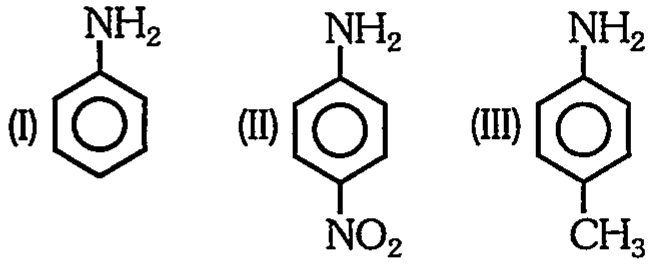
- III < I < II
- III < II < I
- II < I < III
- II < III < I
Show answer
Answer: (C) II < I < III
Explanation: Electron-withdrawing –NO₂ makes the para-nitro compound the weakest base, whereas the electron-releasing methyl group makes p-toluidine the strongest; aniline is intermediate.
Question 2
Previous-year questionThe electrolytic reduction of nitrobenzene in a strongly acidic medium produces [AIPMT 2015]
- Azoxybenzene
- Azobenzene
- Aniline
- p-Aminophenol
Show answer
Answer: (D) p-Aminophenol
Explanation: In strongly acidic conditions the reduction stops at phenylhydroxylamine, which then undergoes an acid-catalysed rearrangement in which the –OH migrates to the para position of the ring, giving p-aminophenol.
Question 3
Previous-year questionThe method by which aniline cannot be prepared is [AIPMT 2015]
- hydrolysis of phenylisocyanide with acidic solution
- degradation of benzamide with bromine in alkaline solution
- reduction of nitrobenzene with H₂/Pd in ethanol
- treatment of the potassium salt of phthalimide with chlorobenzene followed by hydrolysis with aqueous NaOH
Show answer
Answer: (D) treatment of the potassium salt of phthalimide with chlorobenzene followed by hydrolysis with aqueous NaOH
Explanation: Aryl halides do not undergo nucleophilic substitution with the phthalimide anion under ordinary conditions because the C–Cl bond has partial double-bond character and the ring is electron rich. The other three routes are all standard preparations of aniline.
Question 4
When aniline is nitrated with a mixture of concentrated HNO₃ and concentrated H₂SO₄, a large amount of m-nitroaniline is formed along with the ortho and para products. The reason is:
- The nitronium ion attacks only the meta position of any substituted benzene
- The –NH₂ group is converted into an acetamido group during nitration
- In the strongly acidic medium much of the aniline is present as the anilinium ion
- The –NH₂ group is a meta director in electrophilic substitution
Show answer
Answer: (C) In the strongly acidic medium much of the aniline is present as the anilinium ion
Explanation: In strong acid the basic –NH₂ group is protonated to –NH₃⁺. The anilinium ion has no lone pair on nitrogen to donate to the ring and withdraws electrons strongly, so it deactivates the ring and directs the nitronium ion to the meta position. The small amount of free aniline still gives ortho and para products.
Question 5
Which one of the following orders is incorrect for the property given in brackets?
- Chloroacetic acid > acetic acid > propanoic acid (acid strength)
- Benzoic acid > phenol > ethanol (acid strength)
- Aniline > cyclohexylamine > 4-nitroaniline (basic strength)
- Cyclohexylamine > aniline > benzamide (basic strength)
Show answer
Answer: (C) Aniline > cyclohexylamine > 4-nitroaniline (basic strength)
Explanation: Cyclohexylamine is an alkylamine whose lone pair is fully available, so it is a much stronger base than aniline, whose lone pair is delocalised into the ring; placing aniline above cyclohexylamine is therefore wrong. Benzamide is weaker than aniline because its lone pair is drawn onto the carbonyl oxygen. The acid order carboxylic acid > phenol > alcohol is correct, and chloroacetic acid is strongest of its set while propanoic acid is weaker than acetic acid because of the larger electron-releasing alkyl group.
Question 6
Phenyl isocyanide can be prepared from aniline by the
- Gabriel phthalimide synthesis
- Reimer–Tiemann reaction
- carbylamine reaction
- Sandmeyer reaction
Show answer
Answer: (C) carbylamine reaction
Explanation: Aniline warmed with chloroform and alcoholic KOH gives phenyl isocyanide, C₆H₅NC; this is the carbylamine reaction, which works for aromatic as well as aliphatic primary amines. The Sandmeyer reaction replaces a diazonium group by –Cl, –Br or –CN. The Reimer–Tiemann reaction puts a –CHO group on phenol, and the Gabriel synthesis prepares primary aliphatic amines.
Question 7
Compound X is reduced to Y. Y is warmed with chloroform and alcoholic KOH to give Z, and catalytic hydrogenation of Z gives 4-CH₃C₆H₄NHCH₃ (N,4-dimethylaniline). What is X?
- 4-Methylbenzonitrile
- Nitrobenzene
- 4-Nitrotoluene
- 4-Methylbenzamide
Show answer
Answer: (C) 4-Nitrotoluene
Explanation: Hydrogenation of an isocyanide Ar–NC converts the terminal carbon into a methyl group on nitrogen, so Z must be 4-methylphenyl isocyanide. An isocyanide is formed in the carbylamine reaction of a primary amine with CHCl₃ and alcoholic KOH, so Y is 4-methylaniline. This amine is obtained by reduction of 4-nitrotoluene, so X is 4-nitrotoluene.
Doing well? Create a free account to take timed tests on this topic and see your weak areas.
Question 8
4-Chloroaniline is heated with acetic anhydride to give X. X is treated with bromine in ethanoic acid to give Y, and Y is then heated with dilute aqueous acid to give Z. The major product Z is
- 3-bromo-4-chloroaniline
- 2,6-dibromo-4-chloroaniline
- 2-bromo-4-chloroaniline
- 2-bromo-4-chloroacetanilide
Show answer
Answer: (C) 2-bromo-4-chloroaniline
Explanation: Acetylation converts –NH₂ into –NHCOCH₃, which is a milder activator, so bromination can be stopped at one bromine. The acetamido group directs ortho and para, and with the para position occupied by chlorine, bromine enters ortho to the –NHCOCH₃ group. Acid hydrolysis then removes the acetyl group and gives back the free amine, so Z is 2-bromo-4-chloroaniline.
Question 9
4-Chlorobenzoic acid is treated with SOCl₂ to give P. P reacts with ammonia to give Q, and Q is warmed with Br₂ and aqueous NaOH to give R. What is R?
- 4-Chlorobenzamide
- 4-Chloroaniline
- 4-Chlorobenzylamine
- 4-Aminobenzoic acid
Show answer
Answer: (B) 4-Chloroaniline
Explanation: Thionyl chloride converts the –COOH group into –COCl, and ammonia then gives 4-chlorobenzamide (Q). In the Hofmann bromamide degradation the carbonyl carbon is lost and the aryl group moves onto nitrogen, giving an amine with one carbon fewer. The ring chlorine is not touched, because aryl halides resist nucleophilic substitution, so R is 4-chloroaniline.
Question 10
Which one of the following statements about reactions of amines is incorrect?
- N,N-Dimethylaniline reacts with NaNO₂ and HCl at 273–278 K to give a diazonium salt at its nitrogen atom.
- Methanamine reacts with benzenesulphonyl chloride to give N-methylbenzenesulphonamide.
- Ethanamine reacts with nitrous acid to give ethanol with evolution of nitrogen gas.
- Aniline reacts with NaNO₂ and HCl at 273–278 K to give benzenediazonium chloride.
Show answer
Answer: (A) N,N-Dimethylaniline reacts with NaNO₂ and HCl at 273–278 K to give a diazonium salt at its nitrogen atom.
Explanation: A diazonium salt can be formed only from a primary amine, because two hydrogens must be lost from the nitrogen. N,N-Dimethylaniline is a tertiary amine with no hydrogen on nitrogen, so it cannot be diazotised. The other statements are correct: a primary aliphatic amine gives an alcohol and N₂ with nitrous acid, aniline is diazotised in the cold, and a primary amine gives an N-alkylsulphonamide with Hinsberg's reagent.
Question 11
The –NHCOCH₃ group of acetanilide is a weaker activator of the benzene ring than the –NH₂ group of aniline. This is why acetylation is used to control substitution in aniline. What is the main reason for the weaker activation?
- The acetyl group's methyl pushes electrons on to nitrogen, which then cannot pass them to the ring
- The bulky acetyl group blocks the ortho and para positions, so the ring cannot be attacked there
- Nitrogen of acetanilide has lost its lone pair by forming a bond with the acetyl carbon
- The lone pair on nitrogen also interacts with the carbonyl oxygen by resonance, so it is less available to the ring
Show answer
Answer: (D) The lone pair on nitrogen also interacts with the carbonyl oxygen by resonance, so it is less available to the ring
Explanation: The nitrogen in acetanilide keeps its lone pair, but this lone pair is delocalised towards the carbonyl oxygen by resonance. It is therefore less available for donation to the benzene ring. The ring is less strongly activated than in aniline, so monosubstitution becomes possible instead of the 2,4,6-trisubstitution seen with bromine water. The group can later be removed by hydrolysis to regenerate the amine.
Question 12
Benzamide is treated in one experiment (X) with Br₂ and aqueous NaOH, and in another experiment (Y) with LiAlH₄ followed by water. Which statement correctly compares the two?
- Both X and Y give aniline, and the carbonyl carbon is lost in both cases
- X gives p-bromobenzamide by substitution in the ring; Y gives benzyl alcohol with loss of nitrogen
- X gives benzylamine with no loss of carbon; Y gives aniline by migration of the phenyl group
- X gives aniline by migration of the phenyl group from carbonyl carbon to nitrogen; Y gives benzylamine with no loss of carbon
Show answer
Answer: (D) X gives aniline by migration of the phenyl group from carbonyl carbon to nitrogen; Y gives benzylamine with no loss of carbon
Explanation: Bromine with aqueous NaOH brings about the Hoffmann bromamide degradation, in which the alkyl or aryl group migrates from the carbonyl carbon to nitrogen. The product has one carbon less than the amide, so benzamide gives aniline. LiAlH₄ instead reduces the C=O group of the amide to CH₂, so benzamide gives benzylamine, C₆H₅CH₂NH₂, with all its carbon atoms kept.
Question 13
Aniline is acetylated with ethanoyl chloride in the presence of pyridine. Why is pyridine added?
- It acts as a Lewis acid that directs the acetyl group to the para position of the ring
- It oxidises aniline to nitrosobenzene, which is the species that reacts
- It supplies the acetyl group that becomes attached to nitrogen
- It removes the HCl formed, which shifts the equilibrium towards the amide
Show answer
Answer: (D) It removes the HCl formed, which shifts the equilibrium towards the amide
Explanation: Acylation of an amine with an acid chloride is a nucleophilic substitution in which the hydrogen on nitrogen is replaced and HCl is formed. Pyridine is a base stronger than aniline, so it takes up this HCl. Removal of HCl shifts the equilibrium to the right and favours formation of the amide, here acetanilide.
Question 14
Nitrobenzene is reduced to aniline with iron scrap and hydrochloric acid, and only a small amount of the acid is needed. What is the reason?
- Aniline formed in the reaction is acidic enough to replace the hydrochloric acid
- The FeCl₂ formed gets hydrolysed during the reaction and releases hydrochloric acid
- Water formed in the reduction ionises strongly enough to supply all the H⁺ needed
- Iron alone reduces the nitro group, so the acid serves only to clean the metal surface
Show answer
Answer: (B) The FeCl₂ formed gets hydrolysed during the reaction and releases hydrochloric acid
Explanation: Iron and hydrochloric acid give FeCl₂ as the reaction proceeds. This FeCl₂ undergoes hydrolysis and releases hydrochloric acid again, so the acid is replenished. Only a small amount of acid is therefore needed to start the reaction, which is why this reducing system is preferred.
Want more Aromatic Amines General methods of preparation. Properties, reactions, and uses. Amines – Nomenclature questions?
E-GYAN NIDHI has 51 questions on this topic and 63,000+ in total, all free: timed CBT tests, NEET marking and instant analysis.
Register free Free Sunday Mock Test