Quantum mechanical approach to covalent bonding – Valence bond theory: NEET MCQs with Answers
15 free questions on Quantum mechanical approach to covalent bonding – Valence bond theory for NEET (UG), starting with previous-year NEET and AIPMT questions. Try each one, then tap Show answer for the answer and a short explanation.
Syllabus covered: Valence bond theory - its important features, the concept of hybridization involving s, p, and d orbitals; Resonance.
Question 1
Previous-year questionWhich of the following statements correctly describes the structure of the carbonate ion, CO₃²⁻? [NEET 2022 (Overseas)]
- Of the three C–O bonds, two are longer and one is shorter.
- It has three σ-bonds and three π-bonds.
- All three C–O bonds are equal in length, with a bond order between 1 and 2.
- It can be explained by considering sp³ hybridisation.
Show answer
Answer: (C) All three C–O bonds are equal in length, with a bond order between 1 and 2.
Explanation: CO₃²⁻ is a resonance hybrid of three equivalent canonical structures, so all three C–O bonds are identical in length with bond order 4/3 (between a single and a double bond). There are no separate longer and shorter bonds. Carbon is sp² hybridised (trigonal planar), not sp³, and the ion has three σ bonds and only one delocalised π bond, not three π bonds.
Question 2
Previous-year questionMatch the species in List I with the hybridisation of the central atom in List II. [NEET 2021 (Paper-2)]
List I:
a. IF₂⁻
b. HCN
c. PCl₄⁺
d. XeF₄
List II:
i. sp
ii. sp³d
iii. sp³d²
iv. sp³
List I:
a. IF₂⁻
b. HCN
c. PCl₄⁺
d. XeF₄
List II:
i. sp
ii. sp³d
iii. sp³d²
iv. sp³
- a – i, b – iv, c – ii, d – iii
- a – ii, b – i, c – iv, d – iii
- a – iii, b – ii, c – i, d – iv
- a – iv, b – iii, c – ii, d – i
Show answer
Answer: (B) a – ii, b – i, c – iv, d – iii
Explanation: IF₂⁻: 2 bp + 3 lp → sp³d (linear); HCN: carbon forms 2 σ bonds → sp; PCl₄⁺: 4 bp → sp³ (tetrahedral); XeF₄: 4 bp + 2 lp → sp³d² (square planar). Hence a – ii, b – i, c – iv, d – iii.
Question 3
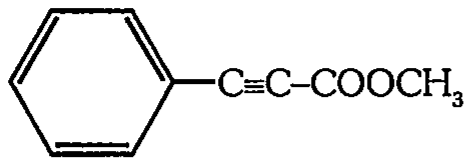
Previous-year questionFor the compound shown below, find (i) the number of sp²-hybridised carbon atoms and (ii) the number of π bonds present. [NEET 2020 (COVID-19)]
- 7, 5
- 8, 6
- 7, 6
- 8, 5
Show answer
Answer: (C) 7, 6
Explanation: The six benzene-ring carbons and the carbonyl carbon of –COOCH₃ are sp² (6 + 1 = 7); the two C≡C carbons are sp and the –CH₃ carbon is sp³. π bonds: 3 in the benzene ring + 2 in C≡C + 1 in C=O = 6. Hence (7, 6).
Question 4
Previous-year questionWhich one of the following compounds has a linear structure? [NEET 2020 (COVID-19)]
- NO₂
- HOCl
- O₃
- N₂O
Show answer
Answer: (D) N₂O
Explanation: N₂O (N≡N⁺–O⁻ ↔ N⁻=N⁺=O) has an sp-hybridised central nitrogen with no lone pair, so it is linear. NO₂ and O₃ are bent (angular) because of a lone pair/odd electron on the central atom, and HOCl is bent because oxygen carries two lone pairs.
Question 5
Previous-year questionWhich one of the following statements is incorrect? [NEET-II 2016]
- SeF₄ and CH₄ have the same shape
- I₃⁺ has a bent geometry
- PH₅ and BiCl₅ do not exist
- pπ–dπ bonds are present in SO₂
Show answer
Answer: (A) SeF₄ and CH₄ have the same shape
Explanation: SeF₄ has 4 bond pairs and 1 lone pair (sp³d), giving a see-saw shape, while CH₄ (sp³) is tetrahedral, so they do not have the same shape and this statement is incorrect. I₃⁺ (2 bp + 2 lp) is bent; PH₅ and BiCl₅ do not exist (poor P–H overlap, inert pair effect in Bi); SO₂ contains one pπ–pπ and one pπ–dπ bond.
Question 6
Previous-year questionIdentify the correct order of electron-pair repulsions. [NEET-I 2016]
- lone pair–lone pair > lone pair–bond pair > bond pair–bond pair
- lone pair–lone pair > bond pair–bond pair > lone pair–bond pair
- bond pair–bond pair > lone pair–bond pair > lone pair–lone pair
- lone pair–bond pair > bond pair–bond pair > lone pair–lone pair
Show answer
Answer: (A) lone pair–lone pair > lone pair–bond pair > bond pair–bond pair
Explanation: According to VSEPR theory, lone pairs are held by only one nucleus and occupy more space, so repulsions decrease in the order lp–lp > lp–bp > bp–bp. This is why lone pairs reduce bond angles (e.g. in NH₃ and H₂O).
Question 7
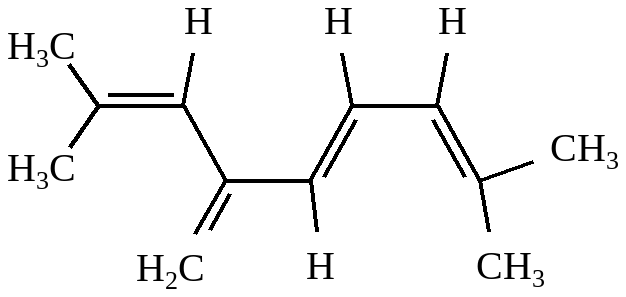
Previous-year questionHow many π-bond electrons in total are present in the structure given below? [AIPMT 2015]
- 8
- 12
- 16
- 4
Show answer
Answer: (A) 8
Explanation: The structure contains four C=C double bonds (including the terminal =CH₂ group). Each double bond has one π bond holding 2 electrons, so total π electrons = 4 × 2 = 8.
Doing well? Create a free account to take timed tests on this topic and see your weak areas.
Question 8
Previous-year questionIn the structure of ClF₃, the number of lone pairs of electrons on the central atom 'Cl' is [NEET 2018]
- One
- Two
- Three
- Four
Show answer
Answer: (B) Two
Explanation: Chlorine has seven valence electrons; three are used in bonding to the three fluorines, leaving four electrons as two lone pairs. These occupy equatorial positions of the trigonal bipyramid and give ClF₃ its T-shape.
Question 9
Previous-year questionIn which of the following pairs are both the species not isostructural? [AIPMT 2015]
- SiCl₄, PCl₄⁺
- diamond, silicon carbide
- NH₃, PH₃
- XeF₄, XeO₄
Show answer
Answer: (D) XeF₄, XeO₄
Explanation: XeF₄ has two lone pairs on xenon and is square planar, whereas XeO₄ has none and is tetrahedral, so this pair is not isostructural. SiCl₄ and PCl₄⁺ are both tetrahedral, diamond and silicon carbide share the same three-dimensional network, and NH₃ and PH₃ are both pyramidal.
Question 10
Previous-year questionWhich of the following pairs of ions are isoelectronic and isostructural? [AIPMT 2015]
- ClO₃⁻, CO₃²⁻
- SO₃²⁻, NO₃⁻
- ClO₃⁻, SO₃²⁻
- CO₃²⁻, SO₃²⁻
Show answer
Answer: (C) ClO₃⁻, SO₃²⁻
Explanation: Both ClO₃⁻ and SO₃²⁻ have 26 valence electrons, with three bond pairs and one lone pair on the central atom. Each is therefore sp³ hybridised and trigonal pyramidal. The other pairs mismatch either in electron count or in shape, since CO₃²⁻ and NO₃⁻ are trigonal planar.
Question 11
Previous-year questionWhich of the following set of molecules will have zero dipole moment? [NEET 2020]
- Boron trifluoride, hydrogen fluoride, carbon dioxide, 1,3-dichlorobenzene
- Nitrogen trifluoride, beryllium difluoride, water, 1,3-dichlorobenzene
- Boron trifluoride, beryllium difluoride, carbon dioxide, 1,4-dichlorobenzene
- Ammonia, beryllium difluoride, water, 1,4-dichlorobenzene
Show answer
Answer: (C) Boron trifluoride, beryllium difluoride, carbon dioxide, 1,4-dichlorobenzene
Explanation: BF₃ is trigonal planar, BeF₂ and CO₂ are linear, and in 1,4-dichlorobenzene the two C–Cl dipoles point in opposite directions, so all bond dipoles cancel and each has zero dipole moment. The other sets contain polar molecules such as HF, NF₃, H₂O, NH₃ or 1,3-dichlorobenzene.
Question 12
Previous-year questionThe number of sigma (σ) and pi (π) bonds in pent-2-en-4-yne is [NEET 2019]
- 10 σ bonds and 3 π bonds
- 8 σ bonds and 5 π bonds
- 11 σ bonds and 2 π bonds
- 13 σ bonds and no π bond
Show answer
Answer: (A) 10 σ bonds and 3 π bonds
Explanation: Pent-2-en-4-yne is CH₃—CH=CH—C≡CH. It has four C—C sigma bonds and six C—H sigma bonds, i.e. 10 sigma bonds, while the double bond gives one pi bond and the triple bond two, making 3 pi bonds.
Question 13
Previous-year questionWhich of the following pairs of compounds is isoelectronic and isostructural? [NEET 2017]
- TeI₂, XeF₂
- IBr₂⁻, XeF₂
- IF₃, XeF₂
- BeCl₂, XeF₂
Show answer
Answer: (B) IBr₂⁻, XeF₂
Explanation: Both IBr₂⁻ and XeF₂ have 22 valence electrons about the central atom with three lone pairs and two bond pairs, giving sp³d hybridisation and a linear shape. The other pairs differ either in electron count or in shape.
Question 14
Previous-year questionThe species having bond angles of 120° is [NEET 2017]
- ClF₃
- NCl₃
- BCl₃
- PH₃
Show answer
Answer: (C) BCl₃
Explanation: BCl₃ has three bond pairs and no lone pair on boron, so it is sp² hybridised and trigonal planar with exactly 120° angles. ClF₃ is T-shaped, and NCl₃ and PH₃ are pyramidal with angles well below 109.5°.
Question 15
Previous-year questionPredict the correct order of repulsion between electrons among the following: [NEET 2016]
- lone pair–lone pair > lone pair–bond pair > bond pair–bond pair
- lone pair–lone pair > bond pair–bond pair > lone pair–bond pair
- bond pair–bond pair > lone pair–bond pair > lone pair–lone pair
- lone pair–bond pair > bond pair–bond pair > lone pair–lone pair
Show answer
Answer: (A) lone pair–lone pair > lone pair–bond pair > bond pair–bond pair
Explanation: A lone pair is held by only one nucleus and spreads out more than a bond pair, which is confined between two nuclei. Repulsion therefore decreases in the order lp–lp > lp–bp > bp–bp, and this is what compresses bond angles in molecules that carry lone pairs.
Want more Quantum mechanical approach to covalent bonding – Valence bond theory questions?
E-GYAN NIDHI has 238 questions on this topic and 63,000+ in total, all free: timed CBT tests, NEET marking and instant analysis.
Register free Free Sunday Mock TestMore topics in CHEMICAL BONDING AND MOLECULAR STRUCTURE
- Covalent Bonding – Concept of electronegativity MCQs
- Kossel - Lewis approach to chemical bond formation, the concept of ionic and covalent bonds. Ionic Bonding – Formation of ionic bonds MCQs
- Molecular Orbital Theory - Its important features. LCAOs, types of molecular orbitals (bonding, antibonding), sigma and pi-bonds, molecular orbital electronic configurations of homonuclear diatomic molecules, the concept of bond order, bond length, and bond energy. Elementary idea of metallic bonding. Hydrogen bonding and its applications. MCQs