Molecular Biology – Molecular basis of Inheritance: NEET MCQs with Answers
15 free questions on Molecular Biology – Molecular basis of Inheritance for NEET (UG), starting with previous-year NEET and AIPMT questions. Try each one, then tap Show answer for the answer and a short explanation.
Syllabus covered: Molecular basis of Inheritance, The DNA, The Search for Genetic Material, Structure of DNA and RNA; DNA packaging; DNA replication, RNA World and Replication, Central dogma
Question 1
Previous-year questionThe given figure shows the structure of a nucleosome with its parts labelled A, B and C. Identify A, B and C. [NEET 2017]
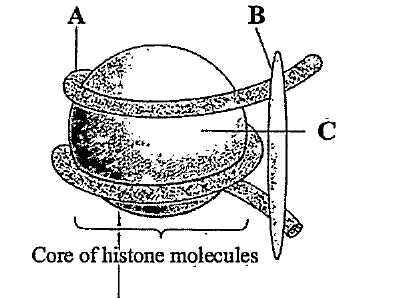
- A – DNA; B – H1 histone; C – histone octamer
- A – H1 histone; B – DNA; C – histone octamer
- A – histone octamer; B – RNA; C – H1 histone
- A – RNA; B – H1 histone; C – histone octamer
Show answer
Answer: (A) A – DNA; B – H1 histone; C – histone octamer
Explanation: The thread wound around the core is the negatively charged DNA (A), the small protein sitting where the DNA enters and leaves is the linker histone H1 (B), and the central core of eight histone molecules is the histone octamer (C).
Question 2
Previous-year questionWhich of the following statements is correct? [NEET 2020]
- Adenine pairs with thymine through one H-bond
- Adenine pairs with thymine through three H-bonds
- Adenine does not pair with thymine
- Adenine pairs with thymine through two H-bonds
Show answer
Answer: (D) Adenine pairs with thymine through two H-bonds
Explanation: Adenine and thymine are joined by two hydrogen bonds, whereas guanine and cytosine are joined by three. The higher number of bonds in a G–C pair makes GC-rich DNA more stable and harder to denature.
Question 3
Previous-year questionIf the distance between two consecutive base pairs is 0.34 nm and the total number of base pairs of a DNA double helix in a typical mammalian cell is 6.6 × 10⁹ bp, then the length of the DNA is approximately [NEET 2020]
- 2.5 metres
- 2.2 metres
- 2.7 metres
- 2.0 metres
Show answer
Answer: (B) 2.2 metres
Explanation: Length equals the number of base pairs multiplied by the distance between them: 6.6 × 109 × 0.34 × 10-9 m = 2.244 m, i.e. approximately 2.2 metres.
Question 4
Previous-year questionThe experimental proof for semi-conservative replication of DNA was first shown in a [NEET 2018]
- Fungus
- Bacterium
- Virus
- Plant
Show answer
Answer: (B) Bacterium
Explanation: Meselson and Stahl demonstrated semi-conservative replication in the bacterium Escherichia coli using 15N labelling and caesium chloride density gradient centrifugation. Taylor later confirmed it in the plant Vicia faba.
Question 5
Previous-year questionThe final proof for DNA as the genetic material came from the experiments of [NEET 2017]
- Hershey and Chase
- Avery, MacLeod and McCarty
- Har Gobind Khorana
- Griffith
Show answer
Answer: (A) Hershey and Chase
Explanation: Hershey and Chase used bacteriophages labelled separately in their protein (35S) and DNA (32P). Since only 32P entered the host and appeared in the progeny phages, DNA was unambiguously proved to be the genetic material.
Question 6
Previous-year questionOkazaki fragments are used during DNA replication to elongate [NEET 2017]
- The lagging strand towards the replication fork
- The leading strand away from the replication fork
- The lagging strand away from the replication fork
- The leading strand towards the replication fork
Show answer
Answer: (C) The lagging strand away from the replication fork
Explanation: On the lagging strand the template runs 5'→3' towards the fork, so the new strand can only be made in short pieces that grow away from the advancing fork. These pieces are the Okazaki fragments, later joined by DNA ligase.
Question 7
Previous-year questionThe association of histone H1 with a nucleosome indicates that [NEET 2017]
- DNA replication is occurring
- The DNA is condensed into a chromatin fibre
- The DNA double helix is exposed
- Transcription is occurring
Show answer
Answer: (B) The DNA is condensed into a chromatin fibre
Explanation: Histone H1 is the linker histone; it binds the DNA where it enters and leaves the nucleosome and draws the nucleosomes together. Its association therefore marks the folding of the beads-on-string structure into the 30 nm chromatin fibre.
Doing well? Create a free account to take timed tests on this topic and see your weak areas.
Question 8
Previous-year questionThere are three genes a, b and c. The percentage of crossing over between a and b is 20%, between b and c is 28% and between a and c is 8%. What is the sequence of the genes on the chromosome? [AIPMT 2015]
- b, a, c
- a, b, c
- a, c, b
- None of these
Show answer
Answer: (A) b, a, c
Explanation: Map distances are additive, so the largest distance separates the two outermost genes. Here b–c is the largest (28 = 20 + 8), so b and c are at the ends and a lies between them, giving the order b–a–c.
Question 9
Previous-year questionWhich one of the following is NOT applicable to RNA? [AIPMT 2015]
- 5' phosphoryl and 3' hydroxyl ends
- Heterocyclic nitrogenous bases
- Chargaff's rule
- Complementary base pairing
Show answer
Answer: (C) Chargaff's rule
Explanation: Chargaff's equivalence rule applies only to double-stranded nucleic acids. RNA is usually single stranded, so its base composition need not satisfy A = U and G = C, although it can form internal complementary pairs.
Question 10
Previous-year questionIn sea urchin DNA, which is double stranded, 17% of the bases were shown to be cytosine. The percentages of the other three bases expected to be present in this DNA are [AIPMT 2015]
- G – 17%, A – 16.5%, T – 32.5%
- G – 17%, A – 33%, T – 33%
- G – 8.5%, A – 50%, T – 24.5%
- G – 34%, A – 24.5%, T – 24.5%
Show answer
Answer: (B) G – 17%, A – 33%, T – 33%
Explanation: Since C = 17%, G must also be 17%, so G + C = 34%. The remaining 66% is divided equally between the complementary bases A and T, giving 33% each.
Question 11
Previous-year questionThe movement of a gene from one linkage group to another is called [AIPMT 2015]
- Duplication
- Translocation
- Crossing over
- Inversion
Show answer
Answer: (B) Translocation
Explanation: Translocation is a structural chromosomal change in which a segment is transferred to a non-homologous chromosome. The gene therefore moves into a different linkage group.
Question 12
Previous-year questionWhich one of the following represents a palindromic sequence in DNA? [AIPMT 2014]
- 5'-GAATTC-3' / 3'-CTTAAG-5'
- 5'-CCAATG-3' / 3'-GAATCC-5'
- 5'-CATTAG-3' / 3'-GATAAC-5'
- 5'-GATACC-3' / 3'-CTATGG-5'
Show answer
Answer: (A) 5'-GAATTC-3' / 3'-CTTAAG-5'
Explanation: A palindrome in DNA reads the same 5'→3' on both strands. In GAATTC/CTTAAG each strand read in the 5'→3' direction gives the identical sequence, which is why it is a recognition site for the restriction enzyme EcoRI.
Question 13
Previous-year questionTransformation was discovered by [AIPMT 2014]
- Meselson and Stahl
- Hershey and Chase
- Griffith
- Watson and Crick
Show answer
Answer: (C) Griffith
Explanation: Frederick Griffith, working with Streptococcus pneumoniae, found that heat-killed virulent S bacteria could convert living avirulent R bacteria into the virulent form. He called this change transformation.
Question 14
Previous-year questionDNA replication is [AIPMT 1989]
- conservative and discontinuous
- semi-conservative and semidiscontinuous
- semi-conservative and discontinuous
- conservative
Show answer
Answer: (B) semi-conservative and semidiscontinuous
Explanation: DNA replication is semi-conservative, since each daughter molecule retains one parental strand, as proved by Meselson and Stahl. It is also semi-discontinuous, because the leading strand is synthesised continuously while the lagging strand is made in discontinuous Okazaki fragments.
Question 15
Previous-year questionWhich is not consistent with double helical structure of DNA? [AIPMT 1990]
- A═T, C≡G
- Density of DNA decreases on heating
- A + T/C + G is not constant
- Both (a) and (b)
Show answer
Answer: (C) A + T/C + G is not constant
Explanation: According to Erwin Chargaff the base ratio (A + T)/(G + C) may vary from one species to another but is constant for a given species. Saying it is not constant is therefore inconsistent with the double-helical model.
Want more Molecular Biology – Molecular basis of Inheritance questions?
E-GYAN NIDHI has 289 questions on this topic and 63,000+ in total, all free: timed CBT tests, NEET marking and instant analysis.
Register free Free Sunday Mock TestMore topics in Genetics and Evolution
- Genetics – Pleiotropy and Polygenic Inheritance MCQs
- Genetics – Chromosomal Basis of Inheritance MCQs
- Genetics – Inheritance of Two Genes (Dihybrid cross) MCQs
- Genetics – Inheritance of One Gene (Monohybrid cross) MCQs
- Genetics – Mendel's Laws of Inheritance MCQs
- Molecular Biology – Transcription MCQs
- Molecular Biology – Genetic Code MCQs
- Molecular Biology – Translation MCQs
- Molecular Biology – Regulation of Gene Expression MCQs
- Molecular Biology – Human Genome Project and DNA Fingerprinting MCQs