Important Compounds of Transition Elements Interstitial compounds, alloy formation; Preparation, properties, and uses of K2Cr2O7, and KMnO4.: NEET MCQs with Answers
15 free questions on Important Compounds of Transition Elements Interstitial compounds, alloy formation; Preparation, properties, and uses of K2Cr2O7, and KMnO4. for NEET (UG), starting with previous-year NEET and AIPMT questions. Try each one, then tap Show answer for the answer and a short explanation.
Question 1
Previous-year questionThe number of hydrogen-bonded water molecule(s) associated with CuSO₄·5H₂O is [NEET (Odisha) 2019]
- 3
- 1
- 2
- 5
Show answer
Answer: (B) 1
Explanation: In blue vitriol, CuSO₄·5H₂O, four of the five water molecules are directly coordinated to the Cu²⁺ ion in a square-planar arrangement, donating lone pairs through coordinate covalent bonds. The fifth water molecule is not bonded to copper at all. It is held in the lattice between a coordinated water molecule and an oxygen atom of the sulphate ion purely by hydrogen bonding. Hence exactly one water molecule is hydrogen bonded. It is also the one most strongly retained on heating, being lost only at about 230 °C.
Question 2
Previous-year questionWhich one of the following ions exhibits a d–d transition as well as paramagnetism? [NEET 2018]
- CrO₄²⁻
- Cr₂O₇²⁻
- MnO₄²⁻
- MnO₄⁻
Show answer
Answer: (C) MnO₄²⁻
Explanation: In MnO₄²⁻ manganese is in the +6 state, i.e. 3d¹. The single d-electron makes the ion paramagnetic and allows a genuine d–d transition. In CrO₄²⁻, Cr₂O₇²⁻ and MnO₄⁻ the metal is d⁰, so those species are diamagnetic and coloured only by charge transfer.
Question 3
Previous-year questionName the gas that can readily decolourise an acidified KMnO₄ solution. [NEET 2017]
- SO₂
- NO₂
- P₂O₅
- CO₂
Show answer
Answer: (A) SO₂
Explanation: Sulphur dioxide is a good reducing agent: 2MnO₄⁻ + 5SO₂ + 2H₂O → 2Mn²⁺ + 5SO₄²⁻ + 4H⁺. The purple colour disappears as Mn(VII) is reduced to almost colourless Mn²⁺.
Question 4
Previous-year questionWhich statement is correct when SO₂ is passed through an acidified K₂Cr₂O₇ solution? [NEET 2016]
- The solution turns blue
- The solution is decolourised
- SO₂ is reduced
- Green Cr₂(SO₄)₃ is formed
Show answer
Answer: (D) Green Cr₂(SO₄)₃ is formed
Explanation: Cr₂O₇²⁻ + 3SO₂ + 2H⁺ → 2Cr³⁺ + 3SO₄²⁻ + H₂O. SO₂ acts as a reducing agent and the orange solution becomes green owing to chromium(III) sulphate.
Question 5
Previous-year questionAssuming complete ionisation, the same number of moles of which compound will require the LEAST amount of acidified KMnO₄ for complete oxidation? [AIPMT 2015]
- FeSO₄
- FeSO₃
- FeC₂O₄
- Fe(NO₂)₂
Show answer
Answer: (A) FeSO₄
Explanation: Only the Fe²⁺ is oxidisable in FeSO₄, so one mole needs just one electron equivalent. In FeSO₃, FeC₂O₄ and Fe(NO₂)₂ the anion (sulphite, oxalate or nitrite) is also oxidised, so more permanganate is consumed.
Question 6
Previous-year questionThe reaction of aqueous KMnO₄ with H₂O₂ under acidic conditions gives [AIPMT 2014]
- Mn⁴⁺ and O₂
- Mn²⁺ and O₂
- Mn²⁺ and O₃
- Mn⁴⁺ and MnO₂
Show answer
Answer: (B) Mn²⁺ and O₂
Explanation: 2MnO₄⁻ + 5H₂O₂ + 6H⁺ → 2Mn²⁺ + 5O₂ + 8H₂O. Here H₂O₂ behaves as a reducing agent: permanganate is reduced to Mn²⁺ while the peroxide oxygen (–1) is oxidised to O₂ (0).
Question 7
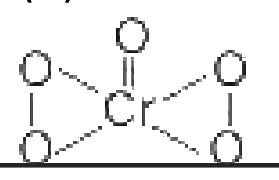
Previous-year questionIn acidic medium H₂O₂ converts Cr₂O₇²⁻ into CrO₅, which contains two peroxide (–O–O–) linkages. The oxidation state of Cr in CrO₅ is [AIPMT 2014]
- +5
- +3
- +6
- –10
Show answer
Answer: (C) +6
Explanation: Of the five oxygens, four are peroxide oxygens (each –1, total –4) and one is a normal oxide oxygen (–2). Hence x + (–4) + (–2) = 0, giving x = +6.
Doing well? Create a free account to take timed tests on this topic and see your weak areas.
Question 8
Previous-year questionPhotographic plates and films have as their essential ingredient [AIPMT 1989]
- silver nitrate
- silver bromide
- sodium chloride
- oleic acid
Show answer
Answer: (B) silver bromide
Explanation: A photographic plate is a glass plate, and a film a thin strip of celluloid, coated with an emulsion of very finely divided silver bromide dispersed in gelatin. On exposure to light, AgBr is partly decomposed to metallic silver, creating the invisible latent image: 2AgBr → 2Ag + Br₂ (in the presence of light) This latent image is then amplified during development and the unreacted AgBr is dissolved away by hypo (sodium thiosulphate) during fixing.
Question 9
Previous-year questionNitriding is the process of surface hardening of steel by treating it in an atmosphere of [AIPMT 1989]
- NH₃
- N₂
- O₃
- H₂S
Show answer
Answer: (A) NH₃
Explanation: In nitriding, steel is heated to about 500–550 °C in a stream of ammonia. The ammonia dissociates at the hot metal surface to give nascent nitrogen, which diffuses into the outer layer and forms an extremely hard skin of iron nitride. The result is a component with a very hard, wear-resistant and rust-resistant surface but a tough interior. Because the process is carried out below the transformation temperature of steel, there is little distortion — an advantage over case-hardening with carbon.
Question 10
Previous-year questionThe most durable metal plating on iron to protect against corrosion is [AIPMT 1994]
- nickel plating
- tin plating
- copper plating
- zinc plating
Show answer
Answer: (D) zinc plating
Explanation: Coating iron with zinc is called galvanisation, and it offers sacrificial (cathodic) protection. Zinc has a more negative standard reduction potential than iron, so even when the coating is scratched and both metals are exposed, zinc acts as the anode and corrodes preferentially while the iron underneath is protected. With tin, nickel or copper coatings the reverse happens: these metals are less reactive than iron, so a scratch makes the exposed iron the anode and rusting is actually accelerated at the break. This is why zinc plating is the most durable protection.
Question 11
Previous-year questionWhen (NH₄)₂Cr₂O₇ is heated, the gas evolved is [AIPMT 1994]
- N₂
- NO₂
- O₂
- N₂O
Show answer
Answer: (A) N₂
Explanation: (NH₄)₂Cr₂O₇ → Cr₂O₃ + N₂↑ + 4H₂O This is an intramolecular redox reaction: the ammonium nitrogen is oxidised from −3 to 0 (giving N₂), while chromium is reduced from +6 to +3 (giving green Cr₂O₃). The reaction is strongly exothermic and the light, fluffy Cr₂O₃ residue is thrown upwards, giving the classic 'chemical volcano' demonstration.
Question 12
Previous-year questionOn passing H₂S gas into an acidified KMnO₄ solution, we get [AIPMT 1995]
- S
- K₂S
- MnO₂
- K₂SO₃
Show answer
Answer: (A) S
Explanation: 2KMnO₄ + 3H₂SO₄ + 5H₂S → K₂SO₄ + 2MnSO₄ + 5S + 8H₂O Permanganate oxidises the sulphide sulphur from −2 to 0, so free sulphur is precipitated as a milky white suspension, while manganese is reduced from +7 to +2 and the purple colour disappears. MnO₂ would be the product in neutral or alkaline medium, not in acidic medium; and sulphur is not oxidised as far as sulphite by this reaction.
Question 13
Previous-year questionStainless steel contains iron along with [AIPMT 1995]
- Cr + Ni
- Cr + Zn
- Zn + Pb
- Fe + Cr + Ni
Show answer
Answer: (A) Cr + Ni
Explanation: Stainless steel contains about 73% Fe, 18% Cr and 8% Ni. Chromium forms a thin protective Cr₂O₃ layer against corrosion and nickel adds toughness, and iron is already named in the question.
Question 14
Previous-year questionCuprous compounds such as CuCl, CuCN and CuSCN are among the very few Cu(I) salts stable in H₂O. This is due to their [AIPMT 1996]
- high hydration energy of Cu⁺ ions
- inherent tendency not to disproportionate
- diamagnetic nature
- insolubility in water
Show answer
Answer: (D) insolubility in water
Explanation: In aqueous solution the Cu⁺ ion is thermodynamically unstable and disproportionates: 2Cu⁺(aq) → Cu²⁺(aq) + Cu(s) The driving force is the very large hydration enthalpy of the small, doubly charged Cu²⁺ ion (≈ −2100 kJ mol⁻¹) compared with that of Cu⁺ (≈ −580 kJ mol⁻¹), which more than offsets the second ionisation enthalpy of copper. Copper(I) compounds can therefore survive in contact with water only if they are so sparingly soluble that the concentration of free Cu⁺(aq) never becomes appreciable. This is exactly the situation for CuCl, CuBr, CuI, CuCN and CuSCN — all of which have extremely low solubility products. NCERT puts it directly: Cu(I) compounds are unstable in aqueous solution but are stable if they are insoluble in water.
Question 15
Previous-year questionK₂Cr₂O₇ on heating with aqueous NaOH gives [AIPMT 1997]
- CrO₄²⁻
- Cr(OH)₃
- Cr₂O₇²⁻
- Cr(OH)₂
Show answer
Answer: (A) CrO₄²⁻
Explanation: K₂Cr₂O₇ + 2NaOH → K₂CrO₄ + Na₂CrO₄ + H₂O In alkaline medium the orange dichromate ion is converted into the yellow chromate ion. The interconversion is pH dependent and fully reversible: Cr₂O₇²⁻ + 2OH⁻ ⇌ 2CrO₄²⁻ + H₂O (orange ⇌ yellow) Chromium remains in the +6 oxidation state throughout, so this is an acid–base equilibrium and not a redox reaction.
Want more Important Compounds of Transition Elements Interstitial compounds, alloy formation; Preparation, properties, and uses of K2Cr2O7, and KMnO4. questions?
E-GYAN NIDHI has 95 questions on this topic and 63,000+ in total, all free: timed CBT tests, NEET marking and instant analysis.
Register free Free Sunday Mock Test