Haloarenes General methods of preparation, properties, and reactions; Nature of C-X bond; Mechanisms of substitution reactions.: NEET MCQs with Answers
10 free questions on Haloarenes General methods of preparation, properties, and reactions; Nature of C-X bond; Mechanisms of substitution reactions. for NEET (UG), starting with previous-year NEET and AIPMT questions. Try each one, then tap Show answer for the answer and a short explanation.
Question 1
Previous-year questionWhich chloro derivative of benzene among the following would undergo hydrolysis most readily with aqueous sodium hydroxide to furnish the corresponding hydroxy derivative? [NEET 2017]
- 2,4,6-Trinitrochlorobenzene
- 4-Nitrochlorobenzene
- 4-(Dimethylamino)chlorobenzene
- Chlorobenzene
Show answer
Answer: (A) 2,4,6-Trinitrochlorobenzene
Explanation: Nucleophilic aromatic substitution is accelerated by electron-withdrawing groups placed ortho or para to the leaving group. Such groups pull electron density away from the ring, making the carbon bearing chlorine more electrophilic, and they stabilise the negatively charged intermediate by delocalising the charge onto their own oxygen atoms. 2,4,6-Trinitrochlorobenzene carries three nitro groups, two ortho and one para to the chlorine. All three are perfectly placed to stabilise the intermediate, so it hydrolyses most readily, under mild conditions. 4-Nitrochlorobenzene has only one such group and needs harsher conditions; chlorobenzene has none and requires extreme conditions. The dimethylamino group is electron-donating, so it deactivates the ring towards nucleophilic attack and makes hydrolysis harder still.
Question 2
Previous-year questionIdentify the product in the following reaction: [NEET 2023]
benzenediazonium chloride —(i) Cu₂Br₂/HBr (ii) Mg/dry ether (iii) H₂O→ Product
benzenediazonium chloride —(i) Cu₂Br₂/HBr (ii) Mg/dry ether (iii) H₂O→ Product
- Benzene
- Phenylmagnesium bromide
- 4-Bromophenol
- Phenol
Show answer
Answer: (A) Benzene
Explanation: Take the three steps in order. (i) Cu₂Br₂/HBr replaces the diazonium group by bromine (Sandmeyer reaction), converting benzenediazonium chloride into bromobenzene. (ii) Magnesium in dry ether inserts into the C—Br bond to give the Grignard reagent, phenylmagnesium bromide. (iii) Water immediately protonates the strongly basic carbon of the Grignard reagent: C₆H₅MgBr + H₂O → C₆H₆ + Mg(OH)Br. The final product is therefore benzene. Phenylmagnesium bromide is only the intermediate after step (ii), not the product after step (iii).
Question 3
Previous-year questionThe compound C₇H₈ undergoes the sequence 3Cl₂/Δ → A, then Br₂/Fe → B, then Zn/HCl → C. The product C is [NEET 2018]
- m-bromotoluene
- o-bromotoluene
- p-bromotoluene
- 3-bromo-2,4,6-trichlorotoluene
Show answer
Answer: (A) m-bromotoluene
Explanation: Toluene first undergoes side-chain chlorination to give C₆H₅CCl₃, a strongly electron-withdrawing group that directs the incoming bromine to the meta position. Zinc and HCl then reduce the –CCl₃ group back to –CH₃, leaving m-bromotoluene.
Question 4
Previous-year questionWhat products are formed when m-xylene is treated with Br₂ in the presence of FeBr₃? [AIPMT 2014]
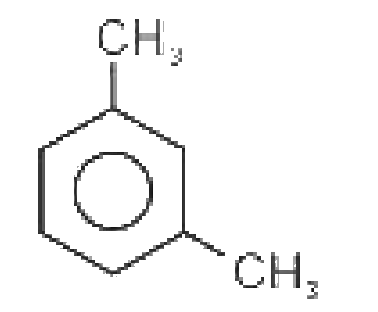
- 2-bromo-1,3-dimethylbenzene and 4-bromo-1,3-dimethylbenzene shown in option (a)
- 3-bromo-1,4-dimethylbenzene and 2-bromo-1,3-dimethylbenzene
- 4-bromo-1,3-dimethylbenzene together with 4-bromo-2,6-dimethylbenzene
- 2-bromo-1,4-dimethylbenzene and 5-bromo-1,3-dimethylbenzene
Show answer
Answer: (C) 4-bromo-1,3-dimethylbenzene together with 4-bromo-2,6-dimethylbenzene
Explanation: Both methyl groups of m-xylene are ortho/para directors and they reinforce each other at C-4 and C-6. Bromination therefore occurs mainly at those activated positions rather than at the sterically crowded C-2 between the two methyls.
Question 5
Previous-year questionThe hydrolysis reaction that takes place at the slowest rate, among the following, is [NEET (Odisha) 2019]
- C₆H₅CH₂Cl —aq. NaOH→ C₆H₅CH₂OH
- 2-chlorotoluene —aq. NaOH→ sodium 2-methylphenoxide
- CH₃CH₂Cl —aq. NaOH→ CH₃CH₂OH
- CH₂=CH—CH₂Cl —dil. NaOH→ CH₂=CH—CH₂OH
Show answer
Answer: (B) 2-chlorotoluene —aq. NaOH→ sodium 2-methylphenoxide
Explanation: 2-Chlorotoluene is an aryl halide: the lone pair on chlorine is delocalised into the ring, giving the C–Cl bond partial double-bond character, and the carbon is sp², so the bond is short and strong and hydrolysis is very difficult. Benzyl and allyl chlorides ionise readily to resonance-stabilised cations and ethyl chloride reacts by S_N2, so all three are far faster.
Question 6
Which of the following compounds does NOT exchange its chlorine for –OH on warming with aqueous NaOH under ordinary conditions?
- Chloromethylbenzene (benzyl chloride)
- 2-Chlorotoluene
- 1-Chloropropane
- 3-Chloroprop-1-ene (allyl chloride)
Show answer
Answer: (B) 2-Chlorotoluene
Explanation: In 2-chlorotoluene the chlorine is bonded directly to an sp² ring carbon. Its lone pair is in resonance with the ring, which gives the C–Cl bond partial double-bond character, and the electron-rich ring repels the incoming nucleophile. Alkyl, allyl and benzyl chlorides have Cl on an sp³ carbon and are substituted readily.
Question 7
2,4,6-Trinitrochlorobenzene is warmed with water. The main organic product is
- 2,4-Dinitrophenol
- 4-Nitrophenol
- 1,3,5-Trinitrobenzene
- 2,4,6-Trinitrophenol
Show answer
Answer: (D) 2,4,6-Trinitrophenol
Explanation: Chlorine on a benzene ring is normally very unreactive towards nucleophiles. Three nitro groups at the ortho and para positions strongly withdraw electrons and stabilise the anionic intermediate, so even warm water can replace –Cl by –OH. The nitro groups are not removed, and the product is 2,4,6-trinitrophenol, picric acid.
Doing well? Create a free account to take timed tests on this topic and see your weak areas.
Question 8
In experiment P, bromobenzene alone is treated with sodium in dry ether. In experiment Q, a mixture of bromobenzene and bromoethane is treated with sodium in dry ether. Which option names the reaction and the intended product of each experiment correctly?
- P: Wurtz-Fittig reaction, ethylbenzene; Q: Fittig reaction, biphenyl
- P: Friedel-Crafts reaction, biphenyl; Q: Wurtz reaction, butane
- P: Wurtz reaction, benzene; Q: Fittig reaction, styrene
- P: Fittig reaction, biphenyl; Q: Wurtz-Fittig reaction, ethylbenzene
Show answer
Answer: (D) P: Fittig reaction, biphenyl; Q: Wurtz-Fittig reaction, ethylbenzene
Explanation: An aryl halide alone with sodium in dry ether joins two aryl groups together, which is the Fittig reaction, so bromobenzene gives biphenyl. A mixture of an alkyl halide and an aryl halide under the same conditions gives an alkylarene, which is the Wurtz-Fittig reaction. Bromobenzene and bromoethane therefore give ethylbenzene.
Question 9
Chlorobenzene has a lower dipole moment than cyclohexyl chloride although each molecule contains one C–Cl bond. Which pair of factors accounts for this?
- The ring carbon bonded to Cl is sp² and more electronegative than an sp³ carbon, and resonance gives the C–Cl bond partial double-bond character
- The carbon bonded to Cl in cyclohexyl chloride is sp², and its ring is planar with fully delocalised electrons
- The C–Cl bond in chlorobenzene is longer than in cyclohexyl chloride, and it ionises easily to give a phenyl cation
- The ring carbon bonded to Cl is sp³ and less electronegative, and the ring π electrons are drawn fully on to chlorine
Show answer
Answer: (A) The ring carbon bonded to Cl is sp² and more electronegative than an sp³ carbon, and resonance gives the C–Cl bond partial double-bond character
Explanation: In cyclohexyl chloride the C–Cl carbon is sp³, while in chlorobenzene it is sp² with greater s-character and so is more electronegative, which reduces the polarity of the C–Cl bond. Resonance also moves a lone pair of chlorine towards the ring, giving the bond partial double-bond character and opposing the C→Cl dipole. Both effects lower the dipole moment of chlorobenzene.
Question 10
The three isomeric dichlorobenzenes have nearly equal boiling points, but the para isomer melts about 70 °C higher than the ortho and meta isomers. This is mainly because the para isomer
- has a much higher molecular mass than the other two isomers
- forms intermolecular hydrogen bonds through its two chlorine atoms
- has a symmetrical structure that packs more closely in the crystal lattice
- is the most polar of the three and has the strongest dipole–dipole attraction
Show answer
Answer: (C) has a symmetrical structure that packs more closely in the crystal lattice
Explanation: Melting depends on how well molecules fit in the crystal as well as on intermolecular attraction. The symmetrical para isomer packs closely, so more energy is needed to break the lattice. Boiling involves no lattice, so the three isomers boil at similar temperatures. The para isomer actually has zero dipole moment, and all three have the same molecular mass.
Want more Haloarenes General methods of preparation, properties, and reactions; Nature of C-X bond; Mechanisms of substitution reactions. questions?
E-GYAN NIDHI has 34 questions on this topic and 63,000+ in total, all free: timed CBT tests, NEET marking and instant analysis.
Register free Free Sunday Mock Test