Genetics – Sex-linked Inheritance and Genetic Disorders: NEET MCQs with Answers
15 free questions on Genetics – Sex-linked Inheritance and Genetic Disorders for NEET (UG), starting with previous-year NEET and AIPMT questions. Try each one, then tap Show answer for the answer and a short explanation.
Syllabus covered: Sex-linked Inheritance and Genetic Disorders: Sex linked inheritance-Haemophilia, Colour blindness; Mendelian disorders in humans-Thalassemia; Chromosomal disorders in humans; Down’s syndrome, Turner’s and Klinefelter’s syndromes.
Question 1
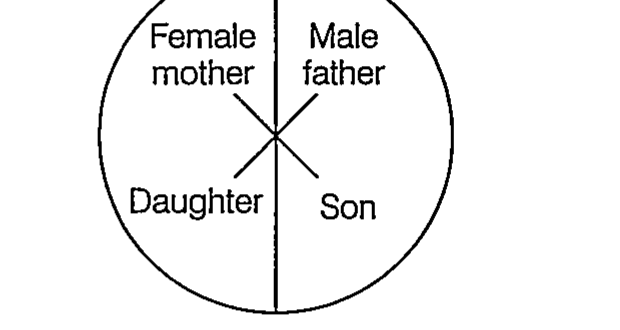
Previous-year questionRepresented here is the inheritance pattern of a certain type of trait in humans. Which one of the following conditions could be an example of this pattern? [AIPMT 2012]
- Phenylketonuria
- Sickle cell anaemia
- Haemophilia
- Thalassemia
Show answer
Answer: (C) Haemophilia
Explanation: The diagram shows criss-cross inheritance — the trait passes from mother to son and from father to daughter. This is characteristic of X-linked recessive disorders such as haemophilia.
Question 2
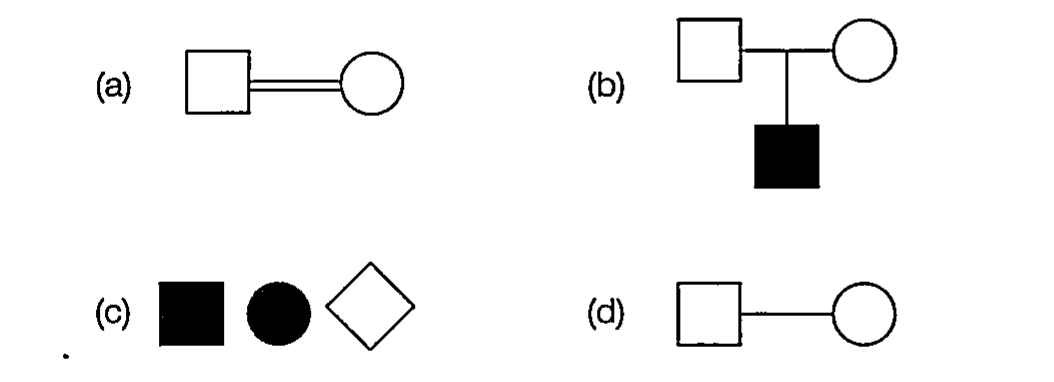
Previous-year questionWhich one of the following symbols represents mating between relatives in human pedigree analysis? [NEET 2023]
- Symbol (a)
- Symbol (b)
- Symbol (c)
- Symbol (d)
Show answer
Answer: (A) Symbol (a)
Explanation: Symbol (a), showing two individuals joined by a double horizontal line, represents consanguineous mating, i.e. marriage between blood relatives. A single line, as in (d), indicates ordinary mating between unrelated individuals.
Question 3
Previous-year questionSelect the correct match. [NEET 2020]
- Phenylketonuria – autosomal dominant trait
- Sickle cell anaemia – autosomal recessive trait, chromosome 11
- Thalassemia – X linked
- Haemophilia – Y linked
Show answer
Answer: (B) Sickle cell anaemia – autosomal recessive trait, chromosome 11
Explanation: Sickle cell anaemia is an autosomal recessive disorder caused by a point mutation in the beta globin gene located on chromosome 11. Phenylketonuria is autosomal recessive, thalassemia is autosomal and haemophilia is X-linked.
Question 4
Previous-year questionWhat is the genetic disorder in which an individual has an overall masculine development, gynaecomastia, and is sterile? [NEET 2019]
- Turner's syndrome
- Klinefelter's syndrome
- Edward syndrome
- Down's syndrome
Show answer
Answer: (B) Klinefelter's syndrome
Explanation: Klinefelter's syndrome (47, XXY) produces an individual with an overall masculine build who also develops feminine features such as breast development (gynaecomastia). The testes remain underdeveloped and such individuals are sterile.
Question 5
Previous-year questionA woman has an X-linked condition on one of her X chromosomes. This chromosome can be inherited by [NEET 2018]
- Only daughters
- Only sons
- Both sons and daughters
- Only grandchildren
Show answer
Answer: (C) Both sons and daughters
Explanation: A mother transmits one of her two X chromosomes at random to every child, irrespective of sex. Hence the X carrying the condition may pass to a son or to a daughter, although its expression differs between them.
Question 6
Previous-year questionA disease caused by an autosomal primary non-disjunction is [NEET 2017]
- Klinefelter's syndrome
- Turner's syndrome
- Sickle cell anaemia
- Down's syndrome
Show answer
Answer: (D) Down's syndrome
Explanation: Down's syndrome arises from failure of separation of the two copies of chromosome 21, an autosome, during gamete formation, giving trisomy 21. Klinefelter's and Turner's syndromes involve the sex chromosomes and sickle cell anaemia is a gene mutation.
Question 7
Previous-year questionThalassemia and sickle cell anaemia are caused due to a problem in globin molecule synthesis. Select the correct statement. [NEET 2017]
- Both are due to a quantitative defect in globin chain synthesis
- Thalassemia is due to less synthesis of globin molecules
- Sickle cell anaemia is due to a quantitative problem of globin molecules
- Both are due to a qualitative defect in globin chain synthesis
Show answer
Answer: (B) Thalassemia is due to less synthesis of globin molecules
Explanation: Thalassemia is a quantitative disorder in which fewer globin chains are synthesised, so haemoglobin formation is reduced. Sickle cell anaemia is a qualitative disorder in which a normal amount of a structurally abnormal globin is made.
Doing well? Create a free account to take timed tests on this topic and see your weak areas.
Question 8
Previous-year questionPick out the correct statements. (1) Haemophilia is a sex-linked recessive disease. (2) Down's syndrome is due to aneuploidy. (3) Phenylketonuria is an autosomal recessive gene disorder. (4) Sickle cell anaemia is an X-linked recessive gene disorder. [NEET 2016]
- 1 and 4 are correct
- 3 and 4 are correct
- 1, 3 and 4 are correct
- 1, 2 and 3 are correct
Show answer
Answer: (D) 1, 2 and 3 are correct
Explanation: Haemophilia is X-linked recessive, Down's syndrome results from trisomy of chromosome 21 (aneuploidy) and phenylketonuria is autosomal recessive. Sickle cell anaemia is autosomal recessive and not X-linked, so statement 4 is wrong.
Question 9
Previous-year questionWhich of the following most appropriately describes haemophilia? [NEET 2016]
- Recessive gene disorder
- X-linked recessive gene disorder
- Chromosomal disorder
- Dominant gene disorder
Show answer
Answer: (B) X-linked recessive gene disorder
Explanation: Haemophilia is caused by a recessive allele on the X chromosome that codes for a defective clotting factor. It is expressed in hemizygous males and in the rare homozygous females, and is transmitted through carrier females.
Question 10
Previous-year questionAn abnormal human baby with 'XXX' sex chromosomes was born because of [AIPMT 2015]
- Formation of abnormal ova in the mother
- Fusion of two ova and one sperm
- Fusion of two sperms and one ovum
- Formation of abnormal sperms in the father
Show answer
Answer: (A) Formation of abnormal ova in the mother
Explanation: A sperm can contribute only one sex chromosome, either X or Y. Two X chromosomes must therefore have come from the ovum, which arose through non-disjunction of the X chromosomes during oogenesis in the mother.
Question 11
Previous-year questionA human female with Turner's syndrome [AIPMT 2014]
- Has 45 chromosomes with XO
- Has one additional X chromosome
- Exhibits male characters
- Is able to produce children with a normal husband
Show answer
Answer: (A) Has 45 chromosomes with XO
Explanation: Turner's syndrome results from the absence of one X chromosome, giving the karyotype 45, X0. Such women are short statured and sterile, with rudimentary ovaries and poorly developed secondary sexual characters.
Question 12
Previous-year questionA man whose father was colour blind marries a woman who had a colour blind mother and a normal father. What percentage of the male children of this couple will be colour blind? [AIPMT 2014]
- 25%
- 0%
- 50%
- 75%
Show answer
Answer: (C) 50%
Explanation: The man is normal (XCY), since he received his X from his normal mother. The woman is a carrier (XCXc) because her mother was colour blind. Half of her sons will therefore receive the Xc chromosome and be colour blind.
Question 13
Previous-year questionIn Down's syndrome of a male child, the sex complement is [AIPMT 1990]
- XO
- XY
- XX
- XXY
Show answer
Answer: (B) XY
Explanation: Down's syndrome is caused by non-disjunction of the 21st chromosome during oogenesis, which is an autosomal and not a sex-chromosomal abnormality. Hence a male child with Down's syndrome has the normal male sex complement XY.
Question 14
Previous-year questionBoth husband and wife have normal vision though their fathers were colourblind. The probability of their daughter becoming colourblind is [AIPMT 1990]
- 0%
- 25%
- 50%
- 75%
Show answer
Answer: (A) 0%
Explanation: The husband, though his father was colourblind, has normal vision and is XY — he cannot transmit a colour-blindness allele to his daughters. Each daughter therefore receives a normal X from her father, so no daughter can be colourblind; she can at most be a carrier.
Question 15
Previous-year questionHaemophilia is more common in males because it is a [AIPMT 1990]
- recessive character carried by Y-chromosome
- dominant character carried by Y-chromosome
- dominant trait carried by X-chromosome
- recessive trait carried by X-chromosome
Show answer
Answer: (D) recessive trait carried by X-chromosome
Explanation: Haemophilia is a recessive trait carried on the X-chromosome. Males have only one X, so a single copy of the faulty allele is expressed, whereas females need two faulty X chromosomes to show the disease.
Want more Genetics – Sex-linked Inheritance and Genetic Disorders questions?
E-GYAN NIDHI has 512 questions on this topic and 63,000+ in total, all free: timed CBT tests, NEET marking and instant analysis.
Register free Free Sunday Mock TestMore topics in Genetics and Evolution
- Evolution – Evidences for Evolution and Adaptive Radiation MCQs
- Genetics – Sex Determination MCQs
- Evolution – Origin of Life MCQs
- Evolution – Biological Evolution and Mechanism of Evolution MCQs
- Evolution – Hardy-Weinberg Principle and A Brief Account of Evolution MCQs
- Evolution – Human evolution MCQs
- Evolution – Biological Evolution and Mechanism of Evolution MCQs
- Evolution – Biological Evolution and Mechanism of Evolution MCQs