Electrochemical Series, Cells and Their EMF Electrochemical cells - Electrolytic and Galvanic cells, different types of electrodes, electrode potentials including standard electrode potential, half - cell and cell reactions, emf of a Galvanic cell and its measurement – Nernst equation and its applications: NEET MCQs with Answers
15 free questions on Electrochemical Series, Cells and Their EMF Electrochemical cells - Electrolytic and Galvanic cells, different types of electrodes, electrode potentials including standard electrode potential, half - cell and cell reactions, emf of a Galvanic cell and its measurement – Nernst equation and its applications for NEET (UG), starting with previous-year NEET and AIPMT questions. Try each one, then tap Show answer for the answer and a short explanation.
Syllabus covered: Nernst equation and its applications; Relationship between cell potential and Gibbs' energy change:
Practise all 92 Electrochemical Series, Cells and Their EMF Electrochemical cells - Electrolytic and Galvanic cells, different types of electrodes, electrode potentials including standard electrode potential, half - cell and cell reactions, emf of a Galvanic cell and its measurement – Nernst equation and its applications questions free
Take a free timed test
Question 1
Previous-year questionConsider the change in oxidation state of bromine corresponding to different emf values as shown in the Latimer diagram. The species undergoing disproportionation is [NEET 2018]
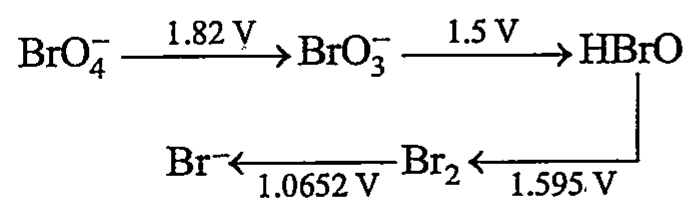
- BrO₃⁻
- BrO₄⁻
- HBrO
- Br₂
Show answer
Answer: (C) HBrO
Explanation: A species disproportionates when the potential on its right is greater than that on its left. For HBrO, the potential to Br₂ (1.595 V) exceeds that from BrO₃⁻ to HBrO (1.5 V), so HBrO disproportionates.
Question 2
Previous-year questionFor the cell reaction 2Fe³⁺(aq) + 2I⁻(aq) → 2Fe²⁺(aq) + I₂(aq), E°_cell = 0.24 V at 298 K. The standard Gibbs energy (ΔᵣG°) of the cell reaction is (F = 96500 C mol⁻¹) [NEET 2019]
- –46.32 kJ mol⁻¹
- –23.16 kJ mol⁻¹
- 46.32 kJ mol⁻¹
- 23.16 kJ mol⁻¹
Show answer
Answer: (A) –46.32 kJ mol⁻¹
Explanation: ΔG° = –nFE° = –2×96500×0.24 = –46320 J = –46.32 kJ mol⁻¹.
Question 3
Previous-year questionFor a cell involving one electron, E°_cell = 0.59 V at 298 K. The equilibrium constant for the cell reaction is (2.303RT/F = 0.059 V at T = 298 K) [NEET 2019]
- 1.0 × 10²
- 1.0 × 10⁵
- 1.0 × 10¹⁰
- 1.0 × 10³⁰
Show answer
Answer: (C) 1.0 × 10¹⁰
Explanation: log K = nE°/0.059 = 0.59/0.059 = 10, hence K = 1.0×10¹⁰.
Question 4
Previous-year questionIn the electrochemical cell Zn|ZnSO₄(0.01 M)||CuSO₄(1.0 M)|Cu the emf of this Daniell cell is E₁. When the concentration of ZnSO₄ is changed to 1.0 M and that of CuSO₄ to 0.01 M, the emf changes to E₂. The relationship between E₁ and E₂ is (RT/F = 0.059) [NEET 2017]
- E₁ < E₂
- E₁ > E₂
- E₂ = 0 ≠ E₁
- E₁ = E₂
Show answer
Answer: (B) E₁ > E₂
Explanation: E = E° – (0.059/2)log([Zn²⁺]/[Cu²⁺]). In the first case the log term is negative (raising E) and in the second it is positive (lowering E), so E₁ > E₂.
Question 5
Previous-year questionThe pressure of H₂ required to make the potential of the H₂-electrode zero in pure water at 298 K is [NEET 2016]
- 10⁻¹⁴ atm
- 10⁻¹² atm
- 10⁻¹⁰ atm
- 10⁻⁴ atm
Show answer
Answer: (A) 10⁻¹⁴ atm
Explanation: E = 0 – 0.059 log(√pH₂/[H⁺]) = 0 with [H⁺] = 10⁻⁷ gives pH₂ = 10⁻¹⁴ atm.
Question 6
For the half-cell Ag⁺(aq, 0.010 M) | Ag(s), the temperature is raised from 298 K to 308 K with [Ag⁺] held constant. Taking E° as unchanged, what happens to the electrode potential according to the Nernst equation?
- It stays below E° and falls slightly, and it would rise on heating only if [Ag⁺] were above 1 M
- It does not change, because temperature does not appear in the Nernst equation
- It stays above E° and rises slightly, because a higher temperature always raises an electrode potential
- It stays below E° and rises slightly, and it would rise on heating at every value of [Ag⁺]
Show answer
Answer: (A) It stays below E° and falls slightly, and it would rise on heating only if [Ag⁺] were above 1 M
Explanation: For this half-cell, E = E° + (2.303RT/F) log[Ag⁺]. With [Ag⁺] = 0.010 M the logarithm is −2, so E lies below E°, and a higher T makes this negative term larger, so E falls slightly. At [Ag⁺] = 1 M the term is zero, and above 1 M it is positive, so only then would heating raise E.
Question 7
A Daniell cell with 1 M Zn²⁺ and 1 M Cu²⁺ solutions has an EMF of 1.1 V. An external opposing potential is connected and is raised to 1.5 V. What happens now?
- No current flows and no chemical change occurs, since the applied potential is greater than the EMF of the cell
- Electrons continue to flow from zinc to copper through the outer circuit, with a smaller current than before
- Electrons flow from copper to zinc through the outer circuit, copper is deposited on the copper electrode and zinc dissolves
- Electrons flow from copper to zinc through the outer circuit, zinc is deposited on the zinc electrode and copper dissolves
Show answer
Answer: (D) Electrons flow from copper to zinc through the outer circuit, zinc is deposited on the zinc electrode and copper dissolves
Explanation: Below 1.1 V the cell works as a galvanic cell with a falling current, and at exactly 1.1 V the current stops. When the opposing potential exceeds 1.1 V the reaction reverses and the device acts as an electrolytic cell. Electrons then flow from copper to zinc, so Zn²⁺ is reduced to zinc and copper is oxidised to Cu²⁺.
Doing well? Create a free account to take timed tests on this topic and see your weak areas.
Question 8
A galvanic cell is set up from a copper electrode in Cu²⁺ solution and a silver electrode in Ag⁺ solution. A salt bridge of KNO₃ in agar gel is preferred over one of KCl because
- K⁺ and Cl⁻ travel at very different speeds, whereas K⁺ and NO₃⁻ do not
- KCl does not set in agar gel, whereas KNO₃ does
- Cl⁻ would oxidise the copper electrode directly and stop the current
- Cl⁻ entering the silver half-cell precipitates AgCl and lowers the Ag⁺ concentration, whereas NO₃⁻ does not do so
Show answer
Answer: (D) Cl⁻ entering the silver half-cell precipitates AgCl and lowers the Ag⁺ concentration, whereas NO₃⁻ does not do so
Explanation: The electrolyte of a salt bridge must not react with the ions of either half-cell. Chloride ions moving into the silver half-cell would remove Ag⁺ as insoluble AgCl and so disturb the cell potential. Nitrate salts are soluble, so KNO₃ causes no such reaction, and K⁺ and NO₃⁻ also have similar mobilities, as K⁺ and Cl⁻ do.
Question 9
Metal X in 1 M X²⁺ and metal Y in 1 M Y⁺ are each coupled with a standard hydrogen electrode. With X, the EMF is 1.18 V and electrons flow from X to the hydrogen electrode. With Y, the EMF is 0.80 V and electrons flow from the hydrogen electrode to Y. What are E°(X²⁺/X) and the standard EMF of the cell X | X²⁺ || Y⁺ | Y?
- +1.18 V; 0.38 V
- +1.18 V; 1.98 V
- −1.18 V; 1.98 V
- −1.18 V; 0.38 V
Show answer
Answer: (C) −1.18 V; 1.98 V
Explanation: Electrons leave the anode, so X is oxidised relative to hydrogen and E°(X²⁺/X) = −1.18 V. Electrons enter Y, so Y⁺ is reduced and E°(Y⁺/Y) = +0.80 V. In the X–Y cell, X is the anode and Y the cathode. Hence E°cell = 0.80 − (−1.18) = 1.98 V; the stoichiometric coefficients do not affect electrode potentials.
Question 10
Given E° values: Ti⁴⁺/Ti³⁺ = +0.01 V, Sn⁴⁺/Sn²⁺ = +0.15 V, I₂/I⁻ = +0.54 V, Fe³⁺/Fe²⁺ = +0.77 V and Br₂/Br⁻ = +1.09 V. Under standard conditions, which species can oxidise Fe²⁺ to Fe³⁺?
- I₂
- Sn⁴⁺
- Br₂
- Ti⁴⁺
Show answer
Answer: (C) Br₂
Explanation: An oxidant can convert Fe²⁺ to Fe³⁺ only if its reduction potential is higher than E°(Fe³⁺/Fe²⁺) = +0.77 V, so that the cell EMF is positive. Only Br₂/Br⁻ meets this condition, giving E°cell = 1.09 − 0.77 = +0.32 V. The other three couples give a negative EMF, so the reaction does not occur on its own.
Question 11
A galvanic cell works by the reaction Zn(s) + 2Ag⁺(aq) → Zn²⁺(aq) + 2Ag(s). Which description of the charge flow in this working cell is correct?
- The silver electrode is negative, and Ag⁺ ions carry charge through the wire
- Electrons travel from silver to zinc through the wire, and also through the solutions
- Electrons travel from zinc to silver through the wire, while ions carry the charge in the solutions and salt bridge
- Electrons travel from zinc to silver through the salt bridge, while the wire carries only ions
Show answer
Answer: (C) Electrons travel from zinc to silver through the wire, while ions carry the charge in the solutions and salt bridge
Explanation: Zinc is oxidised, so it is the negative anode, and it releases electrons that travel through the outer wire to the silver cathode. Electrons do not pass through the electrolyte. Inside the cell, current is carried by moving ions in the solutions and the salt bridge.
Question 12
The cell Pt(s) | H₂(g, 1 bar) | H⁺(aq, 1 M) || M³⁺(aq), M²⁺(aq) | Pt(s) shows an EMF of 0.65 V at 298 K. If E°(M³⁺/M²⁺) = 0.77 V and 2.303RT/F = 0.06 V, about what percentage of the dissolved metal in the cathode compartment is present as M³⁺?
- About 1%
- About 50%
- About 9%
- About 99%
Show answer
Answer: (A) About 1%
Explanation: The hydrogen electrode is standard, so the EMF equals the electrode potential of the M³⁺/M²⁺ couple. Then 0.65 = 0.77 − 0.06 log([M²⁺]/[M³⁺]), which gives log([M²⁺]/[M³⁺]) = 2, a ratio of 100. Hence M³⁺ is 1 part in 101, or about 1% of the metal.
Question 13
The cell Zn(s) | Zn²⁺(aq) || Ag⁺(aq) | Ag(s) is allowed to discharge until it stops delivering current, with both metals still present. Which statement correctly describes the dead cell?
- Ecell = 0 and the ratio [Zn²⁺]/[Ag⁺]² equals the equilibrium constant of the cell reaction
- Ecell = 0 because the salt bridge has run out of ions, while the concentrations are the same as at the start
- [Zn²⁺] and [Ag⁺] have both fallen to zero
- E°cell has become zero and [Zn²⁺] = [Ag⁺]
Show answer
Answer: (A) Ecell = 0 and the ratio [Zn²⁺]/[Ag⁺]² equals the equilibrium constant of the cell reaction
Explanation: As the cell runs, [Zn²⁺] rises and [Ag⁺] falls, so Ecell drops until it reaches zero. At that point the cell reaction is at equilibrium, ΔG = 0 and the reaction quotient equals K. E° is a constant and does not change. Because K is very large, [Ag⁺] becomes very small but not zero, and the concentrations then stay fixed.
Question 14
A hydrogen electrode (H₂ at 1 bar) dipped in an acid solution of unknown pH is connected to a standard hydrogen electrode. The measured emf at 298 K is 0.177 V. Which statement is correct? (2.303RT/F = 0.059 V)
- pH of the solution is 3 and the standard hydrogen electrode is the anode
- pH of the solution is 3 and the electrode in the unknown solution is the anode
- pH of the solution is 1.5 and the standard hydrogen electrode is the anode
- pH of the solution is 6 and the electrode in the unknown solution is the anode
Show answer
Answer: (B) pH of the solution is 3 and the electrode in the unknown solution is the anode
Explanation: For 2H⁺ + 2e⁻ → H₂ at 1 bar, E = −0.059 pH at 298 K, so the electrode in the acid solution has a negative potential relative to the standard electrode. The emf is therefore 0.059 pH, which gives pH = 0.177/0.059 = 3. The electrode with the lower reduction potential undergoes oxidation, so the one in the unknown solution is the anode.
Question 15
Given E°: Au³⁺/Au = +1.50 V, Ag⁺/Ag = +0.80 V, Cu²⁺/Cu = +0.34 V and Fe²⁺/Fe = −0.44 V. In which case will no metal be deposited on the strip dipped in a 1 M solution of the salt at 298 K?
- Silver strip in AuCl₃ solution
- Copper strip in AgNO₃ solution
- Iron strip in CuSO₄ solution
- Silver strip in CuCl₂ solution
Show answer
Answer: (D) Silver strip in CuCl₂ solution
Explanation: A metal displaces another from solution only if the dissolved ion has the higher reduction potential. Cu²⁺/Cu (+0.34 V) lies below Ag⁺/Ag (+0.80 V), so Cu²⁺ cannot oxidise silver and nothing deposits. In each of the other pairs the ion in solution has the higher reduction potential, so E°cell is positive and metal plates out.
Want more Electrochemical Series, Cells and Their EMF Electrochemical cells - Electrolytic and Galvanic cells, different types of electrodes, electrode potentials including standard electrode potential, half - cell and cell reactions, emf of a Galvanic cell and its measurement – Nernst equation and its applications questions?
E-GYAN NIDHI has 92 questions on this topic and 63,000+ in total, all free: timed CBT tests, NEET marking and instant analysis.
Register free Free Sunday Mock TestMore topics in REDOX REACTIONS AND ELECTROCHEMISTRY
- Conductance and Electrolysis Electrolytic and metallic conduction, conductance in electrolytic solutions, molar conductivities and their variation with concentration – Kohlrausch’s law and its applications MCQs
- Oxidation–Reduction and Oxidation Number Electronic concepts of oxidation and reduction, oxidation number, rules for assigning oxidation number, MCQs
- Balancing of Redox Equations balancing of redox reactions. MCQs
- Redox Reactions and Electrode Processes redox reactions, MCQs
- Batteries, Fuel Cells and Corrosion Dry cell and lead accumulator; Fuel cells. MCQs