Combination of Capacitors and Energy Stored in Capacitor – the combination of capacitors in series and parallel: NEET MCQs with Answers
15 free questions on Combination of Capacitors and Energy Stored in Capacitor – the combination of capacitors in series and parallel for NEET (UG), starting with previous-year NEET and AIPMT questions. Try each one, then tap Show answer for the answer and a short explanation.
Syllabus covered: the combination of capacitors in series and parallel, Energy stored in a capacitor
Question 1
Previous-year questionA capacitor is charged by a battery. The battery is removed and another identical uncharged capacitor is connected in parallel. The total electrostatic energy of the resulting system [NEET 2017]
- decreases by a factor of 2
- remains the same
- increases by a factor of 2
- increases by a factor of 4
Show answer
Answer: (A) decreases by a factor of 2
Explanation: The charge is conserved while the capacitance doubles, so U = Q²/2C falls to half its original value; the missing energy is dissipated during the redistribution.
Question 2
Previous-year questionA combination of capacitors is set up as shown, with a 4 μF capacitor in series with a parallel pair of 3 μF and 9 μF, and a 2 μF capacitor, driven by an 8 V source. The magnitude of the electric field due to a point charge Q (having a charge equal to the sum of the charges on the 4 μF and 9 μF capacitors), at a distance of 30 m from it, would equal [NEET 2016]
- 420 N C⁻¹
- 480 N C⁻¹
- 240 N C⁻¹
- 360 N C⁻¹
Show answer
Answer: (A) 420 N C⁻¹
Explanation: The 3 μF and 9 μF in parallel give 12 μF, which with the 4 μF in series gives 3 μF across 8 V, so the 4 μF carries 24 μC and the 9 μF carries 18 μC. Their sum 42 μC gives E = 9 × 10⁹ × 42 × 10⁻⁶/900 = 420 N C⁻¹.
Question 3
Previous-year questionA capacitor of 2 μF is charged as shown in the diagram. When the switch S is turned to position 2, the percentage of its stored energy dissipated is [NEET 2016]
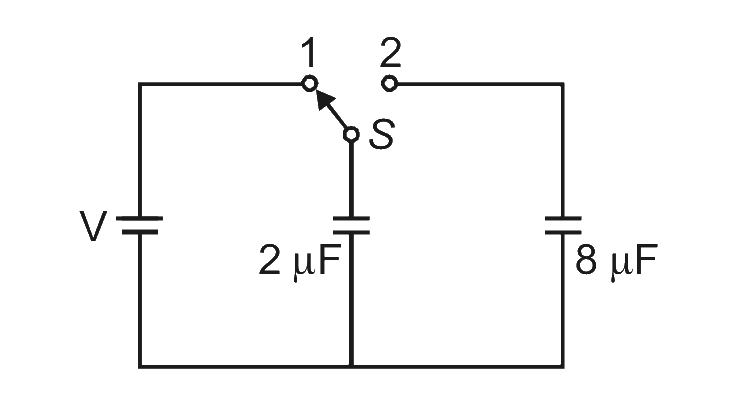
- 0 %
- 20 %
- 75 %
- 80 %
Show answer
Answer: (D) 80 %
Explanation: Sharing charge between 2 μF and 8 μF, the fraction of energy lost is C₂/(C₁ + C₂) = 8/10 = 80 %.
Question 4
A capacitor C₁ = 6 μF is in series with a parallel pair formed by C₂ = 4 μF and C₃ = 8 μF, and the combination is connected across a 15 V supply. Once steady, what are the charges on C₁, C₂ and C₃, in that order?
- 60 μC, 30 μC and 30 μC
- 30 μC, 10 μC and 20 μC
- 60 μC, 40 μC and 20 μC
- 60 μC, 20 μC and 40 μC
Show answer
Answer: (D) 60 μC, 20 μC and 40 μC
Explanation: The parallel pair is 12 μF, and in series with 6 μF it gives 4 μF. The total charge is 4 μF × 15 V = 60 μC, and all of it is on C₁. The parallel pair has 60/12 = 5 V across it, so C₂ holds 20 μC and C₃ holds 40 μC.
Question 5
Capacitors C₁ and C₂ are joined in series across a 12 V battery and are fully charged. Going along the branch from the positive terminal, the potential falls by 9 V across C₁ and by the remaining 3 V across C₂. If C₂ = 6 μF, what are the value of C₁ and the charge on each capacitor?
- 2 μF and 54 μC
- 2 μF and 18 μC
- 18 μF and 18 μC
- 8 μF and 72 μC
Show answer
Answer: (B) 2 μF and 18 μC
Explanation: Capacitors in series carry the same charge, so the voltage across each is inversely proportional to its capacitance. The charge is Q = C₂V₂ = 6 μF × 3 V = 18 μC. Then C₁ = Q/V₁ = 18 μC/9 V = 2 μF, so the smaller capacitor takes the larger voltage.
Question 6
An uncharged capacitor is charged slowly to a final charge Q, the potential difference across it rising in proportion to the charge. What fraction of the total work is spent in adding the second half of the charge, from Q/2 to Q?
- 1/2
- 3/4
- 2/3
- 1/4
Show answer
Answer: (B) 3/4
Explanation: The work done equals the area under the graph of V against q, which is a straight line through the origin. This gives W = q²/2C up to any charge q. Up to Q/2 the work is one-fourth of the total Q²/2C, so the remaining three-fourths goes in adding the second half, against a larger potential difference.
Question 7
The charge on a given parallel plate capacitor is raised from Q to 3Q. By what factors do its capacitance, the potential difference across it and its stored energy change, in that order?
- 3, 1 and 3
- 1, 3 and 9
- 3, 3 and 9
- 1, 3 and 3
Show answer
Answer: (B) 1, 3 and 9
Explanation: Capacitance depends only on the geometry and the medium, so it does not change when the charge changes. Since V = Q/C, the potential difference becomes 3 times. Since U = Q²/2C, the energy becomes 9 times.
Doing well? Create a free account to take timed tests on this topic and see your weak areas.
Question 8
Four identical capacitors joined in series across a 12 V battery store a total energy of 1.2 mJ. The same four capacitors are then joined in parallel across the same battery. What total energy do they store now?
- 9.6 mJ
- 19.2 mJ
- 4.8 mJ
- 76.8 mJ
Show answer
Answer: (B) 19.2 mJ
Explanation: For identical capacitors of capacitance C, the series value is C/4 and the parallel value is 4C, so the equivalent capacitance rises 16 times. At fixed voltage U = ½CV² is proportional to C. The energy therefore becomes 16 × 1.2 mJ = 19.2 mJ.
Question 9
An air-filled parallel plate capacitor has plate area 0.50 m² and plate separation 2.0 mm. Air breaks down at an electric field of about 3 × 10⁶ V/m. What is the largest energy, approximately, that this capacitor can store? (ε₀ = 8.85 × 10⁻¹² C² N⁻¹ m⁻²)
- 4.0 × 10⁻² J
- 6.6 × 10⁻⁶ J
- 40 J
- 8.0 × 10⁻² J
Show answer
Answer: (A) 4.0 × 10⁻² J
Explanation: The energy density in the field is u = ½ε₀E² = ½ × 8.85 × 10⁻¹² × (3 × 10⁶)² ≈ 40 J/m³. The volume between the plates is 0.50 × 2.0 × 10⁻³ = 1.0 × 10⁻³ m³. The maximum energy is therefore about 40 × 10⁻³ = 4.0 × 10⁻² J. Using ½CV² with C ≈ 2.2 nF and V = 6000 V gives the same value.
Question 10
An uncharged 20 μF capacitor is charged fully from an ideal 50 V battery through a 100 Ω resistor. The experiment is then repeated with the capacitor uncharged again, using a 1000 Ω resistor in place of the 100 Ω resistor. What is the heat produced in the resistor in the two experiments?
- 25 mJ in both experiments
- 25 mJ with 100 Ω and 2.5 mJ with 1000 Ω
- 50 mJ in both experiments
- 25 mJ with 100 Ω and 250 mJ with 1000 Ω
Show answer
Answer: (A) 25 mJ in both experiments
Explanation: The final charge is Q = CV = 20 μF × 50 V = 1 mC, so the battery does work QV = 50 mJ. The capacitor stores ½QV = 25 mJ, and the remaining 25 mJ appears as heat. Both figures depend only on C and V, so a larger resistance only slows the charging and does not change the heat.
Question 11
A 6 μF capacitor is connected in series with a parallel pair of 1 μF and 2 μF capacitors, and the combination is connected across a 12 V supply. Once steady, which capacitor stores the greatest energy?
- The 6 μF capacitor
- The 2 μF capacitor
- All three store equal energy
- The 1 μF capacitor
Show answer
Answer: (B) The 2 μF capacitor
Explanation: The parallel pair is equivalent to 3 μF, and with 6 μF in series this gives 2 μF, so the charge drawn is 24 μC. The 6 μF capacitor has 4 V across it and stores ½ × 6 × 4² = 48 μJ. The pair has 8 V across it, so the 1 μF stores 32 μJ and the 2 μF stores 64 μJ.
Question 12
125 identical spherical mercury droplets, each carrying the same charge, are far apart. They merge into one large drop with no loss of charge. The electrostatic energy of the large drop is how many times the total electrostatic energy of the droplets before merging?
- 25 times
- 3125 times
- 5 times
- 125 times
Show answer
Answer: (A) 25 times
Explanation: Conservation of volume gives R = 5r, and the charge becomes 125q. The energy of an isolated charged sphere is proportional to Q²/R, so the large drop has (125q)²/(5r) = 3125 q²/r in these units. The 125 droplets together have 125 q²/r, so the ratio is 3125/125 = 25. The increase comes from the work done against repulsion in bringing the charges together.
Question 13
Two air-filled parallel plate capacitors X and Y have the same plate separation, but the plate area of X is three times that of Y. Their charge q is plotted on the vertical axis against potential difference V on the horizontal axis, giving two straight lines through the origin. Which statement is correct?
- X gives the steeper line, and for the same charge X stores one-third the energy of Y
- Both give the same line, since their plate separation is the same
- X gives the steeper line, and for the same charge X stores three times the energy of Y
- Y gives the steeper line, and for the same charge Y stores one-third the energy of X
Show answer
Answer: (A) X gives the steeper line, and for the same charge X stores one-third the energy of Y
Explanation: The slope of a q–V line is q/V, which is the capacitance. Since C = ε₀A/d, X has three times the capacitance of Y and gives the steeper line. For a fixed charge, the energy is U = q²/2C, so the larger capacitance stores less energy, and X stores one-third of what Y stores.
Question 14
A parallel plate air capacitor stays connected to a battery. The plate separation is halved and the space between the plates is completely filled with a dielectric of dielectric constant 3. The energy density in the space between the plates becomes:
- 36 times its original value
- 4 times its original value
- 6 times its original value
- 12 times its original value
Show answer
Answer: (D) 12 times its original value
Explanation: With V fixed and d halved, the field E = V/d doubles. The energy density in a dielectric is ½Kε₀E², so it changes by a factor 3 × 2² = 12. As a check, the capacitance and hence the total energy rise 6 times while the volume is halved, which also gives a factor of 12.
Question 15
An isolated metal sphere of radius 9 cm in air carries a charge of 4 μC. What is the electrostatic energy stored in the charged sphere? (Take 1/4πε₀ = 9 × 10⁹ N m² C⁻²)
- 0.4 J
- 1.6 J
- 0.8 J
- 0.08 J
Show answer
Answer: (C) 0.8 J
Explanation: An isolated sphere has capacitance C = 4πε₀R = 0.09/(9 × 10⁹) = 1 × 10⁻¹¹ F. The energy stored is U = Q²/2C = (4 × 10⁻⁶)²/(2 × 10⁻¹¹) = 0.8 J.
Want more Combination of Capacitors and Energy Stored in Capacitor – the combination of capacitors in series and parallel questions?
E-GYAN NIDHI has 98 questions on this topic and 63,000+ in total, all free: timed CBT tests, NEET marking and instant analysis.
Register free Free Sunday Mock TestMore topics in ELECTROSTATICS
- Electric Charges and Coulomb's Law – Electric charges MCQs
- Electric Field MCQs
- Continuous Charge Distribution, Electric Flux and Gauss's Law – continuous charge distribution MCQs
- Conductors, Dielectrics, Capacitors and Capacitance – Conductors and insulators MCQs
- Electric Dipole MCQs
- Electrostatic Potential and Equipotential Surface – Electric potential and its calculation for a point charge MCQs
- Electric Dipole and Potential Energy – Electrical potential energy of a system of two point MCQs