Animal Tissues: NEET MCQs with Answers
15 free questions on Animal Tissues for NEET (UG), starting with previous-year NEET and AIPMT questions. Try each one, then tap Show answer for the answer and a short explanation.
Question 1
Previous-year questionWhich tissue is correctly identified with its location and function? [AIPMT Mains 2012]
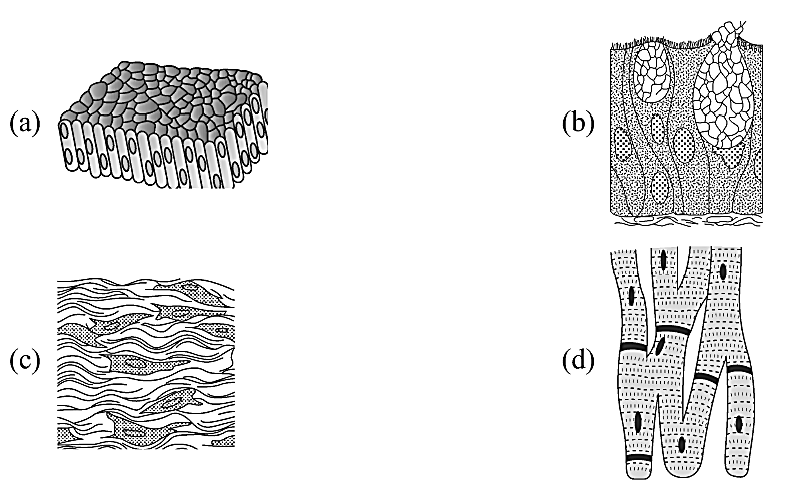
- Collagen fibres — cartilage — attach muscles to bones
- Smooth muscle — heart — heart contraction
- Columnar epithelium — nephron — secretion and absorption
- Glandular epithelium — intestine — secretion
Show answer
Answer: (D) Glandular epithelium — intestine — secretion
Explanation: Glandular epithelium, with secretory goblet cells, lines the intestine and carries out secretion, so this match is correct. Collagen fibres in tendons, not cartilage, attach skeletal muscles to bones. The heart wall has cardiac muscle, not smooth muscle. The nephron tubules are lined by cuboidal epithelium, not columnar epithelium.
Question 2
Previous-year questionDiagrammatic sketch of areolar connective tissue — identify parts I, II, III, IV. [AIPMT (Mains), 2012]
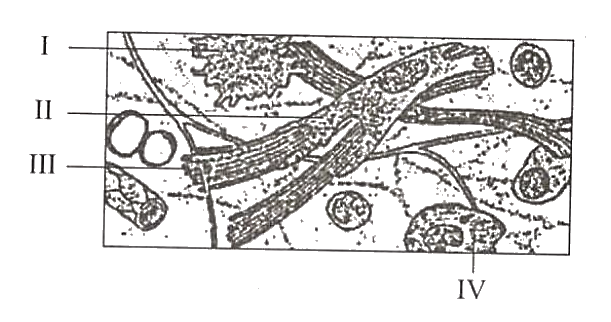
- I-Macrophage, II-Collagen fibres, III-Fibroblast, IV-Mast cell
- I-Mast cell, II-Collagen fibres, III-Fibroblast, IV-Macrophage
- I-Macrophage, II-Fibroblast, III-Collagen fibres, IV-Mast cell
- I-Mast cell, II-Macrophage, III-Fibroblast, IV-Collagen fibres
Show answer
Answer: (C) I-Macrophage, II-Fibroblast, III-Collagen fibres, IV-Mast cell
Explanation: In this sketch of areolar connective tissue, I is the macrophage (irregular phagocytic cell), II is the fibroblast (elongated cell that secretes the fibres), III is the collagen fibres (thick wavy bundles) and IV is the mast cell (large granular cell).
Question 3
Previous-year questionSome features of epithelial tissue are listed below. Choose the most appropriate answer from the options given. [NEET 2024 (Swaimadhopur)]
A. Bear cilia on their free surface.
B. Provides a lining for some parts of the body.
C. Compound epithelium is multilayered and meant for a limited role in secretion and absorption.
D. Located in the tip of the nose.
E. Exocrine glands possess epithelial tissue.
A. Bear cilia on their free surface.
B. Provides a lining for some parts of the body.
C. Compound epithelium is multilayered and meant for a limited role in secretion and absorption.
D. Located in the tip of the nose.
E. Exocrine glands possess epithelial tissue.
- A, B and C only
- B, C and E only
- C, D and E only
- B, D and E only
Show answer
Answer: (B) B, C and E only
Explanation: Epithelial tissue provides a lining for some parts of the body (B); compound epithelium is multilayered and has a limited role in secretion and absorption (C); exocrine glands are made of glandular epithelium (E). Only ciliated epithelium bears cilia, so A is not a general feature of epithelial tissue, and the tip of the nose is a site of cartilage, which is a connective tissue (D).
Question 4
Previous-year questionTwo statements are given below. In the light of these statements, choose the most appropriate answer from the options given. [NEET 2024 (Swaimadhopur)]
Statement-I: The ground substance of bone is solid, pliable and resists compression.
Statement-II: The bone marrow of all bones is the site of production of blood cells.
Statement-I: The ground substance of bone is solid, pliable and resists compression.
Statement-II: The bone marrow of all bones is the site of production of blood cells.
- Both Statement-I and Statement-II are incorrect.
- Statement-I is correct but Statement-II is incorrect.
- Statement-I is incorrect but Statement-II is correct.
- Both Statement-I and Statement-II are correct.
Show answer
Answer: (A) Both Statement-I and Statement-II are incorrect.
Explanation: Both statements are incorrect. Bone has a hard, non-pliable ground substance rich in calcium salts and collagen (it is cartilage whose matrix is solid, pliable and resists compression); and blood cells are produced in the red bone marrow of only some bones, not all bones.
Question 5
Previous-year questionRead the following statements and choose the most appropriate answer from the options given below. [NEET 2022]
(a) Bones support and protect softer tissues and organs.
(b) The weight-bearing function is served by limb bones.
(c) Ligament is the site of production of blood cells.
(d) Adipose tissue is specialised to store fats.
(e) Tendons attach one bone to another.
(a) Bones support and protect softer tissues and organs.
(b) The weight-bearing function is served by limb bones.
(c) Ligament is the site of production of blood cells.
(d) Adipose tissue is specialised to store fats.
(e) Tendons attach one bone to another.
- (a), (b) and (d) only
- (b), (c) and (e) only
- (a), (c) and (d) only
- (a), (b) and (e) only
Show answer
Answer: (A) (a), (b) and (d) only
Explanation: Bones support and protect softer tissues (a), limb bones serve the weight-bearing function (b) and adipose tissue is specialised to store fats (d). Blood cells are produced in the red bone marrow, not ligaments (c is wrong), and tendons attach muscle to bone, while ligaments attach bone to bone (e is wrong).
Question 6
Previous-year questionSelect the correct statement regarding muscular tissue. [NEET 2022]
- Skeletal muscle fibres are uninucleated and found in parallel bundles.
- Intercalated discs allow the cardiac muscle cells to contract as a unit.
- The walls of blood vessels are made up of columnar epithelium.
- Smooth muscles are multinucleated and involuntary.
Show answer
Answer: (B) Intercalated discs allow the cardiac muscle cells to contract as a unit.
Explanation: Intercalated discs are communication junctions that allow cardiac muscle cells to contract as a unit. Skeletal muscle fibres are multinucleate, not uninucleated; smooth muscle cells are uninucleate, not multinucleated; and the walls of blood vessels are lined by squamous epithelium, not columnar epithelium.
Question 7
Previous-year questionWhich type of epithelium is found in the bronchioles and Fallopian tubes? [NEET 2022]
- Simple squamous epithelium
- Simple columnar epithelium
- Ciliated epithelium
- Stratified squamous epithelium
Show answer
Answer: (C) Ciliated epithelium
Explanation: Ciliated epithelium is mainly present on the inner surface of hollow organs like bronchioles and Fallopian tubes, where cilia move particles or mucus/ova in a specific direction. Squamous epithelium lines blood vessels and air sacs, and stratified squamous lines the skin, buccal cavity and pharynx.
Doing well? Create a free account to take timed tests on this topic and see your weak areas.
Question 8
Previous-year questionMatch List-I with List-II and choose the correct option. [NEET 2022 (Overseas)]
List-I:
(a) Adhering junctions
(b) Tight junctions
(c) Gap junctions
(d) Synaptic junctions
List-II:
(i) Establish a barrier that prevents leakage of extracellular fluid across a layer of cells
(ii) Function like rivets and fasten cells together into strong sheets
(iii) Pass information through neurotransmitters from one cell to another
(iv) Provide cytoplasmic channels from one cell to the adjacent cell for communication
- (a)-(i), (b)-(iii), (c)-(ii), (d)-(iv)
- (a)-(ii), (b)-(i), (c)-(iv), (d)-(iii)
- (a)-(i), (b)-(ii), (c)-(iii), (d)-(iv)
- (a)-(iv), (b)-(iii), (c)-(ii), (d)-(i)
Show answer
Answer: (B) (a)-(ii), (b)-(i), (c)-(iv), (d)-(iii)
Explanation: Adhering junctions act like rivets fastening cells into strong sheets (a-ii); tight junctions form a barrier preventing leakage of extracellular fluid across a cell layer (b-i); gap junctions provide cytoplasmic channels between adjacent cells (c-iv); synaptic junctions pass information by neurotransmitters (d-iii).
Question 9
Previous-year questionThe cells that secrete ear wax are made of which type of epithelium? [NEET 2022 (Overseas)]
- Exocrine glandular epithelium
- Compound epithelium
- Endocrine glandular epithelium
- Columnar epithelium
Show answer
Answer: (A) Exocrine glandular epithelium
Explanation: Ear wax (cerumen) is secreted by exocrine glands, which release their products through ducts; these are formed of glandular epithelium. Endocrine glands are ductless and secrete hormones directly into the blood.
Question 10
Previous-year questionMatch the figures in Column I with their characters in Column II and select the correct combination. [NEET 2021 (Paper-2)]
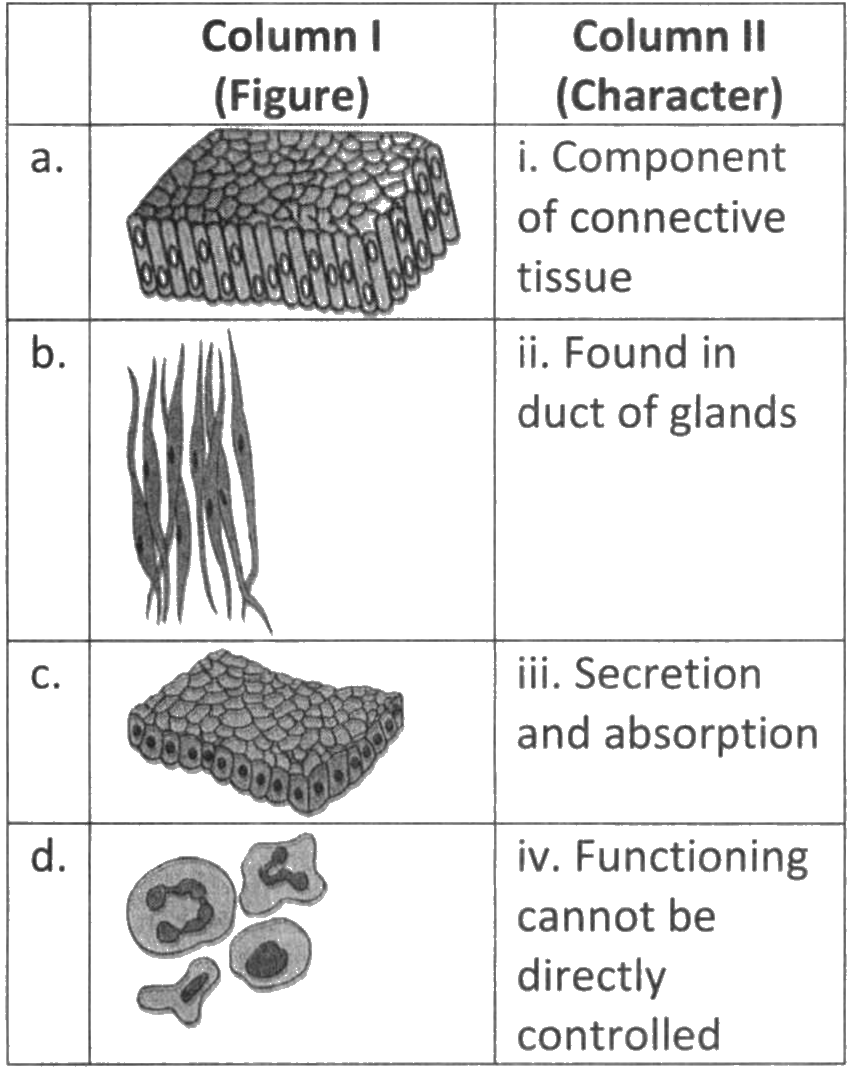
- a–ii, b–iii, c–i, d–iv
- a–iii, b–iv, c–ii, d–i
- a–iv, b–iii, c–ii, d–i
- a–i, b–ii, c–iv, d–iii
Show answer
Answer: (B) a–iii, b–iv, c–ii, d–i
Explanation: (a) Columnar epithelium performs secretion and absorption (iii). (b) Smooth muscle fibres are involuntary, so their functioning cannot be directly controlled (iv). (c) Cuboidal epithelium is found in the ducts of glands (ii). (d) Blood cells are a component of blood, which is a connective tissue (i).
Question 11
Previous-year questionWhich of the following is NOT a function performed by muscular tissue? [NEET 2021 (Paper-2)]
- Locomotion and change in body postures
- Transportation of food through digestive tract
- Transportation of gametes through genital tract
- Transmit different kinds of stimuli
Show answer
Answer: (D) Transmit different kinds of stimuli
Explanation: Transmitting stimuli is the function of neural tissue, not muscular tissue. Skeletal muscle brings about locomotion and posture changes, while smooth muscle in the walls of the gut and genital tract moves food and gametes along.
Question 12
Previous-year questionGoblet cells of the alimentary canal are modified from [NEET 2020]
- columnar epithelial cells
- chondrocytes
- compound epithelial cells
- squamous epithelial cells
Show answer
Answer: (A) columnar epithelial cells
Explanation: Goblet cells are unicellular glands formed by the modification of columnar epithelial cells of the gut lining, and they secrete mucus.
Question 13
Previous-year questionWhich one of the following is the most abundant protein in animals? [NEET 2020]
- Collagen
- Lectin
- Insulin
- Haemoglobin
Show answer
Answer: (A) Collagen
Explanation: Collagen is the chief structural protein of connective tissues and constitutes about a quarter of all the protein in the animal body; RuBisCO is the most abundant protein in the biosphere.
Question 14
Previous-year questionCuboidal epithelium with a brush border of microvilli is found in the [NEET 2020]
- ducts of salivary glands
- proximal convoluted tubule of the nephron
- Eustachian tube
- lining of the intestine
Show answer
Answer: (B) proximal convoluted tubule of the nephron
Explanation: The PCT is lined by simple cuboidal epithelium bearing dense microvilli, which greatly increase the surface area for the reabsorption of the glomerular filtrate.
Question 15
Previous-year questionCiliated epithelial cells are required to move particles or mucus in a specific direction. In humans, these cells are mainly present in the [NEET 2019]
- bile duct and bronchioles
- fallopian tubes and pancreatic duct
- Eustachian tube and salivary duct
- bronchioles and fallopian tubes
Show answer
Answer: (D) bronchioles and fallopian tubes
Explanation: Cilia sweep mucus and trapped particles up the bronchioles and move the ovum along the fallopian tube; ducts of glands are lined by non-ciliated epithelium.
Want more Animal Tissues questions?
E-GYAN NIDHI has 758 questions on this topic and 63,000+ in total, all free: timed CBT tests, NEET marking and instant analysis.
Register free Free Sunday Mock Test